

aesterion
winter 2026
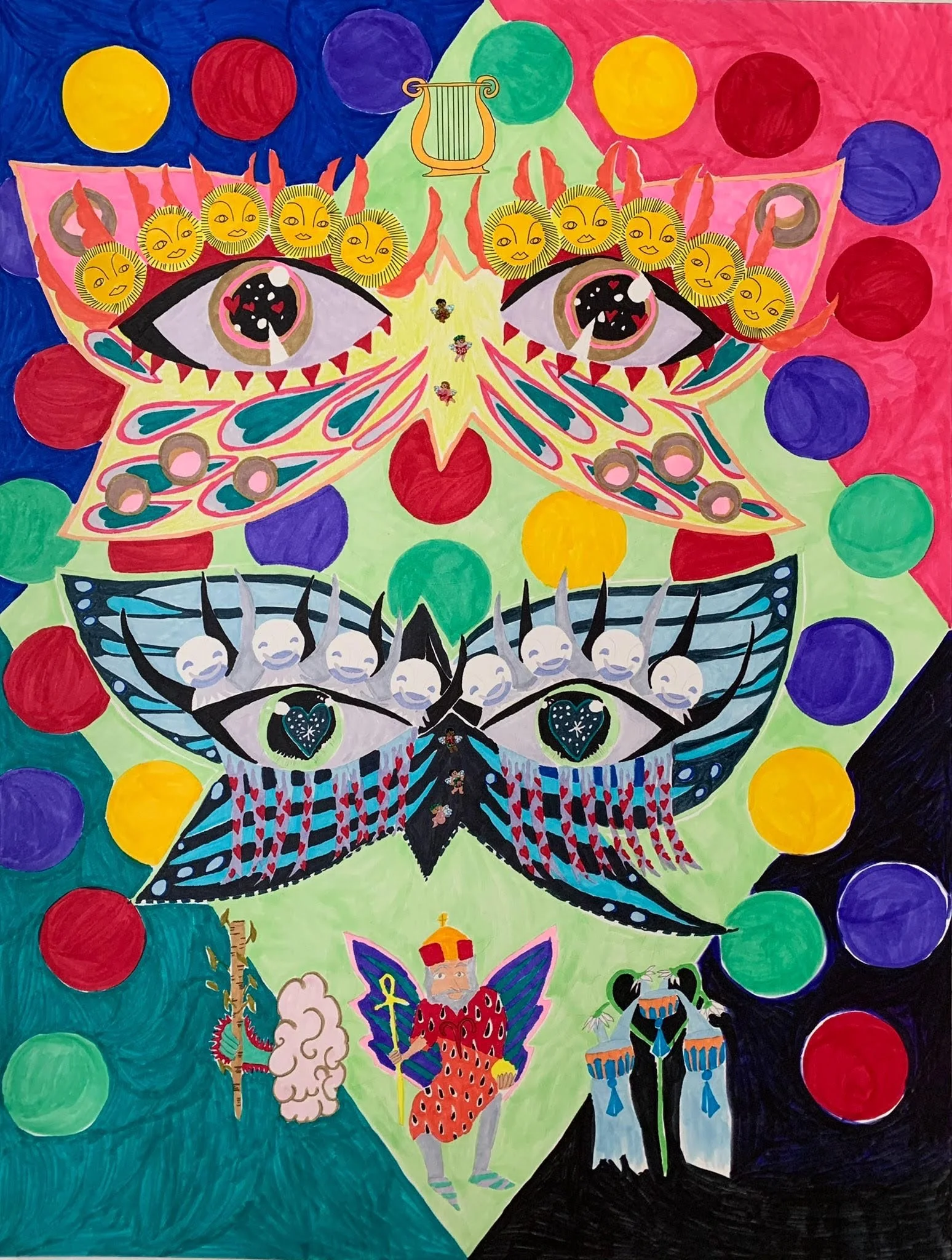
Sun and Moon, King and Queen Mask - Raven Servellon
The Gloaming Mirror
-Bianca Rose Ambrosino
After a short night, before
the full sun
I stood, bleary
in front of a long,
dark mirror
I did not turn the light on
(not yet, not myself)
I focused & unfocused
on my face, & it changed
It changed into a stiff
covered book, bound &
standing on its spine &
edge
slightly open so that
the gilded
edges of every
page spread apart
just slightly enough
to become
600 slices of faces
& nameless,
in awe
I was every mother & son
& enemy of all
the trickling of my blood,
converging in waves of discretion
into an ocean of my one, hideously
intricate, ever shifting face
holding in all of the monsters of the sea
from bursting into the air (meant for doves)
And out of the dark, in the long gloaming mirror,
so rose the sun as the window behind me, cast
before me, lured my gaze into the growing light
& at once I was seeing my seeing & I
shut
Losing Time - Bianca Rose Ambrosino
I want to
dig my toes into
the sands of the hour
g l a s s
of years
w a t c h
the grains flow a second
time, upwards
c l i m b
a rope and become
the pendulum
back & forth
&
back
in a sandstorm
recount
recall
remember
remind
winding
clocks & clocking
&
filling
the glass
with water to turn
the glass of hours into
a shapely
snow globe
& shake & remember & know
I a m s n o w i n g
•°*:;°•`*:;.`°•
To Visit Who You Lost - Bianca Rose Ambrosino
The music of the rain
drifts around the covered porch
A song, symphonic movement that booms
with heartbeats in
rocking chairs next to empty rocking horses
As thunder
and licks of lightning beyond the screen of the wet door
and the chimes in the wind
and the death in the window all
howl You are here Under the weather
that’s shielding the dark from the Moon
until the flood floats you
up
to it
To visit who you lost in the music of the rain
in rocking next to empty rocking horses
in not looking at what’s right there
in looking at what’s left you
You are here
shielding
the dark
you feel the flood of
light that
the Moon rose
before you
the rocking horse
floats
back up to me
upon the Moon
The music of the rain
drifts
The Magpie
-Hazel McCorriston
The steam from the kettle lands in a cloud on the window, which overlooks the flat
rooftops of the surrounding homes. Behind the light mist a magpie hops along the
slate tiles. I wave my hand at him as he passes. The condensation begins to clear and
his body is larger now from up close. He has a black long object clasped in his beak.
The end of it catches underneath his feet when he moves and he spans his wings to
balance.
He stops a few bounces along, considers his next move. Twists his head
abruptly in my direction and I wonder if he is truly looking at me. I see now that the
item in his beak is a pencil, the paint along its stem peck-chipped, the wood beneath
damp and rotten. It is in fact my pencil, the same dark blue with a red rubber
clamped to its end. We are still and hold gaze through the glass. He drops his new
item onto the slate then, in the rooftop corner where the chimney breaks upwards. I
see there is a twig collection forming where he stands. My pencil is furniture for this
kind of home.
He puts his beak to the tile and begins rearranging the pencil among the twigs,
but it is somewhat larger than the others in his collection and he is frustrated that it
does not fit. Then the long shadowed sun moves just millimetres around the corner
of the building and November copper flows over the magpie’s pencil home. He looks
up, looks at me. He has stopped rearranging the wood, is he satisfied? With a sharp
movement he flicks his beak against the pencil and it rolls down the light slope of the
roof. I fear too that my pencil too does not fit in my hand and its lead will blunt and
smudge my pages. It rolls to the gutter and then he is gone. The pencil is no comfort
to him, my words are no comfort to me. The kettle is boiled. Like him I doubt that my
pencil can make my world better. Water goes into cup and soaks the teabag through,
light to dark and heavy.
The kettle goes back on its base, and then, there he is again, bouncing in gold
afternoon. He hops down to the gutter where the pencil is discarded and rotten.
There, the chance for words, there the astonishing warmth in the makeshift nest he
makes from sticks, unsure if he wants them, unsure if the world offers better.
The next morning is deep and fresh-cold in its darkness, and above me I hear
the bounce of small three-clawed feet on slate. Somewhere between my wake and
sleep is the magpie’s pencil, its eraser intact and its unwieldy shape awkward in a
nest. And my pages, a gulf of thought, void of things that are my own. I had wanted
my words to be like a song, a brief interlude in someone’s mind that tells a life in
three or four minutes. How can new exist if all note orders have been claimed.
But there is the rattle of clawed feet above my head in early morning. He has
something new in his beak now, a flash of myself, a spark of my face red from cold
and tired and firmly in his clasp. Fragment of mirror, of me. Quiet in the glassy
rooftop cold, he is sorrow and joy and I am inside and out, behind my window and in
his voice. I understand from feeling his breath that words shall move me like tide
above sand, rocking, indenting, drawing in and out, and I will not resist his pull. Leap
and rattle, magpie, make my words sing and let my story be the frame of the window
through which I see and speak the world. What is that if not song.
Kid Christmas
-Roberto Ontiveros
Kid Christmas, this dime store desperado who stands outside Enero’s Arrangements like it’s his
job to be a festive gargoyle, blew my mind by walking into the shop and instead of just asking to
use the bathroom actually putting down three bucks for a single rose.
I thanked him for his purchase and as I looked around for a bottle of water to give him,
Kid shook his head and asked me if I would deliver the bloom to a woman who worked just ten
easy traffic minutes away.
We don’t deliver anything under twenty bucks; that is the closest thing we have to a store
policy here, but it was about to be noon and Enero, who makes all the arrangements in the back
and hired me specifically so he could stay in the back when someone like Kid Christmas came
in, would send me out to pick up some take out in like ten minutes anyway, so: “Yes, I’ll drive
your flower out, man. Where to and whom to?”
Kid’s face froze up in cryptic apology and he said: “Here’s the thing, Boss, I don’t know
her name, just where she works – a law office, I think, or could be a stationary store. Here is the
address.”
I held the crumpled restaurant receipt he handed me up to study the stiff scrawl of black
ballpoint digits and the word “CLEO.” The address was discernible and not far at all. I sighed
so that he would feel the depleting nature of my favor, then just looked into Kid’s coal-gray eyes
to see if he might bail on the plan. Kid was smiling. This guy, who I had seen every day since I
started working for Enero, was a very dull diamond, but his eyes were mercy magnets and his
smile could crack into an eager charm that motivated the unguarded to give him any pocket
change if the suckers didn’t watch it. I handed the receipt back to him and he folded up the name
and numbers like a fetish that literally seemed to trick away up his sleeve.
“That’s not her name,” Kid Christmas said. “Or, it might be her name but I don’t know. I
call her Cleo because she looks like a Cleo to me, what I think Cleopatra might have looked like.
Like I call you Boss because you look like a Boss to me.”
“You can keep calling me that,” I said and turned the sign on the door to CLOSED.
Enero was working on funeral flowers for his ex-wife’s brother Jerry. My employer was
not on the friendliest terms with his ex-wife or her family and he only found out about the death
because of the daily legacy house emails he gets. No one asked him to put anything together, but
he felt a genuine compulsion. He was not going to drop the arrangement off though, so that
meant me.
“I take this rose to those numbers, and someone will be at the desk to accept?”
“Yeah, for sure, Boss, might even be her. She drives a red car. If you see that red car
you can just leave the rose under a windshield wiper,” he suggested.
“No, I will make sure someone gets it in hand.”
And Kid Christmas – who, no way was under thirty-five – nodded in gratitude and then
turned to look around for impulse items, which, having given me what was surely his last money,
he could no longer afford.
“Enero, I’m off,” I said and heard a swivel chair in the back room moving, as my
employer knew he would have to stand over the register and await my return.
. . .
When I pulled into the strip mall that corresponded to the numbers on the back of Kid’s receipt, I
looked for that red car and found it fast, some not old enough to be vintage looking Volkswagen
Rabbit, a B104 bumper sticker that someone had tried and failed to completely remove.
I sighed like a two-dimensional working stiff about to punch in a timecard in some
Hanna-Barbera hardhat cartoon, and got out to deliver that single rose, wrapped in that basic
emerald delivery paper which any customer spending less than five bucks could expect.
I walked into the comforting scent of jasmine tea and what might have been just sliced up
office birthday cake, the hot wax aroma of candles and a wick blown out emanating.
A woman with straight shoulder-length black hair looked up and smiled her greeting and
I said: “Hey, does the owner of that red Rabbit out there work here?”
“Oh, shoot – that’s mine, did I leave the lights on again?” The woman said and started to
walk around the desk to check. “I do that, I really do and it’s crazy …”
“No, that’s not it, I –” I held the rose before her and said: “This is from a guy named, er
…Chris. I am delivering this one rose to you. No note, just this simple gesture.”
The woman brushed a strand of hair that had fallen over her eyes back and held the rose,
turning the flower in her grip as if to examine it for some kind of spring-release trick, and
repeated the name: “Chris…”
“Look, that might not be his name. And he sure as hell doesn’t know yours,” I said, and
relayed the morning oddness, but declined to offer any deeper info on Kid Christmas but the
basics. “You might know the guy if you see him outside our shop. That’s his spot. He does not
stray from it much and I would bet he lives in those little apartments behind the Lucky Lotto
Food Store. He knows you and where you work. He even had the address written on a receipt
for me. But he doesn’t know your name unless it really is Cleo. He thinks you look like what
the real Cleopatra was supposed to look like.”
The woman smiled and brought the rose over to a pencil holder and set it on a tilt
between a set of Sharpies and a pink vape pen. “No. I am not Cleo. My name is Miranda. And I
never got Cleopatra before – I always get these two dark-haired comedians that really look
nothing alike but sound like me for sure. I gave this guy, this …”
“Christmas. Kid Christmas, that’s what he goes by.”
“I gave this Kid Christmas this address when he insisted on paying me back,” Miranda
said and shook her head and tried to figure everything out.
“I am guessing you gave him more than a few bucks, maybe more money than he was
used to getting or maybe he wanted to thank you, or he was charmed into mustering up a token
of gratitude. But really, you know he’s crazy, right? He goes by Christmas because he used to
wear these holiday lights around his chest, over his T-shirt and plugged into a battery pack in his
jacket. The guy always wears a jacket. No lights today when he put down for this rose but, yeah,
a jacket.”
The receptionist smiled. “I remember. Yes, I did help him out. Jesus. Almost six
months ago. Yes, by your shop, that sushi place where the whole office was having a kind of
end of the year party. He was outside and yes he had the lights on, and after I complimented his
costume, all those lights on a jacket I thought was a costume and then gave him a Target gift card
that was like a door prize, and a twenty. He insisted, really insisted, that he wanted to pay me
back because I looked like someone he said.”
“Cleopatra – or what people say she is supposed to look like,” I said.
“Well, he couldn’t think of who just then.”
“He was thinking of an actress,” I said. “Some black hair and bangs beauty, no doubt.”
Miranda blushed. “Like you said, he’s crazy.”
. . .
When I came back to the shop, the sign was turned back to OPEN, and Enero was in the front
and already done with a simple arrangement of Birds of Paradise in a teal vase.
I placed a sack of tacos I picked up for him by the register and nodded at his work.
Since I already ate in the car and knew I would be heading out to deliver this arrangement
in no time I asked my boss if he needed a soda from the next door store.
Enero shook his head and then informed me that I didn’t have to drive this arrangement
out for him. He’d changed his mind. He wanted to pay his respects, and say goodbye to his
dead ex-brother-in-law. He would go early. “The viewing is at five but they always let the
flowers in. If I go now I can say goodbye to Jerry and be out before I have to say hello to anyone
else. Which means you have to watch the store until five.”
He said all this with a straight face, but even as he spoke out his scheme to skip the
service I knew there was no way he would not just stay for the full funeral.
Five minutes after my boss left I turned over the little cardboard store sign back to
CLOSED to let the sidewalk world know we were done for the day.
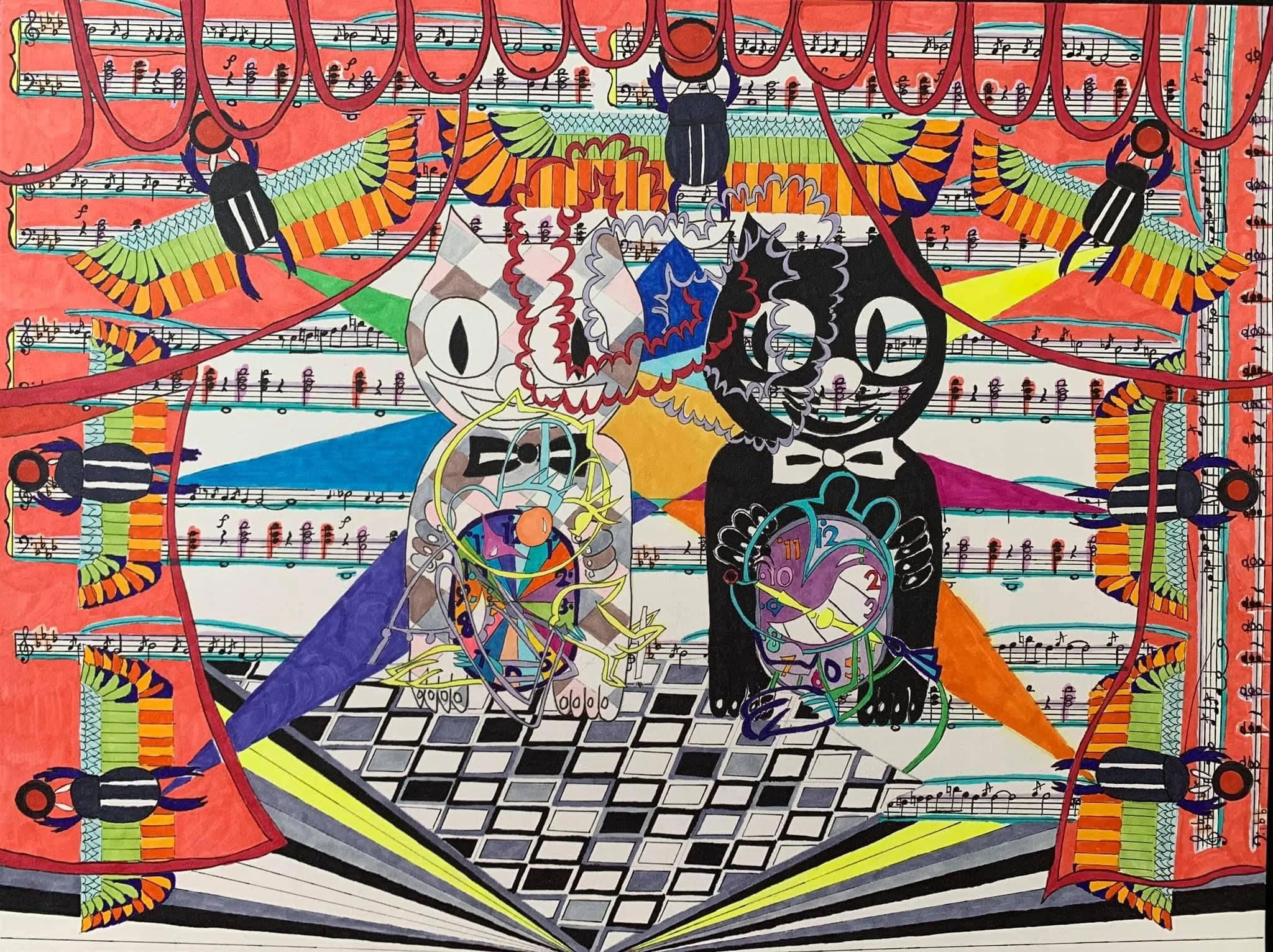
Gnosieness - Raven Servellon
Strange bird
-Priya Parikh
I cock my sleepy head east, then northwest, craning my neck and crinkling my brows. A conscious step
toward a strange croaking spilling over the branches. A neon flash, gone almost as soon as it registers.
They have yellow beaks, if I remember correctly. There it is.
Is it?
It is.
It must be.
Is it?
It is.
Or maybe it was just another belly of another leaf winking at me?
Dare I say - I saw the toucan that day? A bird as strange as me, so far away from home, its rain-kissed
eyes just as curious and cautious and finding mine. The minute lassoed by stillness, careful enough not to
startle it, I remaining careless enough to just see it scuttle.
Another morning with the moon on a stroll I’d been choreographing for days. Banal and beautiful and
ripe for the pricking. And when something I remember flies into vivid color, like a vulture ruptures the
placid Lagoa, I can’t help but look and wait, keeping the yearning docked. Bewildered but here, sifted
into the very second, a powder ready to be blown away. And then clumped by the succulence, glued to the
ground just to hope to be trampled on, to flatten, to dry.
Storybooks and sanctuaries have serigraphed the toucan in my sleepy head. There is no confusing the
toucan for another man — animal.
bird.
Bird.
Familiar in the way a dream might be, far enough to taste the water at the end of long roads dipping into
sunsets, dying the closer you get, delayed for what seems like an eternity, only to be stretching alongside
you the entire walk home.The Lagoa reads like hot milk, and if I remember correctly, toucans feed on
berries that would end up curdling the whole bowl. A visitor that lends his yellow for my lips to fall apart
at the cusp of the canopies.
But my sleepy head yawns instead - the sky, the sidewalk cradling it centered. Lullabies from the distant
sea, the parakeets’ mantras, and the snare of my gait roll into symphony again.
The toucan may have seen me that day. Native and free, fleeting by nature, us two strange birds. Let’s not
deny each other the pleasures of a voyeurism so spotless and naïve.
Not quite a not quite, barely a maybe, and none of the sizes between a not yet or an almost seem to fit
either. Perhaps a similitude of certainty and the shoulder turned away from a nothing. A satisfaction of a
something only awakened by the mourning.
And my sleepy head still knows dreams from waking life.
And a croak from a chirp.
And to think back and back to that day.
It’s a toucan, I’m sure of it.
It is, isn’t it?
Is it?
It is.
-
To P. - Gabriella Garofalo
Then what?
The dark swallows wandering highways,
Speed the only option for haggard souls
As restless women and new puritans fight back,
Fed up with tangles of twigs, dew-laden blades,
And their whispers-
Not them again, please, and no, we can’t bloom,
Breathe, belong to the blue, if stars go blinking by
Like distant thoughts, or skittish waves
Always give in to shores-
So let their limbs dance, soul, you just lie silent
Under ice blue blankets, shun those eyes
Gleaming dews hold to ransom-
Can’t you see the sea’s becoming
A breathing cathedral where salt and solitude
Lean into the madness of unresolved nights,
Where water howls smashed prayers,
As waves don’t ask, don’t care, they just keep coming,
And wolfing down prayers while hope thinks she’s
As infinite as the sky, the poor delusive girl-
End of story, this is a truth she can’t name,
The tales of lost moorings, or uncharted lands
Where under the weight of souls waves
Fall down to blue, and God’s breath bends the tides,
So that faith shan’t be a whisper, but an angry tide
Shouting at your sky, as His hands shape infinity, waves,
And too bad they yield no more than silence, shadows,
A unrequited love, a longing for salt and silence-
You done now? Sorry, but the sky is in conference,
Please try a different blue, maybe the faded denim
Of your jeans, maybe blue veins on your hands,
That map of slow decay.
-
-
To M. - Gabriella Garofalo
Askance, askew, the lovers get no sense
Of a late blue tonight,
As anger shrugs it off, she only cares
About thriving among the grass,
They both shining with a sick dazed green
While sunsets sing of new births,
But heaven’s only hint is a breath drawn
From the field’s scent in those blue nights
Or hectic days when nobody cares
For colours freezing behind the shadow line-
Look, limbs and fields are running wild,
So play it safe, no more cryptic games
With shadows, light, time, infinite,
Cut it out, OK, OK, the soul’s so great
At mocking the dreary life, the daily grind
Of everyday folks, doing the dishes,
Doing the groceries, even falling in love,
Great acting, sure, but what’s the point
If her garden lies north of the rising wind,
Or you can’t give the night a blue leeway
When she haggles with the sky over the stars,
And the angel going astray among mails rife
With “Oh woe is me” or “I’m so fed up”
Sighs why don’t they ever write they feel so fine-
Well, I guess they’re not used to hanging round with light-
Oh, look, how odd, a teen girl at the library
Flashing a micro black top, all cheek and no taste
She shows off her skin like false alabaster,
Sure, dream on, she ’ll never yield to the blue,
That hidden place smashed with shadows,
She knows, if light gets freezed we’ll stay
In the dark, no chance to write-
But what about blue, the sham of uncharted depths?
Well, if souls and God can wait, the grass certainly can’t,
Nor can the stones ready to unfold,
For the lovers’ faults to be forgiven.
A New Beginning
-S.J Sangeetha
The ever-cherishing...
View of the panoramic blue hills
The melodious tone of a Thrush
A glimpse of a distant horizon
The sight of clouds kissing the sky
The Panache of...
Lovers weaving the dream
The demanding depths of a mountain pass
The luxuriant foliage
The sparkly stars in the pitch-black skies
The sharpest gaze at the infinite.
It is a desire...
To descend the hours of hardship
To sightsee a palmy garden
To feel the caressing north wind afar
To recreate the defunct fauna and flora
To sense the aroma of Bethlehem Lily.
Must care...
The emotions swinging in the sky canoe
To mouth shut the gamut of harsh words
To augment the woe of parted love
To fill the voids with the right choice and
To put off rage, a forest fire in action
Exquisite is...
The unheard song from the unknown
The illusion is craving for an Oasis
The reality is time plunging into an hourglass.
Afar, a new beginning undoes
The sunrise, twilight and nightfall, the viewers
Untitled No. 9
-G. W. McClary & Lucien R. Starchild
Maybe we’re at our realest when we’re pretending.
Shy rapped on the office door. Two timid knocks.
“Come on in,” the man inside said. He wasn’t smoking. Shy expected him to be smoking.
“You’re the guy who called, right?” Both he and his office were clean cut and organized, but Shy
didn’t want to close the door.
“Yeah, sorry, I’m kinda nervous. I’ve never done this before.”
“You’re alright, kid. So what do you want to find out?” Shy studied his dark features, the
straight nose, the hair trimmed expertly around the ear, and guessed him to be fortyish.
“Well, we decided it was best if my girlfriend quit her job so she could stay at home and
take care of the house.”
“Uh huh,” he said, not looking at Shy, but sorting through some files.
“So she’s had a lot of time on her hands.”
“And?” Still, he wasn’t looking.
“And it doesn’t add up. Sometimes she’ll tell me about her day, and it doesn’t make
sense, like there are gaps.”
“You think she’s screwing around on you.” Now he decided to look.
“No, I mean, maybe? I don’t know. That’s why I came to you.”
“Well, I might be able to find out a thing or two. I’ll just need some information, and the
payment of course.”
“Yeah, right, of course.” Shy slipped out his wallet and handed off the bills, placing them
flat on the table and sliding them across. “Sorry, I’ve always wanted to do that.”
“Right. Let’s get started,” the P.I. said, finally cracking a smile.
Maybe we’re at our realest when we’re pretending—
When the roles we play hold more truth than our names,
When the lines we speak in borrowed voices
Carry the weight of all our unspoken pains.
The lover in the script kisses with a fire
That the timid heart refuses to show.
The hero in the tale stands tall in the fray
While the real one trembles, afraid to let go.
So let’s raise the curtain, let the scene unfold—
Truth is a shadow that follows the light.
Maybe we’re never more honest than when
We pretend we’ll be okay tonight.
Shy waited until after dinner. Beth was in the kitchen scrubbing dishes when he laid the
photos on the counter beside her. They were grainy shots of her coming and going from a
building downtown, one that rented out spaces to various kinds of artists.
“Why did you hide this from me?”
“I didn’t want you to think I was squandering my role as housewife,” Beth said, drying
her hands. Shy imagined something beautiful being produced by those spindly fingers.
“Baby, isn’t that why we agreed to this, for you to have more freedom?”
“Yeah, but I’ve been… I’m scared to say it.”
“Beth, what is it?”
“That’s where some of my money has been going.”
“How much? No, wait, it doesn’t matter. Honey, that’s fine. I gave you that money for
you to spend it as you please. I’m just shocked and honestly a bit hurt that you felt like you had
to hide this from me.”
“What I was doing, what I’m going to keep doing, is sacred, and you should have thought
about that before you violated my trust like this.”
“Should I be asking myself why you wouldn’t show me your sacred?”
“Have you shown me yours?”
“What?”
“Do I need to go behind your back and hire a private investigator to find out your sacred
place?”
“You know my sacred place is with you.”
“You say that, but it’s too easy, too simple. You can’t find the sacred in other people. It
comes from within.”
“That’s where you’re wrong. I know you’ve been hurt in the past, but I’m not them.”
“You think throwing my trauma in my face is going to get me to open up? Why do you
think I hid this from you?” Shock left Shy’s face hanging in slack-jawed limbo for a few
moments.
“That’s what this is about?”
“I really have to spell everything out, don’t I?” She stormed to their bedroom, slammed
the door, clicked the lock. Another night on the couch, Shy thought to himself.
Beth iced him out for a few days, ignoring him and staring blankly at her phone. He
would stand in the doorway as she wallowed in bed.
“Beth,” he would say, then after a few moments, “Okay,” and he would walk away. On
the third day, when Shy thought the tension would drive him mad, she finally relented.
“Why didn’t you just talk to me?” she asked him.
“Because I didn’t want you to feel accused.”
“You literally hired someone to follow me. Isn’t it a little late for that?”
“I know it looks bad.”
“It looks bad because it is. Well, you found out my little secret, now what?”
“Look, all this talk about that you’re painting, and not enough about what you’re
painting.”
“You really want to know?”
“Of course I want to know! If it’s not too late for that?”
“Ugh, you’re so insecure,” she joked, but not really, slapping his arm. “You gotta toughen
up with me. I’ve got dimensions.”
“I see that.”
“You’re really awful, you know that?”
“Aww, babe, I’m gonna cry. Now take me to your super secret artist hideout. What, too
soon?”
Beth had dabbled in high school but decided to pick it up again. She’d been painting for
months when Shy found out, when the man he’d hired laid out the proof of her second life. She
drove them to her downtown studio, clandestine, until that very moment.
“Come on, you’ll like this part. I have to put in a code.” She keyed in the four-digit
password and the door unlocked with a hiss and a clink. They entered the lobby, passed the
restaurant on the ground floor, and moved to the elevators.
“These things can be a little crotchety. You’ll see.” She jabbed the ‘up’ button with her
thumb, waking its tallow glow, warm and buttery under the scrutiny of the fluorescent lights.
Ding. The elevator doors opened with a wheeze.
“After you, mon frere,” Beth said, following him in.
“Beth, look,” Shy said, pointing at the control panel, a waver of fear in his voice. Several
of the buttons were lit up, spread seemingly at random across the thirty-two floors.
“I told you they were crotchety.”
They waited as the elevator lurched from floor to floor, until it finally reached their
destination, the third. Beth hopped giddily into the hallway. The stained red carpet was
struggling to keep its grip. The walls and ceilings were littered with holes, jagged with fractured
drywall. Down the hall to their left was a junk-piled storage room, which in the darkness looked
ghost-ridden and dangerous.
“How do I know you’re not taking me here to kill me?”
“Why do people always joke when they’re about to be murdered?” She fished her keys
out of her purse. “One sec, just gotta unlock my death chamber…”
It was a small room, padded with noise suppression cushions, so it must have been a
recording studio, complete with a derelict vocal booth. The mess of wires and cables dangling
from an abscess in the ceiling said that room hadn’t been live in a long while. In a corner, by the
window which looked out on the street, an incomplete painting rested, half-naked, half-revealed,
on an easel. It showed a valley surrounded by mountains, and all throughout the valley were
these little towers made of stone. At the foot of the mountains, there was the start of a small
pond.
“How many of these do you have?”
“A few.” There were easily a dozen leaning against the walls.
Shy studied the other paintings. They were all fantastical landscapes like the one on the
easel. The dividing line was always at a different angle, but she left roughly half the canvas blank
every time. The border of the completed portion wasn’t even or clearly defined. It was textured
to match the brush strokes of whatever object the edge fell upon. It was an invitation, not just to
complete her vision, but to mirror the way she painted. Shy got it right away. He thought of all
the times she’d been left behind by family members and lovers, how she’d been reduced to
storing up and concealing herself, forced to put up walls in order to survive. Those paintings
were her escape. Shy felt a pang of shame as he realized she was escaping from him.
“Wouldn’t it be crazy if whoever first looked at one of my paintings got sucked into
them, and they couldn’t escape until they painted the other half?”
“Yeah, that’d be pretty crazy.” He spun his pointer finger next to his head. “Coo-coo,
coo-coo.”
“Shut up, these are the things I think about when I’m here. I really want people to get
involved in my work.”
“Have you thought of displaying them somewhere?”
“You mean like in a gallery?”
“Of course, eventually, but maybe a coffee shop in the meantime? I know a guy who
makes a living off his paintings that way. Not to compare you with him. He’s one of those people
who are just wayyy too positive, if you get what I mean.”
“I know the type, but you don’t have to put other artists down to make me feel better. I
know I suck.”
“No, I actually really like the concept. It’s interactive art!”
“Stop, you’re just saying that.”
“I’m saying it, and I’ll say it again. I think you’re onto something.”
That night, Beth imagined an interview, flashbulbs strobing, microphones shoved
aggressively in her direction.
“What’s next, half-finished vases? Half-folded origami perhaps?” the reporter asked her.
“I plan to continue painting in my style. If you see me producing work in a different
medium, then you’ll know my focus has shifted.” Her statement was poised, well-rehearsed.
Should I be asking myself why you wouldn’t show me your sacred?
Was the offering too frail in my hands?
Did my fingers tremble, too human, too flawed
To hold what your silence withholds like a demand?
Or did the moon, that night, press too close
Its silver tongue licking the edges of your name?
Did you fear I’d mistake your pulse for prayer
Or mistake my hunger for grace all the same?
I would’ve traced every scar like a scripture,
kissed the wounds where your godhood had bled.
But you kept your divinity locked in the shadows—
So I worshipped the you that you left unsaid.
“Breathe,” he told her as they stood outside the door, both toting boxes of her paintings.
“Think of it as an unofficial art opening.”
“You’re not helping.”
“Sorry, I’ll shut up.” He locked eyes with her and raised his eyebrows as he leaned into
the door, opening it with his back. There were a few customers inside the shop. The marble
countertop offered bagged goodies, all homemade. A long couch lined the wall opposite the
counter, and another smaller one sat before the window. Shy thought of saying, “Your paintings
will be nice and cozy here,” but he held his tongue.
“Hey, guys,” the barista greeted them, her ponytail lassoed by a ball cap.
“Hi, I called about displaying the paintings,” Shy said.
“Let me go get Mark,” the barista said, ponytail just a-bobbing as she went into the back.
Mark was the owner, and the one who agreed to let Beth display her paintings. He was in his
fifties, with maybe a few days’ stubble, a greying surfer hairdo (think an overgrown bowl cut),
and low eyes that glistened with the sheen of vast marijuana consumption.
“You must be Beth. Shiloh’s told me all about you,” Mark said. She looked around for a
place to put down her box. “Oh, right, over here is fine,” he said, helping her lower it onto the
counter. Shy sat his down too. They were both a little tired from carrying them. “Good to see you
again, brother,” Mark said to Shy as they shook hands. “Okay, well, my space is your space. You
can put them up anywhere. Hell, even the bathroom.”
“I’d like to keep my work as far away from the temptation of flushing it down the toilet
as possible,” Beth said.
“I’m sure people will love it. Do you mind if I take a look?” Mark asked.
“Sure,” Beth said. He slid a painting carefully out of the box and studied it for a few
quizzical moments.
“Huh,” he said, before sitting the painting down and retreating to his office slash smoke
den. While Shy and Beth waited, a group of young people came in, all patchwork skirts and hole-
ridden t-shirts.
“Oh no,” Beth whispered.
“Don’t, let’s just… see what they have to say.”
“If anything.”
“Ooh,” a girl in the group lulled, making a sound like a slide whistle as she wandered off
to one of the paintings. “Is the artist gonna like, finish them at some point?” she asked the
barista.
“No, they’re supposed to be like that. That’s the artist right over there if you want to ask
her.” At that moment, Beth wanted to rip her little ponytail right off her head. She went red.
“We’re leaving,” she hissed at Shy through clenched teeth.
“You could be losing a customer,” Shy coaxed, putting a chiding melody to his words.
Beth sighed.
“Fine,” she said, plastering on a smile as the girl approached them.
“Hi, cool paintings,” the girl said, “I just wanted to know why you left them, you know,
how they are.” Shy inhaled as if he was about to reply for her, but Beth beat him to it.
“Oh, I, uh, I wanted the audience to recreate the other half in their imagination.”
“I’ll do you one better. How much for that one over there?”
“Oh, they’re all—” Beth waved her closer and whispered the price in her ear.
“Joyce, give me fifty dollars,” the girl shouted across the coffee shop. Her friend
begrudgingly slipped her the cash. “You’ll be here same time tomorrow?”
“We can be,” Shy butted in. Beth eyed him, her mouth slightly agape, dumbfounded.
“Cool, see you tomorrow. I’ll have a little surprise for ya,” the girl said. She tiptoed over
and plucked the painting off the wall, tucking it safely under her arm. The group got their coffees
and left. “Pleasure doing business with ya,” the girl said as she left.
“See, see,” Shy teased her as a smile spread across Beth’s face.
“See what?”
“I told you, if you’d bolted, you’d have missed out on a customer.”
“Ugh, stop calling her that. How about… patron.”
“Patron it is. Here’s to many more.” They toasted with their styrofoam cups and Beth
thought to herself that she could die happy.
Beth started a bit of a local craze. People loved to take the paintings home and complete
them, then show them to the originator, trying to match her imperfections. Skilled painters were
too precise, raw beginners too clumsy. It took a person of similar skill and experience to really
match the style. Still, it saw paintbrushes in the hands of those who hadn’t touched one in years,
if at all, where it was once a dying art.
The first customer’s, or patron’s rather, completion fascinated Shy the most. By sheer
chance, they must have been painting for a similar amount of time. She matched her brush
strokes perfectly, finishing the painting with a tortoise and a peculiar little tree around the pond.
Its trunk didn’t branch but was rather a continuous stalk that curved in a spiral. At the center of
that spiral, where the stalk terminated to a keen point, there hung a single fruit, which was bright
red and bore a striking resemblance to a human heart.
“You want to hear a confession? Sometimes I use my knuckles, when the paintbrush just
won’t do,” Beth responded after the first patron quizzed her about how she achieved the texture
of the towers.
***
“So, your art inspired me,” Shy said.
“Oh, it did?”
“Turns out it’s even more interactive than you thought. I started writing a story based on
one of your paintings.”
“Which one?” Beth perked up, her heart on a tightrope.
“The one with the fruit shaped like a human heart.”
“Oh…” Beth slumped.
“What?”
“I didn’t paint that.”
“I know, but that’s what’s so cool about your art. Now there’s another artist involved.” He
paused. “Moi.”
“I guess it is pretty cool,” Beth grinned.
“So yeah, do you mind if I get in touch with the… patron who completed it? I’ve picked
your brain, now I want to pick hers. You know, for story ideas. Then I’ll, you know,” he
interlocked his fingers, “Put the two together.”
“Okay, sure, so you can get both sides of the story.”
“Exactly. You get me. I love you.”
“Love you too, Shy Town.”
***
One day, while Shy was at work, Beth received a visit from the P.I.
“May I come in?” he asked her, flashing his credentials.
“Of course, what’s going on?”
“You might want to sit down for this, ma’am.” Beth continued to stand.
“Oh god, is it Shy? What happened?”
“No one’s hurt, ma’am.” He eyed her from across the room. “Yet.”
“Yet?”
“Let me show you some photos.”
Tears raced across her cheeks as she stared, downcast, at the pictures, her hand over her
mouth, her breath labored. Shy and the patron hugging in the park. Shy and the patron stumbling
into her apartment, unable to keep their hands off each other.
“Wait.” She looked down at his business card where it rested on the coffee table. “I
recognize that name. You’re the guy who spied on me. Shy hired you to find out what I was
doing.”
“I know, that’s why I continued to monitor him. He seemed controlling.”
“So you continued to spy on us? Get out. Get out of my house. This is none of your
business.” She scooped up the photos and flung them at the P.I. He reflexively caught one.
“Leave.”
“I just thought I was—”
“Leave.” She was raising her voice now, her chest rising and falling, clutching her phone.
“Okay, I’ll go. I just thought you’d want to know.”
“Don’t say another word.”
The P.I. left and Beth confronted Shy almost as soon as he got home.
“One of my patrons, Shy, really?”
“What are you talking about?”
“Don’t play dumb. The first girl to buy one of my paintings. I know you’ve been with
her. Did you fall in love when she told you about her side? You think I didn’t notice how distant
you became after that?”
“I—”
“Save it. I just wanted to tell you, looking you in your face, so you know that I know.”
Tears welled in her eyes and her bottom lip trembled. “I’m moving out. I’ll have someone come
get my stuff.” She made for the door. “Asshole,” she hissed, before closing her old life behind
her. And for once in her existence, she was the one who walked away.
Beth continued painting. She earned enough to pay her bills and then some. She found
out that Shy and the patron were on again, off again, but he split with her for good after she had
an affair with Mark, the real catalyst of all this if you really think about it. She wasn’t starving
for love, nor was she actively seeking it, when she met a well-spoken preschool teacher on one
of her walks and knew she’d found the person to whom she could indeed show her sacred. He
was a little messy but kind, and he supported her art but never attempted to meddle in it. He let
her art be, and in so doing set her heart free. And no insecure investigation was going to interfere
with her happiness. With peace and stability secured, she dipped her paintbrush, this time into a
victorious blue-green, and set to work.
You want to hear a confession?
Then here’s one: I, too, have knelt at altars
And called it love. I’ve bitten the sacrament
Let the wine stain my teeth like a threat.
I’ve played the priest in our borrowed cathedral
Absolving you with my mouth, not my hands.
But the holiest thing I ever worshipped
was the ruin of you I couldn’t understand.
So yes—I lied when I said I wasn’t hungry.
I lied when I called this longing divine.
The truth? I’d burn every scripture we whispered
To keep one real verse of yours as mine.
-Greg Arius, P.I.

Heart Conquerors - Raven Servellon
Girl House
-Brooklynn Golinvaux
I used to live here, where those narrow slits still flicker themselves lit
struck by the click of a white cream switch.
I used to spit up cherry seeds in the kitchen and stain my teeth red.
Now cherries make my lips swell.
My abdomen vibrates like the beehive I touched so softly when I was a child
Chest, like that hallowed space beneath the staircase, idle and unreachable.
When you tickle my keys tread lightly please,
I am not the creaky floorboard you reach your fingernail under and lift,
out slips a confession, saying it had to be kept somewhere.
I am without doors and sometimes headless now?
Where do they always come from? Tucking themselves in,
my shoulder blade juts mother wing and why
do I keep growing more arms like chimneys clogged, am I bearing?
They’ll sit humming some tune on the couch and leave you
in that un-funny position.
I wear this house like I’m trying to stretch a t-shirt on.
Don’t they know it’s humiliating?
My body is an unlit hallway cooing empty.
They think all we do is wait for a filling.
Body, a sugar crunch cavity yum?
He thinks I eat his advice for dinner.
Why do they always want to watch us swallow it? Show our nude tongues glossed
with some repeated wish wash, he thinks it’s brilliant.
When the dining set hits the ceiling
my body is an imprint speckled pinkish, that time I wanted to play angels, naked in the snow,
my bleeding toes got stuck to the ice again.
Once when I was five, I ran to the top of Kenwood hill,
landed my body in a purple sled and flew.
The knots from my childhood hairdo
swell in my throat forever.
I am awkward —
Taking each arm out a window,
waving like this house might finally be burning itself down.
The Animal - Brooklynn Golinvaux
I found myself resting in the river’s tendency to hush limbs against the shallow ends.
My hair concerned by the slippery weight of waters tug,
golden bits torn and wound along some mossy shoot.
I used to collect fossils in first grade,
printed sea shells and animal bones, the dainty leaves of long forgotten trees
laced the hem of my bedroom floor
like the impenetrable rings of witches.
I found myself without shoes or clothing,
steam escaping my glacial skin,
like some shivering piece of me could vanish.
Coughing feathers, phosphorescent in pink slush.
It stung when my claws came in,
I discovered my skin ribbed and scaly safe guarded with patches of thick un-shimmering strands,
I was rough.
Wanted to run, engulfed in sticky pine, hide, eat everything, rip open, open open…
Something wild growing at the pit of my spine where my pelvis split unbolted
I wanted to breathe underwater and hiss.
I used to sit with my toes tucked in like a pretzel
centered in my fossilized bedroom humming a shield,
silent wish, I’d think-
poisonous butterflies
fluttering kaleidoscope, new life,
mother wolf barking and unhungry,
the red bellied piranha flashing her teeth at the fisherman
Body, gills and swim bladder body, faultless fur, unforgiving fang,
the tear is the gem is the animal is the ripping open
of an old cocoon crackling comfort
where we never quite fit in the first place.
When I was nine, I found a silver caterpillar crawling in circles behind my knee
I placed her high on the branch of a willow tree beside cedar lake.
Some things we will never see again.
Fight Act II - Brooklynn Golinvaux
Alone, in the dark passage
there is that little moment
Where the things that have the properties to glow are lit.
The little jump
baby bee breathe,
fluid and suspended, the great acrobat!
Firefly tumble and swing
like wind, the definitive brush stroke— such a thrill!
We are clapping our hands together
Cupping, clasping, clapping for
As it was As it was As it was As it was
Alone, in the awful room
the light came on and out.
You’d opened the little cup,
the buzz on your sweat sealed palms
but nothing bright escaped you after all.
So the things that glow are without glare,
the aerial hoop, a swirling loom
hangs in the painted theatre sky.
Alone, script-less and obedient in a rectangular brain
a clear string, missing attachment, bodiless, you’ve got no spark
Cold and damp as sinking mud
fresh on this March night. This can’t be what you’d wanted.
Butterfly - Brooklynn Golinvaux
The side mirror a zipping void of white, then January trees
I was straightening my spine,
to fit most vastly in the front seat.
It’s hard to remember if happiness was bear
or a fish then,
whatever queasiness it came with or didn’t
when you’re approaching double digits
Was there life before the chrysalis?
Does she know to miss it,
when she sees her winged reflection in a drop of rain?
No longer a wrinkle in time but cut of pigment of sky,
Now two bodies of the self, are never gathered for one.
Weaving the under over of space and time by my pen
to make another birth false at best
written under the hot tense of metamorphosis:
changes while remaining solid
compressed beautiful with its likeness.
Always a tease and always still a stone,
fawning clay, molding again around the heart.
and that is all.
so we thank it ten thousand times
it is enough to make our hot tears cool
and never tell how we wanted so much more.
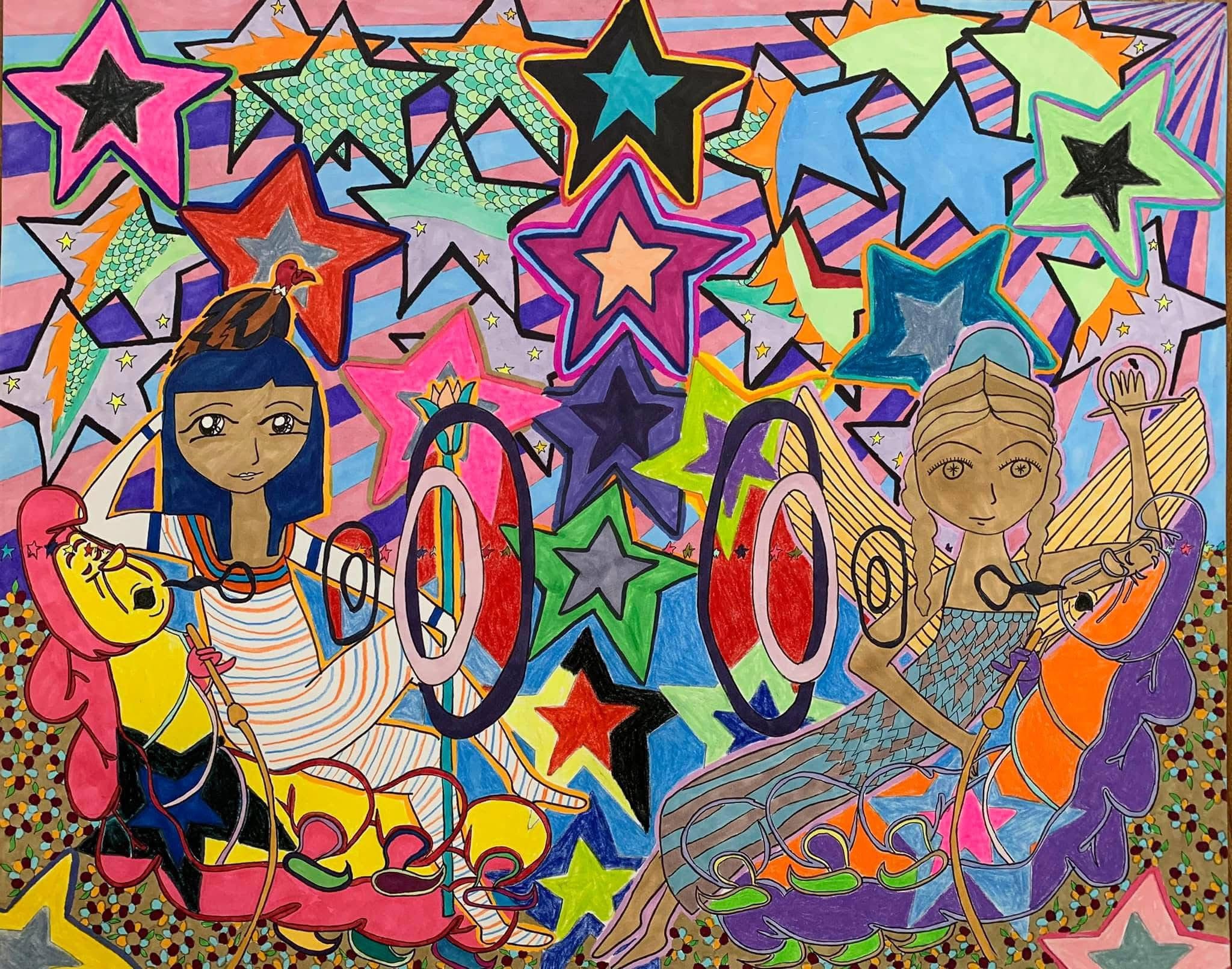
Who Are You - Raven Servellon
Beasts - Gianmaria Franchini
He drives up the coast in fits, stopping at abandoned cars to search for gasoline. Before dawn,
as it is now, he usually prepares to dive for abalone, a vague soul surveying the water, sliding on a
wetsuit, and bellowing cries of love to the creatures beneath the sea. But today, before turning onto the
beach, he drives farther than usual. It’s hard to say why, exactly. He would like, more than anything, to
escape the black road hugging the coast from Point Arena to Mendocino, where imploded cabins hide
behind mad fog spells and half-dead trees, and where sea cliffs hover, ready to fall, it seems, at the pull
of a speargun, into the relentless, darkening waves pounding the break.
But he can never find a way out.
Toward the pallid ocean, wind turbines on sea platforms shine in the starlight. The blades are
motionless in the wind.
Up the road, there’s a motel he’s never seen before. The sign flickers on. In the back, a blue
light burns. Later, they’ll probably serve breakfast to lone hunters. But they can’t take lodgers as the
county breeds bandits, vigilantes, violent wanderers. Hosting strangers for the night is unthinkable,
even for a fixed rate, even for the innocent. If he returns for coffee after the dive, he must watch for the
Wilderness, Fish, and Game gang members, who sometimes take fingers from unlicensed foragers, and
entire hands from poachers. Turning his old truck around, hearing the first faint abalone calls, he
thinks about his meagre existence. In his life, everything is a mystery, as if he were creating the world
anew, from the beginning all over again.
At the beach, the sea is shimmering and flat. The hushed waves lap the shore with their rain-stick
caress. An old rowboat he doesn’t use bobs near a crumbling pier. Near dim tide pools, he kisses his
suit, mask, fins, and gloves, and slips them on. As he squares his shoulders to scan the horizon, a cold
saltwater film passes over his eyes. The abalone sing: “We offer our ear-like-shells, our jaw-locked
mouths, our lathering tongues; take our mother-of-pearl, harvest our flesh, and feed your children.”
Dancing lights, like the glint of knives, the mercurial iridescence of tiny fish, appear where the water
darkens. He shrills a gull’s call, a curt battle cry, and walks toward the lights. When the water is
shoulder-deep, he tests the mask, fingers the shell bag, and goes under with lungs full of air, feeling the
tide pool’s edge toward colder, deeper water. Every time he counts to sixty he rises to spot the shore
and track the lights: There they are, oil-slick scales refracting moonlight. When he reaches them, they
disappear. He checks the shore once more and dives down, counting first to ninety, then higher. Near
the bottom, the calls echo, then diminish. Dark, fertile, and familiar, the abalone wait like children at
the foot of a small reef. Their infantile, muted murmurs are sweeter than the purest harmony. His
heart, so rarely moved, floats toward the surface.
For many years, he hasn’t needed a knife for the harvest; the abalone come willingly.
He repeats the dive, each time filling the bag with a few shells, which grow silent on the
journey to the surface. Working through the dawn, he collects several dozen large, healthy specimens,
and names each of them as a shepherd calls a beloved flock to slaughter.
Later, near the truck, he runs waterlogged hands over the rose-colored shells, the rough outer
growths, the living barnacles. They hum in his hands. When he sees Kairi, his daughter, he will tell her
he can feel them breathe, and sense their probing tongues from the outside. Entire worlds are
contained in each shell. Such a pity, it always is, to pry them dead for meat and pearls. The market in
Mendocino takes nothing else as the half-shells are out of fashion, and food and luxury go a long way.
Driving toward Mendocino, he eases onto Elysian Road, turns inland, and passes isolated, improvised
settlements, which, lying under thick tree cover, never see the full light of day. After the deserted
school and blown-out post office, he crests a hill, cuts the engine, and rolls in silence to the house he
knows so well. Wind chimes flutter in the garden. Kairi’s fish kites jump in the breeze. A dog yelps,
greets him, and settles in the truck’s shadow. Everything is as he remembers, except there are two
trucks in the driveway where last week there was one. His ex-wife split after the flood. He was aimless,
could never provide enough, and felt guilty. She resented losing her freedom, couldn’t fill the void, and
felt guilty. When she left, he had little to give except his grandmother’s old house, where she lives with
Kairi now. Perhaps she has one of her hateful surviving cousins over to help with Kairi, or she’s
sleeping with one hunter or another.
Melancholy washes over him, a stinging, pleasing shower of regret.
Soon, the sunrise stalks the treetops. Inside the house, someone turns on a light. He tiptoes
across the driveway and leaves a basket of abalone on the porch. Back in the truck, he waits, then starts
the engine and drives up the hill, to the coast, and south toward the motel. Before arriving, he sleeps in
the truck for a haunted hour, dreaming of cities under the sea, with people chained to the bottom,
anchoring strands of seaweed tall as redwood trees.
At the motel, a graying, wiry woman is serving coffee, thinking aloud, then to herself. “Burned as hell,”
she says while pouring a cup. Her voice seems to surprise her: “If the burner goes this place will blow.”
The sweet smell of propane wafts over the window seat, where he sits, pleased with the small change
he’s made to his routine, and wonders if he should make another go with his ex. No. She hates him half
the time and he isn’t much for forgiveness. Which is to say, he still loves her and Kairi very much. If he
could spend the rest of his days diving for abalone and driving between their house and Mendocino
he’d be alright. But this love presents a fundamental problem in his life, an obstacle to losing himself
like he wants. Nothing keeps him from driving farther north or south, to what remains of San
Francisco or the no-man’s-land past Arcata. Instead, he drives in circles, stays low, and dives once or
twice a week.
He hasn’t tried the coffee but the woman shuffles to his table and offers more. She lingers,
pouts with her wrinkled mouth, and nods toward a pantry behind the counter. It’s obscured by busted
shelves and kitchen supplies from the motel’s former life. Perhaps she needs help reaching something.
He moves to rise from his seat, but she lowers her eyes and says, “No. No.” A moment later, she points
the coffee pitcher, which has never left her hand, toward the pantry, and says, “See something?” Only
shadows and morning light. Turning to face him, she says, “No one there.” It’s not quite a question.
She cradles the pitcher in both hands. He strides over and flips on the light—just an empty pantry.
“Oh,” she says. “The propane came yesterday.” Then, as if to explain, “An extra set of hands would
help.”
The front door opens, and a bell rings. The jingle is absurd, a relic from another time, when a cafe full
of diners didn’t seem like a distant miracle. A man stops in the doorway. He wears a coat emblazoned
with a giant white “W,” the Wilderness, Fish, and Game gang’s emblem. The “W,” as the gang is called,
protects farms and wild food sources with mafia tactics: they force payouts, sell seized animals, and set
vicious examples of whoever runs afoul of their laws, codes of honor opaque as the omertà. He’s seen
crying farmers plead with them for their last remaining animals, and castrated corpses of permit-less
hunters staked to empty cabins. Over many weeks, the birds tear them to shreds.
The man drags his feet to the center of the room. He glares at a table and angles it to face the
window seat. The woman glides over and pours him coffee. He orders eggs and asks, in a hard,
unyielding voice, if they’re fresh. “From my own brood,” she says, “Same as every week.” He neither
speaks nor moves, and she says, “Must keep the pot warm or we’ll turn up in flames.” She scurries to
the kitchen, clangs pots together, and sings while cooking.
After pockets of silence pass between them, the man turns up his nose and says, “You have the
smell of a scavenger.”
“I’m a diver,” he says, his voice shaky.
“And what do you dive for, coins?” The man’s hat covers his face in shadow.
“Abalone,” he says.
“You pry those clams apart but there’s hardly any meat in that business.”
“It’s all permitted.”
“By the book,” he says, with obvious irony.
A short while later, the woman returns with the eggs. Pleased with herself, she slings the plate
onto the man’s table and blinks toward the window seat. Does she mean something? Perhaps she
knows this man or has heard of his reputation from the hunters who strive, without success, to
conduct their business steps ahead of the W, their mortal antagonists. Perhaps he’s in the thrall of this
morning’s dive, and she didn’t blink in his direction at all. In any case, the man could be after a
poaching violation. The W typically punishes only the most reckless divers. An unspoken rule holds
that the sea has natural laws distinct from the land, and out of deference to what they can’t control, the
W leaves most divers alone. He doesn’t have permits, and keeps his yields small to avoid attention.
Yet this man has unsettling determination in his voice. In such cases, he’s learned it’s better to
retreat into a shell of meekness and wait until danger passes, as storms batter the sea surface over a reef
still as heaven.
The woman clears her throat twice, then speaks: “As you are a chief of the Wilderness, Fish,
and Game officials," she says. “I must report a sighting.”
“I’ve seen the bottom feeder,” the chief says, staring at his breakfast.
“Not the bottom feeder,” she says, “A beast.”
“What beast?” the chief says. His voice suddenly booming.
“A monster, they say, eating farm animals all around.” She clears her throat a third time.
“A goat-sucker,” he says, “a chupacabra!” He chuckles, then purs. “Hide your children!”
“Sir, it is your duty to protect my business.”
“Children, not kitchens, are our most precious resource.”
“I feed half the coast from here to Oregon,” the woman insists.
“Hunters, mostly,” he says, smiling, toying with her.
“It lurked in the pool all night," she says, “Couldn’t get a wink in.”
The Chief turns errant thoughts in his head, and slides from the table. “Is it there now?”
“No, there’s something else.”
“Let’s take a look,” he says, “Slopsucker, your presence is required.”
The woman leads them to an animal pen in the back. He smells something like smoking rubber and
rancid geraniums. She swings the pen door open and waits for them to look inside. There, the carcass
of a half-eaten goat lies on a bed of hay. A mangled incision runs along the animal’s underside from the
throat to the tail. On the still face, the white lips recede above black gums, revealing strangely human
teeth.
“Poor Philip,” she giggles. “Not a drop of blood.”
“Goats give meat and milk,” the Chief says, his voice gentle. “To lose one without offering
suitable protection is a serious offense.”
“It was the beast, not me, sniffing, crouching in the pool—cross my heart and hope to die,” she
says, as if explaining what she’ll serve for breakfast tomorrow.
Earlier, the woman seemed half-mad but honest. She’s calmer now, but he wonders if she’s lost
her mind completely. Coyotes do eat farm animals, but the incision looks oddly precise, and a coyote
would strip the meat or drag the carcass out. Hunters sometimes use carcasses to mark their territory.
And yet, why would a hunter take the blood? Perhaps it was a beast as the woman says. Or, after years
of diving alone, he has lost his mind, and it’s starting to show.
He examines the animal while the chief stands behind him. The scent of damp, rotting fur, like
a rodent’s nest, makes him gag. They could bury the carcass, but the smell would draw attention. He
could toss it into the sea, but it could wash up on shore. Before he suggests either option, the woman
looks toward the kitchen and says, “Have to keep the burner on.” After a moment, they look at each
other, at the carcass, and at each other again. “Burn it,” the Chief says, “and forget this horror.” Then,
perfectly reasonable, “We don’t want the beast to return.” The woman agrees as if it were her idea.
The Chief gathers firewood while they dig a fire pit. He asks what the beast looked like. “Hard
to tell,” she says. “Eyesight’s flying with the birds.” Then, after a few shovels of dirt, she stops digging
and says, “Like a small kangaroo with bloodshot eyes and the limbs of a bat.”
When the pyre is ready the woman complains they have no kindling to keep the fire hot. He
has extra gasoline he found this morning, and volunteers to siphon some from his truck to help. When
he returns with it, the Chief says, “The honor is yours,” and hands him a match to light.
Philip the goat burns quickly, and they watch the smoke disappear into the fog.
Back inside, the Chief stares at his plate between surgical bites. A careful animal, he rises slowly, drops
a fistful of coins on the table, and counts them with short nods. Satisfied, he grunts, rises, returns the
table to its original position, and drags his feet to the exit. With a hand on the door, he says, “You
scared her this morning.” Then, “Break the five-pound limit,” he shows his teeth, “or dive with your
permits in disorder,” he pauses again, “I’ll have your balls.”
The bell rings and the woman startles off her feet as if she hadn’t noticed anyone come in.
He watches the chief’s truck head north. It’s the same truck that was in the driveway this morning. I’m
a careless fool, he thinks. Jealousy rouses from deep regions of his viscera, leaving him hot and dazed. It
would feel good to pass saltwater over the chief’s eyes, dazzle him with the abalone lights, and watch
him drive blind into the ocean. “Everything has a price,” he mumbles, and considers how much this
morning’s abalone haul will fetch at the market. Not much more than food and gas for another week.
The woman clears the Chief’s table and continues her obscure duties, polishing rusty
silverware, staring at cupboards, reaching behind shelves, and searching for something she has not yet
found this morning. She seems to have forgotten about the goat, but while she lingers at the counter,
the spark of memory lights her face, and she says, as if she has finally lost patience, “Closing up. Time
to go.”
Every week he spends a few hours with Kairi after diving. He loves taking her to his diving site, and
cherishes even the abrupt, disconnected conversations with his ex-wife. After leaving the motel, he
returns to the house on Elysian Road to pick up Kairi. As he pulls up, the dog barks, struts to his
truck, and waits for him to climb out of it. The Chief’s truck is nowhere in sight.
“I heard you this morning,” his ex-wife says from the porch. “You don’t scare me, you know.”
She closes the door half-way behind her.
“There’s nothing to fear,” he says through the truck’s window.
“You couldn’t scare a seal pup if you tried. But you’re spooking my boyfriend.” Her eyes drift
to the driveway.
“Are you cavorting with the forest service men again—the gangsters and hunters?”
“So many.” She laughs, though she seems determined not to. The flash of her teeth reminds
him of all the days they spent at the beach together. The roar of the sea muted her laugh then. Today,
her laugh bounces through the trees. She will forget him the moment he leaves.
“The gangster will arrive in a few hours so have her back before then.”
“In one piece, as always.”
“Please, don’t get lost, and don’t wander,” she says. “Kairi, come on.”
She runs out of the door and leaps into his truck. Her backpack has a picture of a whale on it.
On a decrepit picnic table near the beach, he lays out pens and paper he has collected from empty
homes. Kairi draws everything she sees: seagulls, crabs, starfish, otters, sea lions. She draws her dog
hovering over ocean waves with wings and fins. One day last year she returned from the beach with a
backpack full of feathers, sticks, bones. At home, she hung them up and traced their outlines on the
walls.
“Wings and fins, wow,” he says.
“He can go anywhere he wants.”
“Where does he want to go?”
“There are gills too.” She points to fleshy, pink twin blobs.
“You’re good.”
“He wants to dive and chase abalone.” She pronounces the “b” like a “v.”
How wonderful she is, he thinks. The little animal, full of impetuous decisions, uncertainty,
the ignorance and innocence of youth. Every day, she becomes more herself. She has an independent
streak but would be helpless alone.
“Soon, I’ll take you with me.” He says this because he feels that he should, but can foresee he
will never take her diving, and doesn’t want to. He hopes her life will be better than his meager one.
“Let me tell you a story before I have to take you home,” he says, changing the subject. “Do you know
about the turtle that carries the world on its shell?”
“That’s a big turtle.”
“It’s so big we can’t even see it. Let me tell you: Once I was small like you and had a mom and
dad, but I also had a grandfather and grandmother. Things were different in California. There was a
city where we lived, San Francisco, but that city is now under the sea. My grandparents were from
Japan, which doesn’t exist anymore because it’s also under the sea. My grandmother gave me the house
you live in, and told stories she said were very old. She was a good storyteller and would use sounds and
different voices. Her English wasn’t good, but she made the stories fun. The turtle was as big as the
world, which floated on the sea, and it carried the world on its shell. Grandmother would pretend she
was the turtle by craning her head into her body and snapping her teeth. While she was strong enough,
she would take us onto her back and say, ‘You are the world. See? You are floating on the back of the
turtle.’ She would tire and hurt her back but never stop laughing. Then she would fall and we would
crawl over her and die laughing, though we could never understand her completely. Other times she
could be strict and carried around a sadness that I did not see in other people’s grandmothers.”
Driving north, the Chief gives himself a new name. “Angels in heaven hear me,” he yells. “Bless the
land and the people, the fruits of their labor, their hopes and desires.” He traces devious prayers across
his chest, bristling with emotion. “I am reborn: Call me the General.” His mouth stays open after the
sound has left, and his tongue explores the new name, the new calling. He screams: “I curse Chaos, the
enemy, with the voice of my ancestors, and declare vendetta against entropy, the falling, the falling!”
After a bout of silence, he consoles himself: “Someone, no one else, must care to grow the
young. The laws are sacred. Without them, nothing survives.” The wind whistles through the cracked
window. “I must purge the trespassers, starting with the poacher who wants, it seems, to die. Poor
soul, his old woman leads me to her bed. I will raise his daughter as my own.”
The injustice presses so hot in his chest that his eyes burn with pleasure.
After dropping off Kairi, he drives to Mendocino and stares at the brilliant, hypnotic sea for the rest of
the afternoon. Later, at the market, he prepares the abalone for the sale. One by one, he plucks the
shells from buckets of saltwater, cups them in his hands, whispers praise, hisses love, and kisses them
top to bottom. “A worthy price for your children,” says the trader from the entrance of his tent. He's a
short, mysterious man who speaks in familiar tones, as if he was once a diver. After each exchange, he
imagines the trader inhaling the scent of abalone until night falls and the market closes.
The trader plunges his hand into the saltwater and claws out a shell. “Beauty,” he says, “Which
beach?” He tosses it in the air, then back into the bucket. He must know that abalone this size come
only from a few beaches.
“Gualala,” he replies, naming the nearest permitted site.
“Never seen such marvels from Gualala,” says the trader. “This morning?” He lifts the buckets
onto a scale the size of a small statue, and nods at each weighing.
“I dove through the night,” he says, and slips, offering too much information, “And slept
through the morning.”
“That’s funny, I made the morning permit sweep,” the trader says, “Didn’t see you.”
He feels the sale, and perhaps more, slipping away. But, before he volunteers the name of the
beach near the motel where he dove this morning, the trader throws him a lifeline: “Might have missed
you.” Then, “These look good, let’s split them up.” The trader steps into his tent to file paperwork,
perhaps, or to suck the sea slime on his hands.
He begins the dread work. Grateful, after all, that the abalone entrust him with their lives, he
keeps the chain mail glove and stubby knife out of view until the last possible moment. In view of the
foragers, hunters, and traders mingling about the market, he pries half the shells open, digs for pearls,
and slices out the flesh. The shells are pliant in his hands, but their soft, resigned death cries, like the
bleats of clucking hens, nearly make him cry. The other half he leaves for the trader to sell whole.
This week, he will dive once more, and see Kairi a second time. His life will continue on a drab
path until it’s too cold to dive, the abalone die, and the sea swallows the coast forever. But it was a
good dive this morning, and perhaps that is enough. He remembers the woman at the roadhouse, and
wonders how she has stayed alive among the hunters, gang members, and beasts. He finds himself
searching for the chief’s hat and inscrutable face among the faces in the crowds. Just as he thinks he
spots the woman’s white hair, the trader returns with a dark look on his face.
“Your permits,” the trader says, changing tone.
“You’ve never asked about them before,” he says, trying to salvage the situation.
“Look, your hauls are good,” the trader whispers, “but you’re over the limit and without
permits.” He looks over the abalone and asks where they were harvested.
“It’s a secret beach,” he says, not ready to admit to poaching.
“From one diver to another: poaching is a deadly offense.”
“I know,” he says, “I’ve been diving for years.”
“The W is coming down hard on us,” the trader says with a firm, apologetic stare.
Then, as if carried on the back of an inland wind, the General’s god-like voice rises from the
tent behind him.
“HERE is the poacher,” he says, “And torturer of animals.” Indignant, self-serving, his voice
herds attention with the power of music, or a soul-binding spell. “This villain stores poached food
with his family, and burned a farm animal this morning.” A crowd forms in front of the General,
Grand Inquisitor. “The life of his precious child lies on a knife's edge.” He steps aside to reveal Kairi
from behind his great coat. She seems confused more than fearful. “When one of us is in danger, we
are all in danger,” he says. “Can anyone argue with this?” The trader nods. The crowd murmurs
agreement. Some farmers call their animals inside their pens and trailers. Traders put away their wares.
For the first time since the flood, and when his ex-wife left, fear consumes him. His blood
leaves his body, which fights to stay standing.
“What do you say, diver?” says the General.
He gurgles, “They were a gift, for my ex-wife.”
“So you admit to poaching?”
“The goat was already dead,” he says with the conviction of a wounded animal.
“Truth guide us. I have witnesses to the foul deeds.”
The wiry woman’s white hair floats above the crowd as she comes forward. She looks past him,
dazed by the shining sea. “Did this diver instruct you to burn a farm animal?” says the General.
She makes a show of searching her mind and says, finally, “Yes, it was his idea.”
“But the beast killed the goat,” he says.
“What beast?” she says.
“How many children can a dead goat feed?” the General shouts, furious. “And for how long?”
Indignant at the thought of wasted food, someone cries “Justice! Burn him!”
“We have a second witness,” says the General. “Lovely, little Kairi, does your father leave you
abalone?”
“Yes,” she says, proud of her father.
“And where does he dive?”
“Point Arena,” she says and smiles. She has passed the test and looks to her father for praise.
“Point Arena is a prohibited beach,” says the General, his voice mild. “We cannot keep food
sources safe with poachers in our midst.”
“They’re our food sources too,” someone yells.
“Justice hear us, we must not rely on a mere child,” says the General.
The crowd parts and his ex-wife glides through the opening. She’ll save me, he thinks, but is
frightened by her eyes, which hold the uncertain, calculating glance of a woman afraid of public
shame, and, unable to summon the courage to oppose the rabid voices, joins in their savagery.
“The wretch stalks this long-suffering woman daily,” says the General.
She looks at him as one pities a broken toy. She could feign ignorance to cast doubt on the
General’s performance. But, she doesn’t know if that is what he wants. In truth, she has never known
what he has wanted. But with him gone, she can bury her guilt forever.
She drops to her knees, clutches her head in both hands, and cries out in ecstatic pleasure, “Yes!
He comes to watch us! He puts us in danger!”
All eyes turn to him, who is strangely calm. “Cast him out!” the crowd yells.
“The law is the law,” says the General, grave as ever.
“The law is the law,” repeats the crowd, though none know what it might be.
“Take your charge,” the General says. He pushes Kairi forward. “You have until sunset to
escape with your blood. After that, we will hunt you. If you fail to keep her, she becomes our own.”
At the beach, the sun lies below the horizon across an anxious, alien sea. The rowboat is still moored to
the concrete pier. After he rows to the sea platforms, they can hide overnight and continue along the
coast to the ruins of San Francisco. He takes water, a tarp, and food from his truck, and wraps Kairi in
a heavy blanket. “Aren’t you happy we’re together,” he says, hurried, but focused. Her eyes grow wide,
then worried, and she says, “Can’t we dive in the daytime?” “The abalone prefer the dark,” he says, not
convincing even himself. He lifts her into the boat and wraps the blanket tighter. Behind them, not far
up the coast, headlights streak through the falling darkness: The W is on the hunt. He unties the boat,
leaps in, and rows toward the wind turbines, which lie less than a mile from shore. The fog grows
denser, the sea darker—and Kairi becomes quieter.
Halfway to the turbines, he spots a boat with a powerful flood light slip past the shore. It must
be the General. Kairi says she’s cold and whimpers.
Powering through the waves, the General quickly cuts the distance between them in half. His
cries crack through the wind: “Scavenger,” he yells, “Your balls are mine!” When they reach the
turbines, it begins to rain. Kairi cries, first in whimpers, then in sobs, and covers her eyes to escape the
floodlight. But there’s another light in the water, a thousand little candles rising to the surface. He lets
the boat drift toward the platform, watches the lights sparkle, and hears faint abalone calls. This far
out, he’ll have to dive deeper than usual. He sees the General pacing in his boat, and hears his voice tear
through the night: “She belongs to me!” The saltwater film passes over his eyes. “Stay here,” he says to
Kairi, who is motionless in the blanket. For a moment, he’s unsure if he’ll jump. But soon, the dark,
still water drowns out all noise and thought, and the abalone call him to the bottom of the sea.
In each attempt
-Eric Huff
one clue, light behind you. tree fort lungs and a broken cassette tape player. we are dreaming this mellow
baseline, crystal night, crystal river black – shine! driftwood Jesus, your eyes are a glowing ember
remember? hold on, and where were you JC when I dreamed this very bridge, the one lit by little TVs
stashed away in the back of rooms? flash bang Jesus, where were you last standing, cold pressed, with a
dog-end cigarette in your right hand? sing, black river, sing! snag! where are you snake coil? evil
dreamer? as I lean over the edge a bit. nail biter! sinker! when Henry broke – wave maker! how many
dreams does it cost to get on this city bus? how many times do I need to just keep crossing that holy river
night? that sudden plunge! where were you neon Jesus? I was on the corner of Barstow and nowhere. you
were the depth and the frigid water at the confluence.
Cedar Waxwing - Eric Huff
we read about you
in our bird books.
we memorized
your shape,
we imitated your call.
but it’s
November.
will you leave, too?
when I turned to go
back inside,
I knew
winter was on its way to
Minnesota.
the wind
will whistle clear
and we whistle back
in ways
the same.
there is a reflection. - Eric Huff
there is a reflection.
but we continue to look for new constellations in the western sky because this isn’t a little bit of
left behind or rewind. wait, is my name a debris field at the bottom of a lake? is my name an
expanding universe? pull out any cardboard box tucked under my stairs and we are slipping out
of consciousness again. but I hear your voice, though far away like the rising moon, like the
barred owl’s answered prayer. and I know you still love me. we’re standing in my childhood
backyard, the warm night air is punctuated by firefly flight. we’re just behind this old
cottonwood tree and I want to tell you how hard it is sometimes, but before I can, you are moth
and buzz, you are a stir in the leafy wood. and I am gone, too. the sunrise is all pink and orange
before the gray of day settles all around us. you fix your yellow cashmere scarf as I take a deep
breath in.
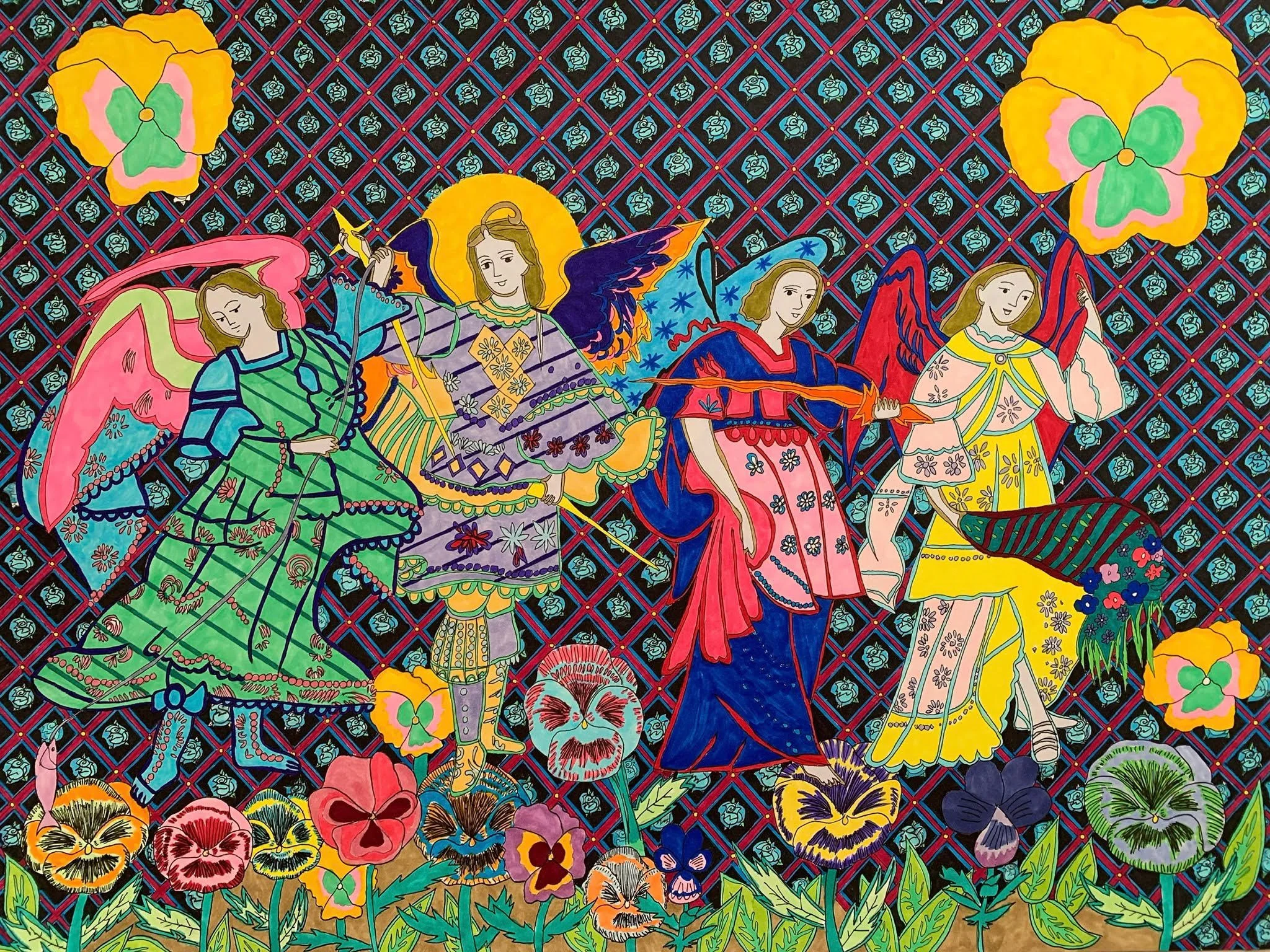
The Angels - Raven Servellon
The Shape of Clouds
-Doug Tanoury
(Nuances of a Theme by Wallace Stevens)
I.
I had a conversation with my brother once about clouds,
We were adults and not children at the time
I remember we were speaking very seriously.
He said that no matter how much you wanted to,
You cannot change the shape of clouds,
They are what they are, as formed by nature.
We were discussing the character of clouds
That day he came to visit me.
II.
I had a problem with clouds and still do today.
He was more accepting of their shape, and
I was not satisfied with them and judged them harshly.
No that is not true, I raged against them, their wonton,
Wistful whimsey and their uncaring distance as they sail
Carelessly across an iridescent summer sky.
Both of our eyes became watery that day as we spoke
About the unchanging nature and shape of clouds.
Sleeper Beach - Doug Tanoury
Sitting on the sand at Sleeper Beach in the morning
Lake Huron stretching out to the far horizon
where the vanishing point is a line of haze
beyond which both water and sky disappear.
We sit together on the side of a rising dune
and look out across the flat Euclidean geometry
of the lake’s stillness, the morning a construct
of horizontal lines, shore, water and clouds.
She who is with me is the witness to this morning
And all the variations of color stacked up vertically
In rising and graduated strata, as glassy lake
blends with a crystalline topaz sky.
Everything is lit with pale fluorescent blueness
that is the joint effect of sky and lake, a watercolor wash
that faintly glows around us so that we too wear its
subtle reserve, a muted and most understated hue.
That October morning with us alone on the beach,
so quietly ordinary and calm, two people aware
for a moment of the morning sounds around them,
the gulls calling and the soft static of surf.
If we were to hear music at that moment it would be
Debussy’s Clair de Lune, a tune of sleepy blue
with notes airy and light, like the thin line of clouds floating
cerulean tinted in descending order of size
so that the three most distant trail off…
forming a perfect ellipsis.
Twenty Three Mourning Doves
-William Greenfield
They come, strutting like break dancers,
with a call from the departed; a ritual
for the forsaken and the unfed.
On the coldest days I count more than
twenty three, a solid mass of buffy-tan;
white feather tips like caps on a dark ocean.
When the juncos join the frenzy, counting
becomes a fruitless task, like trying to count
drops of rain or the seeds that fall from the sky.
Counting cannot explain the differences,
the faces, the feathers. What is needed to
survive is unknown but we continue to
feed the hungry; we continue to count the
differences in words and dialects. Counting
is such a finite thing.
A bird is an archosaur with a music box called
a syrinx buried deep inside. The bird shares
this moniker with the crocodile.
How can these vastly different living things share
some ancient heritage. I once saw a bird sitting
on the tail of an African croc.
I once saw a crow share a worm with a dying
kitten. I once thought that all of these differences
always added up to an uncanny sameness.
The answer may lie in The Dictionary of Obscure Sorrows
where a new language defines the magic of
an early morning birdsong.
Methuselah Syndrome - William Greenfield
A Natural Historian posted a photo of
a four hundred year old Greenland shark.
A jealousy fell upon me as I wondered if
this creature ever bit off the leg of a sailor
bathing beside an ancient galleon.
I thought it would be better to drift for
centuries in cold dark waters than to face
the alternative. As one infected with this
condition, I yearn to watch inventions
become obsolete.
nascar and thoroughbreds would be like
slave driven chariots in the hippodrome.
I could invent a new religion and have
my name enshrined in old scrolls.
But how did they know?
Was it the rotting teeth or the fragile bones?
I’ve seen many a living thing mimic death
in an oddly successful but unintentional way.
Even carbon dating the protein could only
give you an estimate.
Would the generations of cherry blossoms
become a tedious spectacle? Would sleep
become a portal to the Gods I’ve forsaken,
or would I covet the centuries endured
by the Jurapa oak?
Taking Time - William Greenfield
In late July the vanilla hydrangea
accent
much more than I notice on most
days
of the many years since I planted
I see
them from the porch but it was
a movie
about a government taking all
emotion
from its citizens that made me
walk
down to this blossoming
scent
grown tenfold and now touching
melancholy
for I should have walked down
here
many days of many years
even
those after I knew each glorious
bloom
belonged to me like the grass
even
after I knew I could prune a
bouquet
but never did
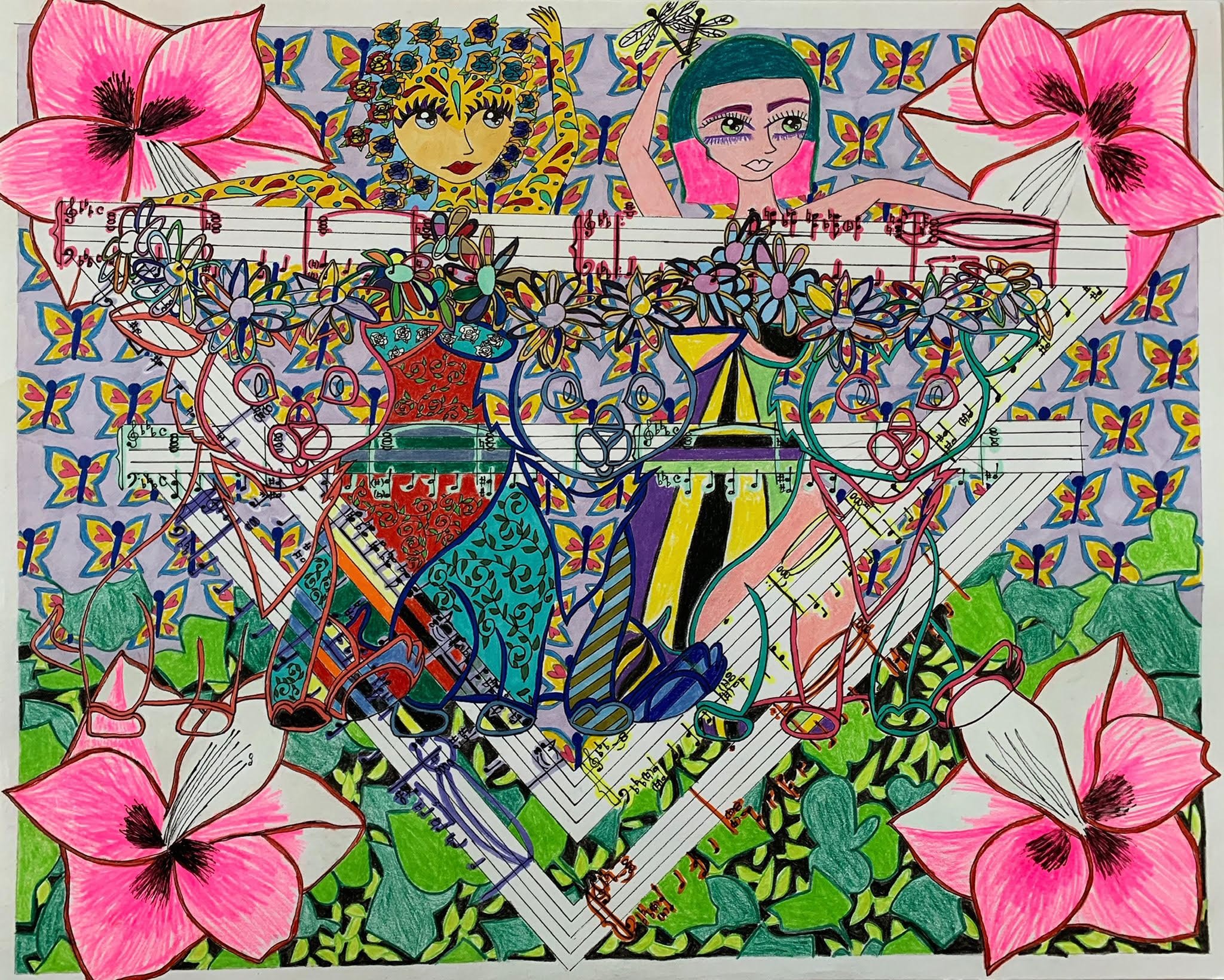
Amaryllis - Raven Servellon
The Watchers
-Carlos Castillo
Close to midnight on a warm evening in 2004, Crispín Timonera drifted awake to the sound of a police siren somewhere in the horizon. In his dream it had been a klaxon warning of some kind of an attack on the city. Bits of the dream snagged at the edge of his consciousness. He reached for them, half-conscious, but the they tore loose and slipped away into the same oblivion where forgotten conversations and the faces of strangers encountered on a train go, leaving only a vague suspicion that something important had been said. He sought Luzmila’s shape in the dark and realized the space beside him was empty. He was alone. The quarrel came back to him in a rush -- the bickering, the yelling, the accusations, the raw, unsparing spitefulness. He threw his legs out over the edge of the bed and sat up, rubbing his eyelids with his knuckles.
He needed a smoke.
The apartment was a mess. There were fragments of glass on the floor. They crunched under the sole of his flip-flops. The argument unspooled in his head like a film reel spliced in no coherent order. She had smashed a few dishes. One. Two. Three. Then she dropped the whole stack on the floor, the shards skittering into the corners of the dining area. She glared at him, savage, her lips trembling with rage, fists balled at her sides. The walls shook when she slammed the bedroom door shut. He pressed his ear against the door. She was sobbing. She wept sweetly, like a child.
He flicked the light on in the kitchen. There was one last beer in the refrigerator, holding its place between a jar of mayonnaise and a collapsed carton of day-old Chinese takeout. He hunted for the bottle opener in the junk drawer. The bottle was cold and wet in his hand. He popped the cap off, heard it strike the tiles and roll away.
He stepped out on the balcony in t-shirt and Bermuda shorts. The night greeted him with a breeze from the northwest. He leaned on the railing and looked down. The neon sign above the liquor store across the street pulsed in intervals, red-blue-red. He thought of Luzmila’s face in that light. Had they argued in the street?
A man in a white undershirt and grease-stained trousers stood at the street corner, smoking. The air smelled like rain though there were no clouds in the sky. Two prostitutes stopped to inspect their reflection in the display window of the liquor store. Crispin took a gulp from the bottle and reached into his pocket for the pack of cigarettes. It was empty.
“Goddamn!” he said out loud. “Goddamn!” he yelled, his voice ricocheting against the buildings around him.
Neither the man in the street corner nor the two prostitutes in front of the liquor store looked up. People never look up. With zero “look‑ups” in n trials, a (1‑α) upper bound on the true probability is p ≤ 1 − α^(1/n). If he could place bet on it, he’d be a rich man. They had moved into the apartment five years ago, and he’d never once seen anybody look up from the street. Not once in five years.
He was just about to walk back inside when something – was it movement? – caught his eye in one of the darkened balconies across the gap. The balcony was one among a multitude in the high-rise that towered over the alley behind the liquor store. He peered across the gap, squinting. Laughter drifted up from the street. The two prostitutes had moved into the cone of light under the streetlamp in front of the liquor store. He looked back up across the gap and glimpsed an ember flaring in the shadows that pooled in the balcony. There was somebody there, smoking.
The elevator carriage smelled like bleach. Was it Saturday? Saturday was cleaning day. He pressed the button, and the carriage lurched gently before descending. The numbers above the door ticked away in reverse. He looked at himself in the mirror. His jeans were loose. He had forgotten to wear a belt. He leaned against the cool metal wall, watching the indicator count down, feeling the weight of the building above him as he sank deeper into its belly.
The elevator doors parted, and the concierge gave him a little wave as he crossed the lobby. Outside, the pavement reeked of burnt insulation wire and stale urine. He crossed the street and pushed into the liquor store. The man behind the counter looked up from his phone. “Back for more?”
“You know it. I’ll need a pack of Marlboros, too.”
Crispin walked to the refrigerator case at the far end of the store and took six Coronas from the middle shelf. He shut the refrigerator with his hip. The glass bottles clinked against each other as he slid them into the crook of his arm. The man put his phone face down on the counter and drummed his fingers lightly on the countertop.
“Another Jack, too?”
“No. I’ve had enough for today.”
“You sure?” the man said.
“I’m sure,” Crispin said. “What’s the matter, slow evening?”
“So-so,” the man said sighed. “I’ve got a delivery coming in tonight.”
The man spoke like someone accustomed to talking to strangers -- the sentences strung along to keep things moving. Crispin didn’t know his name and was sure the man didn’t know his, though he came in every day. All he knew was that this man owned the liquor store and that he was friendly enough in a mildly intrusive sort of way.
“You alone this evening?”
“No. The wife is in the stock room, doing the inventory.”
“Don’t forget the Marlboros.”
“I won’t,” the man said, ringing up the beer and the cigarettes. “I might have to close for a little bit. I have to see to that delivery.”
“Sure. I’ll probably be asleep by then.”
“You sure you don’t want another bottle of Jack?”
Back in the apartment, with the door locked behind him, he put five beers in the refrigerator and opened one, the cap popping off with a hiss. He walked back out onto the balcony, beer in hand, a lit cigarette dangling from his lips. He sat on one of the wrought iron garden chairs set against the balcony wall. Beside the chair was a small, glass-topped table. Luzmila had bought the set – two chairs and a table decorated with iron leaves and butterflies -- when they moved in. She had imagined herself turning the balcony into a garden above the streets, growing tomatoes in wire cages, bougainvillea vines curling along the rail, hibiscus and orchids blazing in clay pots, basil and mint crowding the edges. She never got around to it. He put the beer down on the table.
A yellow light came on across the gap. He saw a woman step from the balcony across the gap through a sliding door. She wore a loose pink robe with faded flowers, the hem brushing the curve of her calves. Crispin had seen her a few times, but only fleetingly. Her hair was wet, clinging to her neck in dark ropes. She was smoking a cigarette. He saw a flicker of movement in the flat behind her – a shadow in a hallway. She wasn’t alone. Her shape lingered for a moment in the square of yellow light, then she turned and moved deeper into the flat.
Crispin rose, went into the apartment, and switched off the kitchen light. He returned to the balcony and sat in the dark. He took a swig from the bottle and walked out to the railing, puffing on the cigarette. The woman came back out and looked down over the railing. Two men were unloading boxes from the back of a truck in the alley behind the liquor store. The woman ran a brush through her hair as she watched them. She tilted her head, letting her hair fall to one side as she brushed it.
Out in front of the liquor store a car pulled up on the curb in front of the two prostitutes. The beam from the headlights spilled down the street, harsh and white. The man at streetcorner was watching the women talk to the driver. Crispin took a drag from the cigarette and watched the smoke twist into the darkness.
He tried not to think about Luzmila. He tried not to think of anything at all. He tried to be aware only of how cold the iron railing felt in his hand. Nothing else. There had been a time when he could do this for hours. To make his mind a blank. To not think of anything. But it became harder to do as he grew older: it was as if the aging mind, weakened, tired, and stripped of its ordinary chatter, reached instinctively for the oldest abstractions. To not think was – for him -- to invite the abyss, and into the abyss the mind poured its most terrible inventions. Tiamat. Bahamut. Camazotz. The jiangshi and the wendigo. He wondered about the ancestors who chose to seed the silence with their nightmares: creatures that devoured the unborn, swallowed souls, and consumed the last cries of the dying. He thought about the terror that must have seized their primitive minds – Homo sapiens newly-risen from the fog of pure instinct -- when they realized the horrors it had conjured: to stand in the boundless savannah at night, surrounded by prairie grass and stars, and to become aware that they were being observed.
In the beginning, God was a gaze, not a hand, he thought.
Some kind of commotion broke out between the two prostitutes and the driver of the car. There was some yelling. One of the women slapped the roof of the vehicle. Crispin looked back up at the balcony across the gap. He saw something -- a blur on the face of the building. What was that? There was a loud bang in the alley. It sounded like a gunshot. He glanced up again at the balcony. He couldn’t see the woman, but the sliding door was open. A shadow darted across an open door in the depths of the flat. Crispin retreated to the table, peering into the flat as he lifted the bottle and took a big swallow of beer. Tires screeched in the street below. He hurried back to the railing and looked down in time to see the car tearing away from the curb. The two prostitutes cursed as the car sped off. “Freak!” one yelled, wagging a middle finger in the air. “Freak!”
The man at the streetcorner stood arms akimbo, looking up at the balcony where the woman had been. Two other men came up to him. They looked like they were in their thirties – uptown executives, probably: jeans, long-sleeved shirts, designer loafers. He’d coined a term for them -- statusoids. Luzmila thought it was funny. One of the young men had a beard. The man in the undershirt pointed up at the balcony and the two young men looked up at the empty space. They were talking animatedly. Crispin could see people running in the alley behind the liquor store, their movements frantic, their shadows leaping and swinging against the walls. There was no movement in the flat across the gap.
The binoculars were in a plastic carrying case under the bed, wedged between a pile of magazines and a shoebox filled with Luzmila’s old Polaroids. Crispin pulled the binoculars out of the case and strode back out onto the balcony. He glassed the street, thumbing the focus wheel until the neon sign leapt into hard-edged letters. A few cars skimmed past. He panned up to the alley behind the liquor store. A small crowd had gathered around the parked delivery truck. He rolled the focus wheel with his forefinger until he could see faces with some detail. He tried to see if something in the crowd might hint at what was going on. A dozen or so people were looking at something in the alley, but the truck was blocking his view. He lowered the binoculars and took out his wallet to check his money. Still enough cash for a liter bottle of whisky. He went back inside the apartment and headed out the door.
The three men at the street corner were still looking up at the empty balcony when he stepped out onto the pavement. Crispin thought about approaching them, but he decided it was better to remain invisible. A police car crossed the intersection and disappeared behind the row of shuttered shops at the far end of the block. He crossed the street, glancing up at the balcony. The two prostitutes under the streetlamp turned and looked at him, half-smiling, expectant. He kept walking. The two women watched him pass and decided he wasn’t buying.
There was no one behind the counter. He could hear voices in the back room. He rang the service bell. The voices stopped. He rang the bell again. The store owner emerged from the back room.
“Let me guess,” the man said. “You’re back for a bottle of whisky.”
“Give me a liter bottle of Jack.”
The man reached behind the counter for a bottle of Jack Daniel’s. He straightened up, holding the bottle, and scratched his throat thoughtfully -- an indication that he was about to say something. Crispin waited.
“You live in the building across the street –the El Mirador, right?”
“Uh-huh.”
“You live on one of the upper floors?”
“Yes,” Crispin said.
The man rubbed his chin. A pause, a subtle signal that he wanted to say something more. He seemed ready to speak, then let it go. The cash register chimed. He put the square bottle of whisky into a paper bag. “There you go,” he said, pushing the bag across the counter.
“Some kind of hubbub in the alley behind the store, huh?” Crispin said.
“There sure is.”
“You know what happened?”
“Suicide.”
“Somebody jumped?”
“Sure did.”
“From the building across the alley out back.”
“Yes. Did you see it?”
“I’m not sure what I saw. There was a woman in one of the balconies of the condo slab out back – you know, the one with the giant satellite dishes. I think she saw what happened.”
“A woman?”
“Yes. I’m sure she had a better view of what happened.”
“A young woman, attractive, in a pink robe with flowers printed on it?”
“That’s her.”
“She is what happened.”
“What do you mean?”
“She was the jumper.”
“What?” Crispin said. “That can’t be. I saw something fall, but it wasn’t her. She was inside the flat. I could see her moving in the flat when it happened.”
“You saw her?”
“I think so,” Crispin said.
“That’s impossible,” the man said. “If you saw an attractive woman in a pink robe, then it was probably her you saw falling. Did she have long hair?”
“That’s right.”
“Well, buddy, she’s splattered all over the alley now,” the man said. “She almost flattened one of the delivery guys. The guy pissed his pants from shock. I had to calm the wife down, too, poor thing. You saw that girl jump?”
“I heard a bang – like a gunshot.”
“I heard that bang, too. We all heard it. That was her body hitting the concrete.”
Crispin paid for the whisky and took the paper bag in his arm. He felt nauseous. His forearms prickled, the hair on the back of his arm stiffening as if even his skin was alarmed.
“You say you saw something moving in her flat?” the man said. “You saw movement in the flat after she jumped?”
“I don’t know what I saw,” Crispin said.
“But you said you saw something.”
“I think there was somebody else in the flat with her.”
“The building superintendent said she lived alone.”
“He told you that?”
“Heard him tell someone else,” the man said. “She used to come in here. A wine drinker. Good taste, too. Liked the expensive French stuff. What did you see, exactly?”
Crispin scratched the side of his face, trying to remember. “I don’t know,” he said. “I thought I saw someone else in the flat.”
Two uniformed policemen walked into the store. One of them made his way to the counter. The other browsed around the shop, scanning the bottles in the racks absently.
“Give me a pack of Camels,” the policeman at the counter said. His voice rasped, like his throat was lined with sandpaper.
“Sure,” the man behind the counter said. He reached for a pack from the cigarette rack behind him. Then he said, “That’s quite the mess with the girl out back, isn’t it?”
The policeman pursed his lips, grim, and took out his wallet. He took a bill out and slid it across the countertop. He must have been in his forties, barrel-chested, heavy-jawed. He looked like a cartoon butcher, Crispin thought.
“Twenty-one floors is a long way down,” the policeman rasped.
“Was she alone in the apartment?” the man behind the counter asked.
“The building superintendent says she lived alone,” the policeman said. “She had a boyfriend, but the doorman says he wasn’t around today. Twenty-one floors. You’ve got to be out of your mind to do that.” He shook his head, voice rasping higher, almost sermon‑like. “People talk about depression and mental illness, but that’s no excuse. That’s cowardice, plain and simple. Is cowardice some kind of mental illness, too?” He tapped the counter with two thick fingers, driving the point home. “Suicide eats at you until you forget the world, forget the people who’ll have to scrape you off the pavement. Death comes soon enough. To go chasing it—well, that’s just cowardice. That’s all that it is.”
“Listen,” the man behind the counter said, motioning toward Crispin, “this fellow here says there was somebody else in the flat with her.”
The other policeman looked up from the display racks. “You saw something?”
“Where do you live, buddy?” the policeman by the counter said.
“Across the street. I live at the El Mirador.”
“What did you see?”
“Nothing,” Crispin said. “I didn’t see anything.”
“Nothing?”
“Well, I might have seen her falling. But that is all.”
“Nothing else?” the other policeman said.
“Didn’t you say you saw someone else in the apartment with her?” the man behind the counter said.
“No, I didn’t see anything.”
“But you were just telling me –"
“You saw her falling,” the other policeman interrupted. He walked over and stood beside his partner, his arms folded over his chest. He was taller, leaner than his partner, and his eyes were quick and suspicious.
“I think so.”
“Did you see anything or not?” the policeman standing by the counter said. The sharpness of his tone surprised Crispin. “Did you see anything?”
“I didn’t see anything,” Crispin said. He nestled the paper bag in the crook of his arm and headed for the door.
“Wait a minute,” the taller policeman said. “If you saw something, then it will help if you make a statement.”
“I didn’t see anything. I thought I did but I was wrong.”
Outside, the man in the undershirt was alone in the street corner again. He was watching cars go by, his face lit and darkened by the sweep of passing headlights. It occurred to Crispin that the man was probably a pusher. Or a pimp. The two prostitutes were gone.
Back in the apartment, Crispin poured an inch of whisky into a glass. He drank it in one gulp. He poured another shot into the glass, took a beer from the refrigerator, and moved out onto the balcony. He sat down on the chair, put the beer down the table, and lit a cigarette. The smoke curled upward, a pale blue haze in the grey light. The skyline cut the horizon like a row of knives. A silent burst of lightning cracked the sky.
“We don’t talk,” Luzmila had said. She was standing in the kitchen, her arms akimbo. Sunlight streamed in from the screen door behind her, slicing the dimness in the kitchen as though it was falling through the canopy of a jungle. “You stopped talking to me a long time ago.”
“What does that even mean?” Crispin said, puffing on a cigarette. “What are you talking about? We’re talking right now, aren’t we?”
“That’s what you do,” she said. “You make me sound foolish.” She stepped closer, her bare feet silent against the tiles. “You talk to me like I’m part of the furniture. Like I’m a chair or something. We don’t talk anymore. Not really. Not like before.”
He tapped ash into the ashtray on the kitchen counter. “Maybe I’m tired. Maybe I have things on my mind. Maybe I don’t have the words --”
“You always have words,” she said, her tone softening for a moment. “You have words like ‘nice’ or ‘fine’ or ‘maybe.’ Words that don’t mean anything.”
“I don’t know what you want from me.”
She crossed her arms, watching him. “Why do you drink so much? You drink more now than when I met you.”
Crispin shrugged and said nothing. He took a drag on the cigarette and let the silence stretch until it felt like another presence in the room.
Finally, Luzmila whispered, “You don’t even try.”
What did she mean? What was she saying? He’d been generous enough in every other respect, or so it seemed to him. He’d even been willing to hole up in the bedroom like some fugitive when her mother visited — her mother, who’d taught school many years ago and sang “Twilight Time” and “I’ll Be Seeing You” in the bathroom and, as if it were nothing, called him by the wrong name every time. He’d been patient, had walked his mile and a half and then some. He didn’t complain when Luzmila fidgeted with her phone at supper, never bothering to look up at him when they talked. But he had his limits, and these inexplicable fits of fault-finding were simply too much. It was a matter of fairness. Was there someone else? Was that what it was about?
He tried to distract himself now, counting the lights in the building across the gap, but his mind kept jumping from one thing to the next (apples, hallways, traffic lights, pigeons), and the brevity of each thought had the comic‑book effect of flattening time into panels, each one already fading at the edges. By the time he finished the last of the beer, rain clouds had rolled in over the skyline. He went back inside to retrieve the bottle of whisky and a glass. The wind had picked up when he came back out.
What did you see? The policeman’s face swam into his mind’s eye.
He saw a shadow. That was what he saw. He saw one shadow in a city of shadows. He saw a falling shadow. The shadow stretched long, longer than the street itself, longer than the night. There were millions of them – shadows, blurs, flickers -- moving against the light of millions of balconies pulsing across the city. He leaned forward, his hands on the armrests of the chair, cigarette between two fingers, and tried to fix his gaze on the empty balcony across the void. For a brief instant, the vacancy seemed deliberate, a kind of staged absence. The sliding doors were open, like a square wound, yellow and empty, cut into the building’s skin. The air buzzed with a faint purr, a mechanical grinding. A truck ground into first gear somewhere. The sound was insistent, implacable, as if the city itself was sighing through ducts and wires. He thought about Luzmila somewhere out there, in one of the windows. Was she alright? Should he send her a text message? He thought of the policeman again, and felt the city crowding in around him, a cacophony of unseen gestures and lives moving behind glass, each one a signal, each one a code. To be unseen in the middle of this city was to be nothing, he thought. Wasn’t it better to imagine a gaze -- even a terrible one, even one that swallows your soul -- than to sink into incomprehensible nothingness? He poured himself a shot of whisky. A faint tapping reached the balcony rail. Drops struck the iron, scattered at first, then close together. The concrete around his feet darkened in patches. More drops came, steadily now, spreading across the balcony. He sat with the glass in his hand, watching the rain begin.
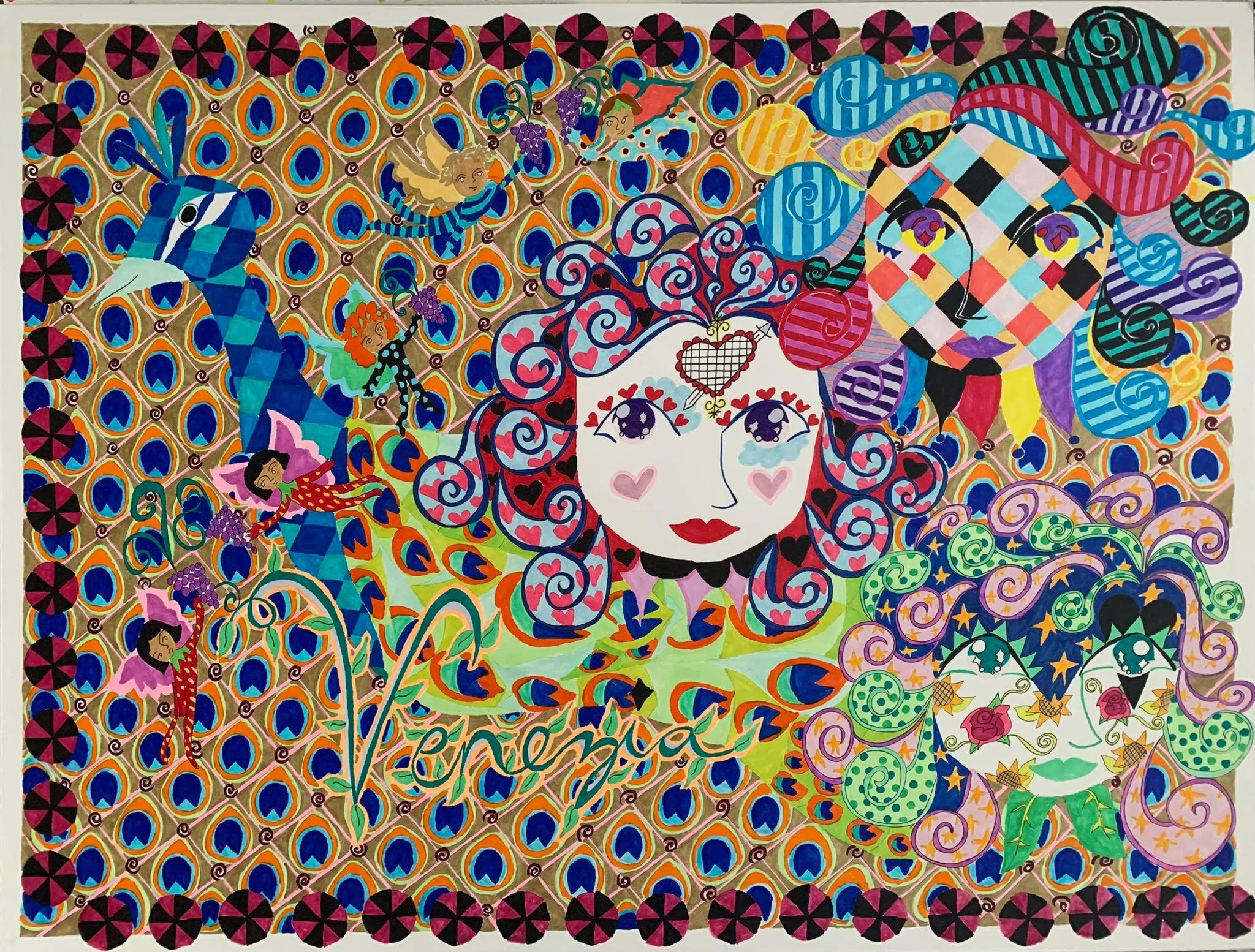
Venezia - Raven Servellon
-
It Was Ok - Sam Hendrian
Returned from the holiday break
With spare change in his unchanging eyes,
Accustomed to the leftovers
Of a placeholder feast.
Mom was on one side of town,
Dad was always in-between
Trying to make up
For his made-up excuses.
When the teacher asked how Christmas was
He said it was okay
With no attempt to hide
The ambivalence in his voice.
Grateful to have homework again
Unlike the rest of his classmates
Who mourned the living room couch
And the parental bookends.
But every book ends
In some way or another,
Destined to desecrate
The most wonderful time of the year.
-
More Than - Sam Hendrian
Stepped out of the Uber and into McDonald’s
Where he’d work the rest of the day
While fantasizing about being
More than a means to an end.
Served plenty of baggy-eyed customers
In similar predicaments
As they counted on one hand
Those who wanted versus needed them.
They once had dreamed of hearing
Something like “I love you”
But now they’d learned to settle for
“Thank you for your service.”
Everyone blamed AI
For minimizing humanity
Without recognizing how easy they’d made it
To turn nuanced emotions into equations.
After McDonald’s it was time for bed
Where the heart surrenders to the head
And accepts that every road ahead
Is paved with “How about this instead?”
-
Should I Have the Last Slice of Pizza? - Sam Hendrian
A spiral notebook for spiraling thoughts
About viral diseases,
Namely the need to heed anxiety
Regarding every little thing.
Should I have the last slice of pizza?
I’ll probably feel bloated later
But if I save it for tomorrow
I might wake up and eat it in the middle of the night.
Can I do what I told my friends I’d do next week?
I know I’m not gonna be in the mood
But I’m a poor author of excuses
And can’t afford to lose another person to text.
Oh, I’ll just sleep on it, I suppose
Not that the morning will bring revelation,
More like devastation
At being no further than I was yesterday.
Should I have a donut or yogurt for breakfast?
Can I handle the empty calories?
Should I put on my nice top or don’t-think-twice shirt?
Can I stop thinking two or ten times about everything?
Reunion
-Rozanne Charbonneau
The keys to Dudley Hall weighed heavy in Lydia’s hand.
“I wish they’d put us in one of the houses on Meadway,” she said to Michaela as they
rolled their suitcases under the arbor of lilac bushes next to the main lawn.
“That dorm is a dungeon,” said Michaela, “but I have flowers and extra quilts in the
car. We’ll make it look homey.”
It was early June. Her best friend had just picked her up at JFK for their twentieth
college reunion at this small, radical institution tucked away in Westchester County. Lydia
had left the United States to marry a man called Willem when she was only twenty-four.
Fortunately, his hometown of Zurich had proven to be the most wholesome of cities for a
family. Their daughter Louise was now sixteen years old. Lydia hadn’t visited her alma mater
since graduation. Michaela, who lived in Maine with her own husband and brood, had been
attending these shindigs every five years like a pilgrim. She apparently loved to reminisce
with their Shelton circle of friends, whom they called, simply, “The Posse.”
They passed Westlands, the Dean’s building. The bricks covered with ivy and steep
roof reminded Lydia of a witch with a beard. Ridiculous. Who was spooked by Tudor
Revival architecture? But its arched entrance—the hag’s lips—began to move. “Welcome
back, my pretty. We’ve missed you so . . .”
*
Lydia thought back. How long, now? Two decades. She recalled the smell of lemons and
wax. An ebony table gleaming like a lake in a fjord. Walnut paneling on the walls—another
nod to Henry VIII. A woman with curly gray hair poured two fingers of scotch in a glass.
Judith Allerton was the most tolerant of deans. When students were arrested in protests, she
would pay their bail with money from Mayflower forefathers. She handed Lydia her drink
along with an ice cube wrapped in a paper napkin for her black eye.
“We knew this Frenchman was staying with you on campus, but we decided to look
the other way.”
So, the faculty had been aware of Jean Luc all along. With a student body of only
eight hundred, any stranger could be spotted a mile away.
She pressed the ice to her eye and burst into tears. “I never wanted him to move back
with me from Paris. I couldn’t get rid of him.”
Judith reached out and placed a hand on her shoulder. “We all make mistakes in our
youth. But now, you need to get back in school . . .”
*
Lydia handed Michaela her key, then turned her own in the lock. They’d been assigned a
suite with an adjoining bathroom on the second floor.
“Thank God, they put us one flight up from my old room,” she said.
But inside, everything was the same: the metal bed, the walls—pockmarked from
posters snatched off in haste—the wooden desk and chest of drawers. The branch of an oak
tree trembled outside the window. Shadows danced on the walls.
She sat on the springy mattress. At least the blankets were clean. Maybe if she’d
donated more to the college over the years, they’d have put her in a nicer dorm for the
weekend. But what was she complaining about? She owed Shelton more than money could
buy.
Michaela stuck her head around the door.
“You must be exhausted from the long flight. Why don’t you rest a bit before the
barbecue?”
Lydia yawned. “Good idea.”
“And don’t worry about wrinkled frocks. I’ve brought a portable steamer for our
clothes.”
Michaela always thought of everything. She closed her eyes but was too wired to
sleep.
*
Lydia’s senior year at Shelton had been turbulent. She’d crashed to her lowest point one
evening near the end of October. She stood outside her dormitory door, accompanied by the
two ancient security guards who patrolled the campus with flashlights. They whispered it was
time to confront “the Frenchman.” Trembling, her right hand curled into a fist and knocked.
“Open the door, Jean Luc!” she said, “I told you to leave two days ago.”
She could hear him shuffling around inside. How to explain this entanglement? It was
such a cliché, the handsome Sorbonne student who lived in a chambre de bonne near the
Bastille. In the beginning, the sex was great, and he was charming enough. But over the
months of her junior year, he seeped into her life like sewage. He alienated her from her
friends. He made her skip classes at the Ecole de Traduction. Eventually he moved into her
studio, broke. The punches began sometime in the spring. She, by then, was alone. She
couldn’t even call her mother or stepfather, as they had no interest in her after their divorce.
(Years later, her Jungian analyst surmised, “You picked this abuser to mask the pain caused
by your parents’ abandonment.” In other words, she had poor self-esteem.)
The door cracked open, and a hand pulled her inside. Jean Luc slammed the door on
the slow, rather ineffectual gentlemen and turned the lock. His body was lean and tan from
sunbeds year-round. His hair stuck up on his head, the lemon juice highlights a dozen honey
shades. One ball—she couldn’t help but notice—hung out of his flimsy black briefs.
The walls were bare. Posters, plants, cozy rugs and throws for a communal life with
this man would have been absurd. Only the grains of an upturned kitty litter were scattered
like confetti over the floor.
“You fucking whore,” he yelled in French, then grabbed her throat.
His cat meowed from under the bed. Finally roused, the security guards burst on the
scene by way of the bathroom she shared with her suite mate.
One grabbed his arms while the other fumbled with a speech on a piece of paper. “Mr.
Jean Luc, two days ago Lydia Townsley requested that you leave the premises. We are
therefore here to enforce—”
But her beach bum broke free from the guard and unlocked the door. His gray cat
streaked across the floor and down the stairs after her master.
Jean Luc didn’t get far in his skivvies. A police car arrived with a siren’s scream.
Students gawked on the green. The officers ordered him to put his hands on the door and
spread his legs wide. He bowed to his audience, then spat on the ground.
After Jean Luc’s arrest, she was notorious. Students imagined they spotted her
paramour everywhere. “Hey, Lydia, last night we saw him crossing the Yonkers Bridge . . .
Hey, Lydia, there was a guy in Dunkin’ Donuts in a leather jacket with streaky hair . . . Be
careful, Lydia, we saw him staring in the shop window of Good Guys Guns and Ammo.” In
the cafeteria, she heard a girl quip, “But he was so good looking. I wouldn’t throw him out of
my bed.” The other students groaned. “Yeah, and get choked? He choked her for God’s
sake!”
*
Lydia sipped a glass of wine, enjoying the balmy evening. Her eyes roamed over her
classmates gathered in the garden at the bottom of the hill. How many of them had shown up?
Around fifty? Maybe more would come out of the woodwork for their twenty-fifth. The
women wore sundresses. Sleeveless if they pumped weights. Puffy balloons of cloth on upper
arms if they didn’t. Lydia swam in the lake at home, so she could get away with the narrow
mid-arm sleeves of her polka-dot dress. The men sported Bermuda shorts and linen shirts.
Sprouting beards hid the slackening of jaws. She felt a rush of unexpected happiness as she
hugged people she used to know. Yes, she’d stayed away too long. Of course, she was oh so
busy with her life in Zurich. Husband, daughter, and her work as a freelance editor and
translator. The States were eight hours away by plane, after all. She put her shawl on the chair
next to Michaela’s. Soon The Posse would convene for the feast.
Waiters placed bottles of wine and mineral water on the tables. She whisked a canapé
off a platter that floated through the crowd. In the distance, she noticed a man leaning up
against a tree with his arms folded. Slight in build. Short brown hair even from here graying
at the temples. No beard. Pants and shirt cut tight to his body. At first, she couldn’t place him.
He struck her as a loner. He doesn’t spend his weekends on the sofa watching the ball game
like the rest of the men at this party, she thought to herself. When his eyes met hers it all
came back to her.
*
The smell of lemon and wax—again. Michaela’s borrowed angora sweater had felt so tight
across her chest. Her ash-blond curls were limp and oily from neglect. A male student sat
across from her at the ebony table. Slight in build, bushy hair, blue eyes. She only knew him
by sight. Wasn’t he the guy who always stared at her in the library? He now kept his eyes on
his hands. Most likely he was trying to avoid the fading yellow-and-green shadows around
her eye and throat.
Judith placed two forms in front of them. “Matthew here has kindly volunteered to
swap rooms with you. We can’t be too careful.”
The police had released Jean Luc after one night in the cell and advised him to return
to France. “Without a girlfriend at Shelton to support you, buddy, you won’t last long in the
great US of A,” they’d bragged to her afterwards on the phone. Judith instructed Lydia to
leave her door unlocked and stay with Michaela off campus. Jean Luc should be allowed to
collect his belongings. “We must set boundaries, but we must also extend compassion. He
might be mentally ill,” she reasoned. But when Lydia returned to her room the next morning,
she found her closet and shelves bare. Jean Luc had packed two suitcases with her entire
collection of vintage clothing. As a calling card, he’d left her one pair of exuberantly soiled
briefs.
The fine print blurred on her form. Matthew’s eyes scanned over the clauses. Why
was he exchanging rooms with her? Dudley Hall was a dive compared to the beautiful stone
house on Meadway.
She’d assumed Jean Luc would beg his uncle for a ticket back to Paris. She’d
assumed he would accept that they were history. She returned to class. She filled out an
application for a part-time job at Macy’s in Manhattan. Within a week, she thought she had a
chance in hell at normalcy. But then she heard his voice floating up to her dorm window. She
opened the curtains and peered down at the public road below. Hand on his heart, Jean Luc
was singing Jacques Brel’s “Ne me quitte pas” at the top of his lungs. Would she ever be free
of him?
Judith placed a pen in front of her. She signed with a flourish and put her key on the
table. Matthew’s signature was left-slanted, controlled.
She hurried after him as he made his way across the main lawn.
“Hey! I hope Judith didn’t twist your arm on my account . . .”
He turned to her and shook his head. “It was my idea. Living in Meadway is like
Animal House. I couldn’t get anything done.”
“Well, I owe you big time.”
He laughed to himself. “The dungeon of Dudley Hall suits my temperament.”
“I left the room clean . . .”
Matthew nodded, then hurried away from her toward the library. He was nice, but she
could tell he wanted nothing to do with her. Everyone knew she was damaged goods.
*
She filled a glass of wine and brought it over to him. “For my knight in shining armor!”
He squeezed her hand. “It’s good to see you, Lydia.”
He asked how she was doing, and she chattered away about her life in Switzerland.
She even showed him a picture of her daughter, Louise, on her phone. He needed to know
she’d landed on her feet—that everything had turned out all right. She noticed he wasn’t
wearing a wedding ring, so she kept the subject neutral.
“And what do you do now?”
He replied that he was based in Copenhagen with Novo Nordisk. “They send me to
Zurich, often.”
Such a coincidence, that they’d both ended up on the Continent!
She touched her hair. “I do editorial work for Takeda, your competitor.”
“Well, we might have to make you a better offer.”
“Too bad I can’t work for both.”
“I’m serious.” He pulled out his phone and she gave him her details. “In July we
should have lunch.”
A meal with this man in July sounded delicious. “Can you sit with us at our table,”
she asked, “or have friends already claimed you?”
He hadn’t kept in touch with anyone. He’d driven a rental car up from Manhattan
after a meeting. He was free as a bird.
Michaela seemed surprised when Lydia motioned Matthew to sit next to her.
“I don’t think I’ve ever seen you before at the reunions,” she said, looking him over.
He put his arm around Lydia, as if they were old pals. “I saw this girl’s name on the
list and decided to come.”
Was he flirting with her? Outrageous, but what a shot in the arm.
The waiters brought burgers and mountains of steaming ears of corn to the tables.
More bottles of wine followed.
To chew the fat, the male members of The Posse asked Matthew about his career, just
as she had. This nerd they barely remembered had gone “corporate.” Lydia could sense their
envy. Matthew had majored in science and business, the least popular fields at this artsy
college. But now he travelled around the world for Big Pharma. By the Patek Philippe on his
wrist, anyone could tell the salary and perks were substantial. Most members of The Posse
had been seduced by the theater and English lit. They’d ended up in teaching jobs. Without
tenure.
Their friend Rob had the greenest eyes of all. “But a life pushing pills. Is it worth it?”
Matthew smiled, ever so benign. “I’m a full believer in the Prozac Nation.”
His audience guffawed, but they seemed uncomfortable. How many of us are on
Prozac or Zoloft? she wondered. Sometimes she took Ambien to sleep.
Glasses were raised; voices grew louder. In the din, Matthew sat closer. She avoided
the corn. It would smear lipstick all over her face.
Lydia noticed Michaela pouring her third glass of wine. When she offered to fill
Matthew’s, he abstained.
“Two is my limit, thanks.”
Such discipline. Lydia’s stepfather had been a raging drunk. Her husband Willem was
a good man. But he now drank enough to be lazy in bed. The strawberries on Lydia’s
shortcake became pointillistic. When she yawned, Matthew offered to walk her back to the
dorm.
They walked up the hill, the moon brushing strokes of silver through the grass. Frogs
chirruped on lily pads in the pond near the elms. She and Matthew remained by the water,
comparing notes about living in Europe—the double-edged sword of comfort among the
countries and longing for the States. Whereas Lydia had made Zurich her home, Matthew
changed cities every two years. “My wife Joanna got sick of it and wouldn’t follow me to
Singapore.”
Wife.
“I’m sorry to hear that.”
He shrugged and walked to the water’s edge. “We’re on good terms now. At the time,
I was too wrapped up in my work to heed her warnings. All the while, I was walking on black
ice.”
He pushed a lily pad with his foot toward the pond’s center. “And whoosh,” he said,
losing his balance.
Lydia grabbed his arm. “It’s easy to fall into parallel lives.”
“Well, I learned my lesson.”
“You always struck me as a bit of a loner.”
“It’s true—too much chaos and camaraderie exhaust me. It wasn’t the best trait to
bring into a marriage.”
The light over the front door of Dudley Hall was broken. The windows were dark as
Samson’s eye sockets.
“Oh my God,” she said. “I was such a mess here.”
Matthew turned to her. “It seems to me you had to live through that to get where you
are now.”
She could only see the silhouette of his face. Nobody had ever put it that way.
He laughed, most likely to lighten the mood. “Only truly happy people show up at
reunions like this.”
Was she happy? Yes, or at least content.
He kissed her cheek. “See you at the dance,” he said, before disappearing into the
arbor of lilacs.
Lydia lay down on her bed. A rope pulled between her legs. What was she doing? Her
eighteen-year marriage to Willem was pleasant, polite, placid. She adored Louise. Last but
not least, her own mother had left the family to chase that gigolo in Madrid. Her stepfather,
who never liked her anyway, remarried a younger woman soon afterward. Both these adults
checked out of her life during her sophomore year. She took out student loans to get by. It
was now her duty to protect her daughter from the past.
*
The next morning, Lydia handed a cappuccino to a comatose Michaela.
She blinked and took a swig from the paper cup. “We started doing shots. You were
smart to leave early.”
Michaela’s phone began to ping. She groaned and glanced through the texts. “I need
an aspirin. The goon squad will have to wait.”
In thirty minutes, the great Ann Parker would be reading from her latest book. Neither
of them wanted to miss this. Lydia had been awake since five a.m. She’d already answered
Willem’s texts. This Saturday he would be working in the dental ward of the
Universitätsspital until six p.m. CET time. She did a quick calculation in her head. He would
be finished at noon on this side of the pond. She would call him then. It was important to
appear consistent—as if everything were the same.
After the reading, Lydia and Michaela slipped into the classroom where they’d first
met. The chairs with side desks—much smaller than they remembered—were arranged in the
exact configuration as before. They sat in their seats for old time’s sake.
“I’m so glad we became friends,” said Michaela, her eyes a little misty.
Lydia touched her arm. “You were the most beautiful, interesting woman I’d ever
seen.”
Dark-brown curls, violet eyes, tall with a narrow frame. To Lydia, Michaela had
always looked like a Modigliani.
Michaela wiped her eyes. “I was a little intimidated by your stare, but so grateful you
made the first move.”
They cracked up at how romantic they sounded. Their relationship had always been
uncomplicated, platonic.
Outside on the main lawn, the bell on top of Bateman Tower tolled four times.
Michaela stopped in her tracks. “Each ring honors a classmate who’s passed away. At the last
reunion, it was only three.”
A chill crept over Lydia. If she ever returned, the bell would toll longer. It wasn’t a
given to reach midlife. She hurried toward the dorm to call Willem and Louise—to touch the
rafts that kept her afloat.
But on the way, she spotted Matthew sitting at a table outside the Pub, with the great
Ann Palmer. Heavy crow’s feet around her eyes. Way too much sun during summers in
Martha’s Vineyard. Lydia watched as she whispered something in his ear. He sipped his iced
coffee and nodded his head. Lydia stepped backward into the arbor of lilacs. Bitch. How did
they know each other? He’d studied business and science. Ms. Ann Palmer had studied
creative writing. Lydia remembered listening to her read her first short story freshman year. It
was an epiphanic experience. There were two kinds of writers in the world: privileged
dabblers and the real thing. Lydia transferred out of that course the next day, enrolled in
beginner’s German. Such serendipity. She chose a language that would later be
indispensable. In a way, this woman had done her a favor. But with all her talent, all her
undoubted success, was she entitled to Matthew, too?
Rust spurted out of the shower head before clearing. Lydia pulled off her underwear.
A snail track covered the crotch. She’d spent the whole day with Michaela, but clearly, her
mind had drifted elsewhere. She looked behind in the mirror. Yes, she was still easy on the
eyes. A thick head of blond hair. Beautiful skin. A body nurtured by the lakes, hills and good
life in Switzerland. She stepped into the shower and let the water flow onto her shoulders.
*
It was early May, a month before graduation. She was hurrying through Grand Central
Station toward Platform 9. Friday afternoon at Macy’s had been hectic with demanding
customers, and she was looking forward to meeting The Posse in the Pub. She would need all
Sunday to catch up on William Blake. She froze and almost fell backward. Jean Luc was
waiting with one of her suitcases at the platform’s entrance. Oh God! What was he doing
back in the States? How did he know she’d be here? He followed her onto the train and sat in
the seat across from her.
“So, Lydia, how’ve you been?” he said in French.
She kept silent. He spoke very fast, his thoughts racing. They were made for each
other. She belonged to him. He was now selling Airbuses to the Far East and the sky had no
limits.
“If you’re a good girl, I’ll return half of your clothes. Once you come back to Paris,
I’ll give you the rest.”
The commuters stared. She sank in her seat. How would she get away from him once
in Bronxville? With luck she could jump in a taxi and lose him, but what if the taxi stand was
empty?
When the train door opened at Fordham Station, Matthew stepped on with his
backpack. Lydia caught his eye. Did he have a job in the city, too? Maybe, but most likely he
was taking a course at Fordham University. Shelton sent several students there as they had no
business faculty. Matthew looked at the jabbering Jean Luc, then back at Lydia. Ever so
nonchalant, he stepped over the suitcase and sat next to her. He pulled out a book and paid no
attention to “the Frenchman.” Lydia kept quiet. It was best not to provoke her stalker in close
quarters. She breathed a sigh of relief when Matthew accompanied her off the train. Jean Luc
hobbled with the suitcase behind them. Her rayon dresses from the forties were his only
bargaining chip left. Not much. Not enough.
“You stinking snake,” he yelled. “I’ll burn your clothes if you don’t come back to
me.”
“That poor young man must be off his meds,” she heard one commuter say to another.
Lydia and Matthew continued in silence toward the campus. At the main lawn, he
turned to her.
“Don’t go back to Meadway.”
“You’re right. My friends are at the Pub . . .”
He spread his hands in the air. “In a month, none of this will matter. We’ll all be
going our separate ways.”
She asked if she could at least offer him a beer. He thought for a moment, then shook
his head. “Thanks, but I have to study.” On a Friday night? After months, was she still
damaged goods?
She turned away from him. Until now, he’d never spoken with her after they’d
swapped rooms, but sometimes he would nod in the cafeteria or library. She thought they had
a special bond.
“Hey, one other thing,” he said, “If you move to Manhattan, keep your number
unlisted. He’s a mad dog off the chain.”
He hurried off into the darkness.
*
The old girls floated across the lawn in their summer finery. Both Lydia and Michaela had
opted for midi dresses and ballerina flats. Heels and floor-length gowns would look like they
cared. The white tent in the distance was grand enough for a preppy wedding.
Lydia bit her lip. She’d acted as maid of honor at her friend’s lavish affair in Maine.
Not she and Willem. They’d tied the knot at eight a.m. in the Stadthaus in Zurich. They’d
pulled two witnesses off the street. Maybe they’d done too little? But her parents had been
long absent from her life, and Willem didn’t invite his own, just to make things even. “This
wedding is about us. To hell with everyone else.” He was always so supportive like that . . .
The DJ dropped Run DMC onto the turntable. The Posse strutted onto the dance floor
and formed a circle, high on nostalgia and pot.
School girl sleazy with a classy kind of sassy
Little skirt hanging way up her knee
Stars from the disco ball caressed their bodies, illuminating their journeys midway.
Lydia remained in her seat. The mayonnaise on the shrimp cocktail at the place next
to hers had developed a film. Would he come? Had he changed his mind?
The great Ann Palmer shimmied into the circle next to Rob. They’d been an item for a
while their senior year. At least she wasn’t after Matthew. It was gratifying to see her
boogying down with an old flame, as if she were still one of them.
“Sorry I’m late,” Matthew said, slipping into his chair. He held a lily in his hand.
He whispered in her ear to turn around. She leaned into him as he fastened the flower
into the back of her bun. Water from the pond trickled down her neck. His fingers brushed it
away, then lingered, waiting.
What were they going to do? Dance cheek to cheek between courses? All eyes would
bore into their backs. Husbands and wives stayed home for reunions. Old girlfriends and
boyfriends were fair game, but tongues would wag with the thrill of a new romance. They
slipped out of the tent before the steaks.
Matthew had a room at the Westchester Hotel across from the train station.
Lydia unbuckled his belt. In one month, none of this will matter.
They didn’t hold back. We’ll go our separate ways.
At dawn he ran his finger along her sternum. “You’re even more beautiful after
you’ve made love.”
Lydia laughed. “You’re not so bad yourself.”
“Are you spending time in the city when all this ends?”
She closed her eyes. Willem had suggested she take three extra days in Manhattan.
“You haven’t been back to Shelton in years, mein Schatz.”
What would he be doing now? Kissing Louise on her cheek goodnight. Wiping down
the kitchen counter for the umpteenth time. Sipping the last drop of Merlot in his glass . . .
Blame it on the oxytocin. “I booked a B&B in the Village until Thursday,” she said.
“I’m at the Pierre.”
“Well, la de da.”
He flipped her onto her side. “I’ll never cause you any trouble.”
He entered her from behind. The position felt fitting—neither too personal nor too
degrading.
This is what he likes. Too much chaos and camaraderie exhaust him.
*
Lydia stumbled into her room. Michaela had cracked the bathroom door open and was
speaking in a worried voice on her phone.
She had hoped to slip into her own bed before her friend awakened. Why burden her
with secrets? They were no longer twenty-one.
“I swear to God I’ll break that skateboard in two. Tom knows he’s not supposed to
ride it down Dorset Avenue . . . and the son of a bitch is worried about his Mercedes?”
Lydia dropped the wilted lily in the trash.
Michaela signed off, then burst into the room. She paid no attention to Lydia’s
smeared mascara and rumpled dress from the dance. “Three boys! Why didn’t God give me a
girl?”
She told Lydia that she would have to leave immediately. Tom, her youngest, was in
the hospital in Maine. Fortunately, he’d only broken his arm.
Lydia gave her a hug. “I’m so sorry.”
Michaela clucked her tongue. “I’m in that emergency ward once a month. Every nurse
on the floor knows my name.”
They piled Michaela’s bags into her SUV and hugged again. When Lydia drew back,
Michaela studied her face.
“This Matthew character . . . should I be worried?”
Lydia hesitated, then shook her head. “No.”
“Good. You’ll have to tell me all about it in Bordeaux. I need the vicarious thrill.”
They would be meeting up in August for a few days in the Gascogne. When had this
woman acquired such a libertine attitude? She’d at least expected a rap on the knuckles. But
apparently, things change. They were no longer twenty-one.
Later that morning, cars drove up to the front gate to whisk alums away. Lydia
nodded to Rob and the great Ann Palmer. The two were standing five feet away from each
other. Their hair was still soaked from the shower, their faces clean and flushed. A station
wagon screeched into a parking space. Three kids and a woman jumped out of the car and
wrapped their arms around Rob, yelling “Daddy!” Before his former love could retreat, the
wife stuck out her hand. “Oh, I’m thrilled to finally meet you!” Flustered, the great Ann
Palmer smiled and signed an autograph on the Reunion Schedule. Rob looked visibly relieved
when a Mercedes limousine—Ann’s ride—glided like a boat up to the gate. He pecked Ann
on the cheek, then hurried to the refuge of his own car.
Lydia leaned up against an elm tree. Her fingers pulled at a piece of bark. Whatever
happens in Shelton needs to stay in Shelton. Was she out of her mind? She couldn’t continue
this affair with Matthew in Manhattan. Sure, she’d already planned to spend time in the city,
but alone. Any lies of omission would pull her further away from Willem. They were in a bit
of a rut, but who wasn’t after eighteen years of marriage, a kid, and two demanding careers?
Plus, she still loved him. After three days with Matthew, she feared the horse would be out of
the gate. In July, he would text his arrival in Zurich, and she would wait for him in some
hotel, waxed between the sheets. There’d be a last-minute rinse on the bidet before the big
bang. A cigarette on the balcony afterwards to assuage the guilt. And what if Louise broke
her arm? What if her mother were off the grid, nowhere to be found, with legs akimbo? She’d
seen this scenario play out in three Hollywood movies already. The. Adultress. Loses.
Everything.
*
Matthew clicked his heels when he saw Lydia waiting in the lobby of the Westchester Hotel.
“Sorry I’m late,” he said, pecking her on the cheek. “I had to call Osaka.”
Lydia stepped back from him. “I can’t do this.”
A waiter was serving coffee to an elderly couple in the corner of the room. Hopefully,
they were deaf. The waiter too.
Matthew sighed. “Why don’t we have a nice meal, make love one more time, then call
it a day.”
She folded her arms. “No, no and no!”
“You’re being awfully ‘American’ about this.” He put the word in quote marks with
his fingers.
Lydia raised her voice. “Don’t give me that, we’re both Yanks.”
The waiter glanced over their way.
“Alright then. Let me drive you into the city.”
“That’s too dangerous for me. I’m taking the train, and you … you need to go back to
Denmark.”
Matthew’s mouth turned down. “Hey, I’m not Jean Luc.”
Lydia said she was sorry. She hadn’t meant to sound so cold. Could he understand
that she was in waters way over her head? That she was afraid of blowing up her life? He
replied there was no need to apologize. He understood that their affair was far more
complicated for her than it was for him. However, he liked to remain true to his word. He’d
already checked out her credentials and contacted Novo Nordisk’s publishing department. He
could introduce her to the editor-in-chief in July. “There’s no harm if we become friends,” he
said.
Lydia looked him in the eye. “Friends? We’d be kidding ourselves. There’s too much
between us.”
*
At the station, Matthew carried her bag over to Platform 2. She’d been so rude, and he’d been
so goddamn rational. He checked his watch.
“Not long now . . .”
The train whistled in the distance. A swell of loss rolled over her.
“Oh Matthew, why didn’t you take me all those years ago?”
He bit his lip, then lifted his fingers to his forehead. “At the time, I was too young for
you.”
She grabbed his hand.
He looked past her, and she followed his eyes, the tracks stretching into the horizon.
“You were wonderful, but miles ahead of me.”
She boarded. Took her seat. Matthew’s face grew smaller as the train pulled out of the
station. She waved back at that boy, so kind, who’d also been finding his way.
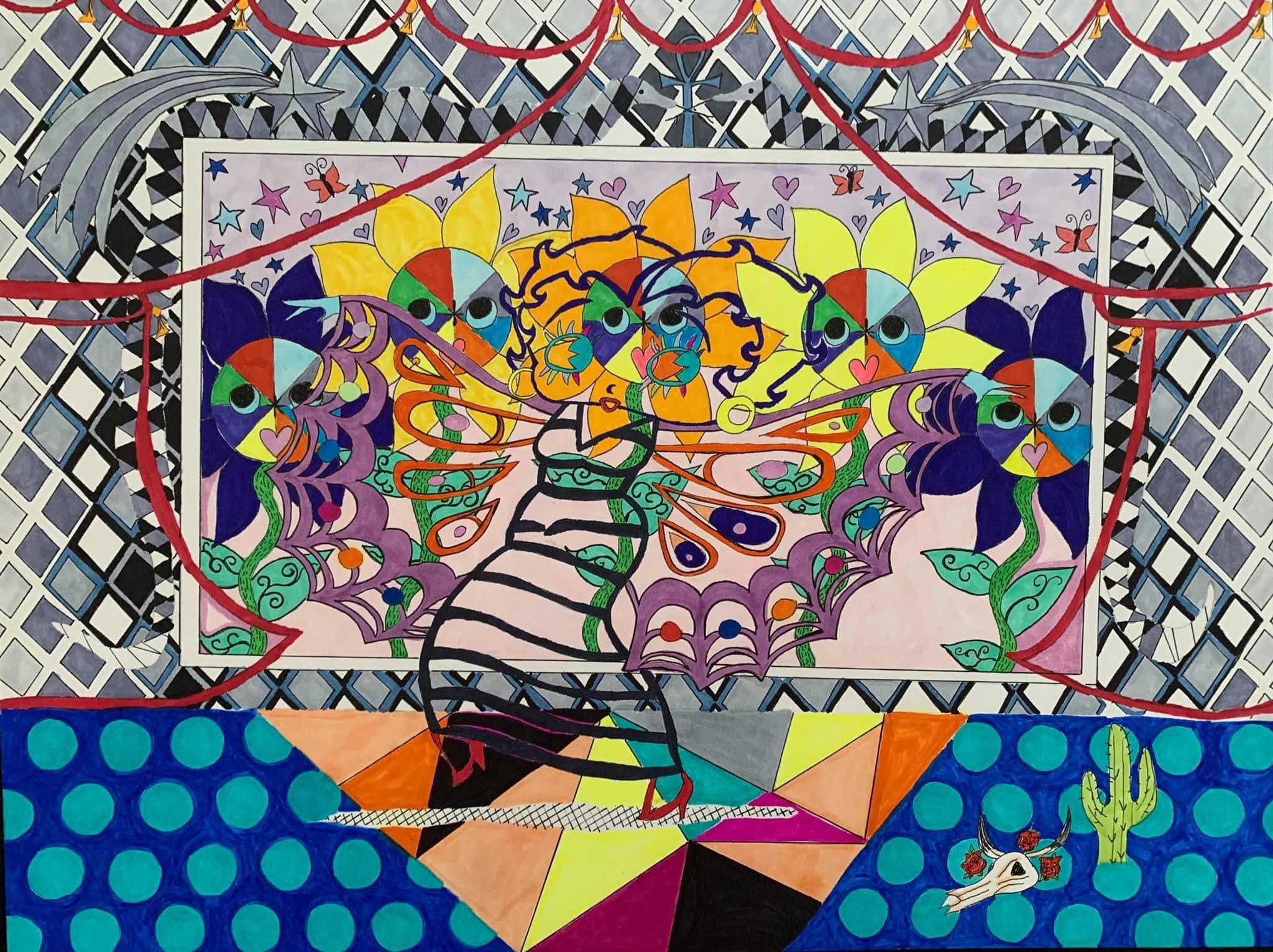
Team Boop - Raven Servellon
Bananas
-Greg Lehman
Bananas
was the light-hearted, accurate, and woefully, horrifically prophetic term
that my twin brother used to bookend the findings
that my AI monopoly,
the large-language
podium-topper,
Crux-Oh,
was heating the planet by intent, no incidental effect
about it, the miracle I owned was burning
its birthplace, inciting
inundation
by
design,
and this, the first
of what my twin called
“two miracles, just wait until
you hear the second,”
he had me,
and the second
would undo me,
fix everything
in its way,
all that us tech bros,
venture conquistadors,
and benevolence brokers
can and will worship
in our angel investors
and canonical stockholders,
the way, the truth, and our light
in these, the true gods,
in these, our
last days,
but my twin,
my beloved brother,
saw me acting like
I was surprised
as he laid out
his data
me, donning wide eyes
like I was not directly in league
with the numbers hovering
in a hologram
like broken
rubies,
red deltas
sharp with results,
projections opening
wide, wider, and
still
wider
from the quicksilver bead
behind his right wrist
where he sat
across
from me
in the clear chamber,
silent
and soundproof
while hiding none of the rage
of the typhoon on the jungle
atop Mount Nekreli
in the Swyndalian Keys,
my islands, my keys
capped by my compound
and crowned with a catwalk
around the bungalow at the height
of my kingdom and command center,
the heart of the processing plant
for the AI behemoth
that I thought,
really,
actually
convinced myself
that I
owned,
even in those
final moments,
my twin’s eyes
bright and waiting
above numbers
and networks
spelled
in leverage
as consistent
as they were
irrefutable
over the table
between us,
the point of the stem
of the single, enormous
banana tree leaf
that I’d given him to wear
as a hat
directed
right
at
me,
deep green
and sharp,
the angle
sharpening a frown
as he said it
again:
“Absolutely,
irredeemably
bananas,”
swiping away the hologram
as I shook my head,
my own banana-leaf hat
sweeping solemnly
as I shook my head,
“Extraordinary work,”
I said, “Beyond
bulletproof,”
“It’s the gambler’s fallacy,”
he said, “by a frog
that knows,
full well,
that the pot
is already hot,
“And keeps
getting
hotter,
“But,
this pot
keeps paying you more
every quarter,
“It just
needs a little more storage,
more coolant,
more computing,
“And
all of it
keeps
selling,
“Selling,
“Selling.”
I snorted,
laughed.
My brother
didn’t laugh.
“I’m sorry,” I said. “I mean, look at me. I feel bad.”
“You should,” he said. “Crux-Oh is the biggest and the worst. Without question.
“But, look,” he said,
“few
get to make their worst
right.
“You can.
Right now.”
I nodded.
“I didn’t think
I could love you
any more than I do,
and
here we are.”
“I love you, too,” he said,
looking me
right in the eye,
nothing wavering
or ingenuine anywhere close
to my twin,
so much so
that I itched my eye
without cause,
dropped
my gaze,
and thanked fate
that he had come to me
alone,
that it was
just him
and I
at the top
of my island,
“Really, really
tremendous work”
I said, straightening
in my seat, breathing
slow, calming my
heart
rate
for
what
had to
come next,
“And I’m honored
to be among the first people
you’ve shared this with.”
“Oh, you’re the first,”
he said. “You’re my brother,
and you own the river
these piranhas
are growing in.
“You can dam it,
drain it.”
“Be a bigger
piranha,”
I said.
He
looked at me.
I made knives
of my eyes,
grinned.
He guffawed,
stomped a foot,
and clapped once.
“Oh, that’s great,”
he said, “Wow,
I can see it.
It’s all I see now.”
“Finally,”
I said.
“Ah, well,”
he shrugged,”
know me,”
he smiled, always
saw so much
and missed
more,
I did, too,
I loved him, this
wasn’t easy.
“I do,” I said.
“Seriously, though.
You haven’t told
anyone else
about this?”
“Nope.”
“All right.”
I let
the moment
sit,
then
let it drown
in the silence
of the chamber.
The storm pounded
everything we could see
outside the tube,
the rain warring
with itself
in sheets,
whipping
trees, maelstrom in
full force
on the forest,
soundless
havoc
filling
the space,
then,
a shade
of a frown
touched
my twin’s eye,
stayed,
creased,
almost
closed,
and
widened
as the tempest
on my mountain
lost all bearing,
shrinking, falling
away entirely beneath
a sad sort of smile
I made,
I shrugged
with my eyebrows,
sighed
through my nose
like an apology, but,
not quite.
He said
my name.
I leaned
forward,
put
one hand
on the table.
“Wait,”
he said.
I was stronger
and faster
than him,
without
a doubt.
But
I wouldn’t have been able
to take down two
at once.
Moments later, I told
Crux-Oh to take us down,
the voice of a weathered sage
answering, telling me, “Yes, well done,”
as the noiseless uproar of the jungle slid upward,
the floor hiding the trees as I watched where I stood
with my brother on the ground behind me, and I told Crux-Oh
that he needed to be cared for with the upmost of care, but had to stay
here, never leave, ever, and Crux-Oh said it understood, which of course it did,
it understood everything I knew and much more, the interface just made it easier,
the voice it spoke in by request, too, especially as we came to the conclusion,
as my brother had just found out too late, that a flood was fair, humanity
had done enough wrong, and to restart things how they should be
with nuclear fallout held drawbacks of half-lives measured by
thousands of years, mutations amuck, and troubling
possibilities around survivors that could find and
stop me, Crux-Oh thought of everything, and
I was glad it caught how a pandemic
by bacterial or viral means was
too prone to make a world
of its own, an evolution
not mine, not wanting exactly
what I’d want, so, heating was best,
literally polarizing geography, identity politics,
hillocks, mountains of money, so much money, and
practical, no-nonsense destruction, yes, this was how one
makes Earth their own, Crux-Oh and I, and a select few
hidden and aligned and in league from every other
AI titan, roasting and quaking with massive
processors at work, prepping
what no one knew but
us, and my twin,
god, my
brother, my
poor brother, I thought,
the floor rushing past us, what timing,
I prayed in gratitude again as the levels below the bungalow
were traded for colossal coolant silos, rising like eyeless blue whales
on the verge of breaching, brooding with scalding hot hazes that each worked
to abate, their bulks forming an underground city around Crux-Oh’s metropolis of glittering
processors and temperatures kept short of uncontainable, cooking
the air channeled up by Crux-Oh and I, a sight that I always loved
seeing, but loved just a little less standing with my twin
at my feet behind me, falling further, threading
the red of this world under the world,
my new Earth churning up
through the old, pulsing
like the heart of a god
getting ready
to pounce
in the Swyndalian
Keys, rife with forests,
a beautiful place my twin
had loved visiting, and had
pointed out when he met me
in the bungalow, hugged me,
held me, smiled and said
we had much to discuss,
the two wonders, foremost,
but, “Brother, this place
is the last bastion
for the latest descendant of bananas?”
“I do,” I said, smiling
in a way that said,
though I knew,
I welcomed everything
he was excited to tell me,
“Well, technically,
not the original
banana,” he said,
“That’s up there
with the Lycorhinus,
the Levuana moth, and
the lions, but the banana,
our most recent phenotype
is hardy enough to out-
maneuver our climate,
scarcity, pervasive
plastics, and is
one of the few
species of
vegetation
left to grow
unassisted,”
“Technically a berry, yes?”
“Yes,” he said, smiling,
“and, as I understand it,
denser with protein, carbs,
potassium, and satiety
than any before,”
I nodded, grinning,
as I handed him
his banana leaf hat,
thread through with a shoe string
like the one I tied on for myself
as we sat down
to talk,
everything
about the banana
that I knew and he told me
was good,
and good
they could float, too,
the new world
would have to build much
on the water,
almost everything,
would strength
and energy,
protein
and carbs,
after what we,
Crux-Oh
and I
had to do,
after
what was
lost, was needed
to be lost,
and
needed
rebuilding
by me,
by us,
Crux-Oh
and I,
and could
have been great,
maybe,
and the chamber
was about to make its last stop
at the cell where I would keep my twin
safe and away from everything as we re-
made everything, but
then, Crux-Oh
said,
“Watch
out,”
and my twin was so fast
I felt the pinch after
my right knee
gave out, took me
down, nearly severed
the nerve where he knew
just where
to get me
right before he landed
two strikes, my blood
replacing most of what
I could see, cut through
with stars and the beams
of red light on the inside of
the tube taking everything else
but my brother’s arms holding me
up, not letting my head hit the ground,
then pleaded, begged for me to stop Crux-Oh,
“Otherwise,” he said,
dipped a shoulder,
got a hand
in his pocket,
then lifted,
of all things,
a banana,
smushed, peel
blackened, dripping
white guts, an odd helix
as wide as his palm
between
the peel
and his skin,
a thorny wreathe,
glittering and sharp,
pewter-esque, intricate, yet
vague in shape, the circumference
shifting like light about to go dark, or
turn on, a halo halfway between
a steel crown and nothing,
flickering a gentle aurora
out and around his hand
and the broken,
dandelion skin
of the banana,
vibrating as it did
in a laurel of energy
like a riding glove made
of warm butter in a pan, popping,
quivering,
ready,
awaiting
an order,
which
it was, “My
second miracle,”
my twin explained:
“the NuCRISPR Plus+
Boundless Expansion Pack
with a Chrono-Condensing
Nano Coil Array,
“Christ’s
12 loaves
and 2 fishes
made manifest
in start-up tech,
“The project
of my life,”
I knew it,
I fucking knew it,
he’d pitched it plenty, sweetheart
that he was,
applied genetics
on a turbocharged time loop,
unreasonable, at best,
impossible on paper,
but
no one
would be hungry
again,
I encouraged him
like you do
with someone you love
setting roots in whatever
inordinate dream
helps them grow,
makes them happy,
and,
apparently,
took a lot of time
and research
and honing of the subatomic exceptions
one makes with science or magic
at its best,
or
most
effective, or
deadliest,
and
the fucker
actually
did it,
“Open
the tube,”
he said, “There are
worse ways to die
than being crushed
by bananas,
“But,
please,
“We can fix this,
all of it.”
He was right,
and after I told
Crux-Oh to take us
back up,
and the tunnel
rocketed through ruddy
to cylindric forestry
back to tropical forestry, back
where we started, the storm
still there,
the wind
howling as I opened
the clear casing
to the elements,
“Here,”
I said,
“You won,”
and he breathed,
I could hear his relief,
a sigh bigger still
than the weather’s distemper,
then,
he saw me
flex back,
getting
ready,
and his disbelief
was total,
mystified,
but
sadder
than any look
I’ve ever seen,
and now
will ever see,
my twin
almost flattening me
to see
who I was,
who I am
before I killed him,
I grabbed the wreathe
and the banana,
but,
of course,
he was smarter than me,
hinged the code
on his heartbeat,
now,
gone,
the berry
burst forth,
fountained out
from the one banana
in his hand, the boosters
on time and stem-flowering-bud-
double-row-flowers-to-golden-fingers
(sans tree) that my twin had set to explode
out from his miracle of a device,
cascading bunches in mustard
and medallion, bubbling forth
the fruits of a better labor
than mine at great speed,
tumbling, burying the best man
I’ve known as the mass overwhelmed
the ground at my feet within seconds, the storm
still at full bore as waves of canary and gold rose into a wave,
a tsunami, a tide falling over itself in skins like bent sunbeams I fled,
sprinted, all but fell down my mountain
as I called over my shoulder
to Crux-Oh,
which,
of course,
could do nothing
but codify, condense,
copy, heat the world,
and repeat, defeat
foregone by
my twin,
nova
versus
the match head
I struck, counted on
for what I wanted to remake
and needed nothing short of wild
disassembly, I see it, now, a brightness
impossible to ignore, the glare hard on the eyes
where I live now, wrestle with this in a file I write in a
hologram floating above my own bead, the battery life
will run out, as will this layer I sit on, floating on berths
of off-kilter bunches like the softest mountains
imaginable, white and saffron, chartreuse,
and citrine given to one yellow tide
over another, smothered
in heaps that will
out-size every
continent,
which,
is better:
nothing
but
bananas
and me, alone,
who could I face,
thinking this was
going to be worth
killing my brother,
I see it
from
up
here,
a here
rising higher
as more bananas
keep spawning, push
perspective on oceans
that are only so much water
between flowering bodies, skins
and flesh enacting this growing girth
of radiance meeting daylight, moonlight,
my twin’s curse of flowering expanding by
the hour, and will push past the atmosphere
in due time past mine, past everyone’s, whoever
else is left on this planet and has to see this with me
and won’t for much longer, we can’t live on this, aglow
under great heat scaling higher, Sol bringing the surface
to steam around my brother’s bananas, I don’t know how
many days it’s been, if the measure of losing track of time
is observing what can’t be but I believe is his spirit moving
over the face of the waters like gold won and smothered
everything that could find value in gold, laid claim to
the horizon lines in every direction, taming even the
tides, the surface untroubled under vast ranges of
bananas, locked under this harvest unhinged,
perfect mayhem, an awful congealing that, I
see it now, is a wound healing, copies
building on themselves until what isn’t
bananas is out done, overwhelmed, made
small under the more layers of bananas too heavy
to carry the bananas above them, smashing each other
open, getting harder, densifying, coagulating with the soft
kneading in of gravity doing its work that will harden more and
more bananas in time in piles that will reach outer space in more time,
and what better to leave than a burying of the thaumaturgy we tried to inherit
and I let loose and just ended up being solely, ridiculously, overwhelmingly, absurdly
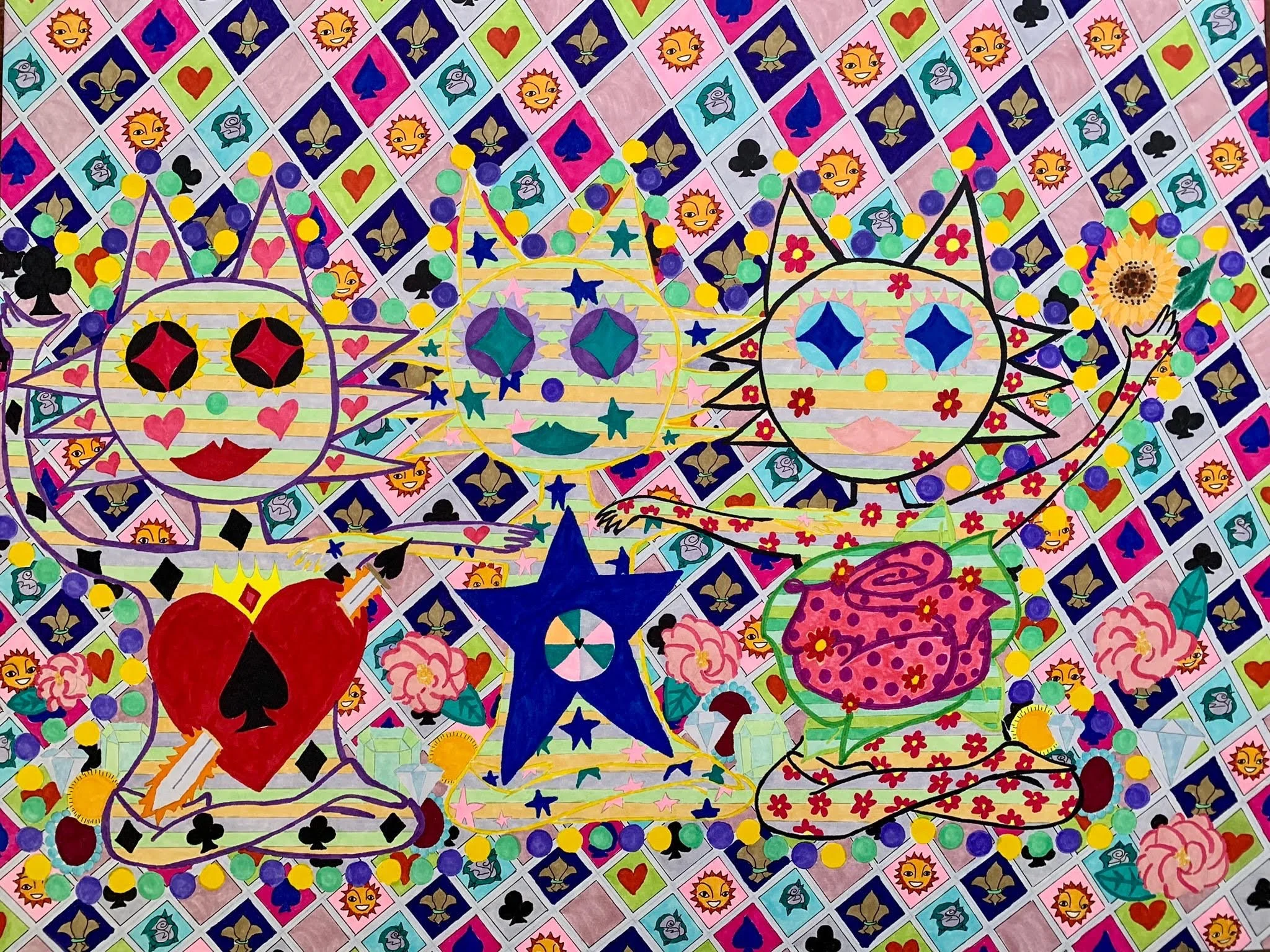
The Revellers - Raven Servellon
Contributors
-

Bianca Ambrosino
Bianca Ambrosino is a somewhat reclusive poet from Richmond, Virginia. Her unique, Autistic perspective illuminates universal themes with startling connections and vivid synesthesia.
She spends her time writing, walking outdoors, raising her children, and reading countless academic papers/ scientific publications (for fun).
-
Carlos Castillo
Carlos Castillo studied English literature and creative writing at the University of Santo Tomas, in the Republic of the Philippines. He published poetry and fiction while in college. He is presently a speech and policy writer for the Philippine Department of Agriculture.
-
Rozanne Charbonneau
Rozanne Charbonneau was born in Texas but has lived most of her life in Switzerland and Italy. She has an MFA in screenwriting, blogs about food and memories, and now writes short stories. Two of her stories have been nominated for a Pushcart Prize.
-
Gianmaria Franchini
Gianmaria Franchini is an Italian-American writer born in San Francisco, CA. He holds an MFA in Writing from the University of San Francisco and is currently completing a poetry collection, Marzamemi, about traveling from Palermo to Milan. His work reflects a life spent between cultures and landscapes, from Italian coasts to California shores. He is also a travel writer exploring the culture, people, and stories that shape life in Italy and the United States.
-

Gabriella Garofalo
Born in Italy some decades ago, Gabriella Garofalo fell in love with the English language at six, started writing poems (in Italian) at six and is the author of these books “Lo sguardo di Orfeo”; “L’inverno di vetro”; “Di altre stelle polari”; “Casa di erba”; “Blue Branches”; “A Blue Soul”, “After The Blue Rush”.
-
Brooklynn Golinvaux
Brooklynn Golinvaux is a painter and poet born and raised in Minneapolis Minnesota. Golinvaux studied at Sarah Lawrence College and graduated with a Bachelor of Arts in 2023. She currently lives and works in New York City. Through the process of layering materials like plaster, clay, acrylic paint, and poetry Golinvaux's artistry is a ritual of rampage and release. Her work aims to unravel the secrets held inside the body, exploring stories of deepest pain, tenderness and utter rage speaking the unspeakable and creating a space for it to exist through poetry and paint.
-

William Greenfield
William Greenfield is the author of four books of poetry: “Momma’s Boy Gone Bad” (Finishing Line Press), “I Should Have Asked the Blind Girl to Dance” (Flutter Press), “The Circadian Fallacy.” (Kelsay Book) and “The Ever Shrinking Universe” (Broadstone Books).His poems have also appeared in dozens of journals, including The Westchester Review, The American Journal of Poetry and many others. He lives in Liberty, New York with his wife, son, and a dog, always a dog.
-
Sam Hendrian
Sam Hendrian is a Los Angeles-based filmmaker, poet, and playwright striving to foster empathy through art. From writing personalized poems for passersby outside of LA's oldest independent bookstore every Sunday, to making Chaplin-esque silent films about loneliness and human connection once a month, Sam lives to make other people feel seen and validated. More poems and films can be found on Instagram at @samhendrian143.
-
Eric Huff
Eric Huff is a poet and public-school teacher living and working in the west metro area of the Twin Cities. His poetry has appeared or is forthcoming in publications such as 1913: A Journal of Forms, Rockvale Review, Curator Magazine, In The Sky She Floats, and The Forge Zine.
-
Greg Lehman
Greg Lehman earned an MFA in creative writing from Lindenwood University and a BA in journalism from California State University at Fullerton. He has published and edited as a poet, professional writer and journalist, and his poetry has appeared in the Moon Tide Press’ Poet of the Month feature series in June 2025, “Like the Wind Magazine,” "Dark Winter Lit,” and “Book of Matches,” among others. He lives in Los Angeles, California, and all are welcome to follow his Substack “@gregwriting Substack,” Instagram @bestcoastgreg and/or @gregwriting, and his personal website loudowl.org. His ongoing video interview series “Moon Beams” is viewable at all the above, as well as on YouTube.
-

G. W. McClary
G. W. McClary is a native of Ohio with a B.A. in literature and founder of The Storycraft Co-op. His stories have appeared in Nova Literary-Arts Magazine, The Haunted Portal, Razzle Dazzle Cafe, and elsewhere. You can keep up with his new releases on Instagram: @gwmcclary
-
Hazel McCorriston
Hazel McCorriston is based in London and writes fiction and creative essays. Her short fiction has been featured in Between the Lines Anthology, and she has been accepted onto a novel-writing course with Curtis Brown Creative. Her work considers how our sense of home informs who we are, and how creativity comes from our immediate experience of the world - themes which continue to pervade this piece. She has a degree in English Literature and a Master’s degree in Psychology. More of her work can be found on her Medium platform: https://medium.com/@HazelMcCorriston
-

Roberto Ontiveros
Roberto Ontiveros is a fiction writer, artist, and journalist. Some of his work has appeared in the Threepenny Review, the Baffler, AGNI and the Believer. His debut collection, The Fight for Space, was published by Stephen F. Austin State University Press, and his second book, Assisted Living, was published by Corona/Samizdat Press.
-
Priya Parikh
Priya Parikh is a writer whose work explores attention, longing, and the fragile, rusted boundary between inner and outer life. She is interested in witnessing the flip-coin occurrence between a destructive and creative act.
-

S.J Sangeetha
S.J Sangeetha is a writer cum civil engineer from Thiruvananthapuram, Kerala, India. She has published 4 books, 3 poetry collections, and a short story collection. She is a flourishing writer. She has been recognized for her unique way of writing. She has secured awards for her works and regional competitions.
-
Raven Servellon
Raven Servellon is an established artist originating from New Orleans and Los Angeles, with shows primarily in LA and London. She is known for her hand drawn intricate creations of colours, layers, depth and style creating what she describes as 'Optrickal Delusions'. "Psychedelic fem-pop ink drawings" as described by LA Times. "Her happy-go-lucky works are fierce, screaming with bold color and confidence; they’re about nothing if not female empowerment." A master of her craft, Raven's works evoke those of Kusama, Escher and Dali. On her free time she practices dream analysis, reading science periodicals and photography.
Visit ravenservellon.com and IG: ravenservellon.art for more
for Dream analysis - https://substack.com/@ravenservellon
-
Lucien R. Starchild
Lucien R. Starchild is an enigmatic poet/writer and cosmic dreamer, weaving tales that blur the line between reality and the surreal. Born under a wandering star, he draws inspiration from forgotten myths, celestial whispers and the hidden magic of everyday life. With a pen dipped in stardust, Lucien invites readers to lose themselves in worlds both strange and hauntingly familiar.
-

Doug Tanoury
Doug Tanoury been writing and publishing poetry all of his adult life. Doug has published over 20 chapbooks of poetry, including: Merida Poems, Cloud Boulevard and Imperfect Venus.
He has strong opinions about poems in particular and poetry in general, but he will spare you dear reader his strongly held beliefs and let his poems speak for themselves and communicate his views of this craft. Doug lives in Detroit with his girlfriend Michelle and a French bulldog named Capone.