
aesterion
spring 2026

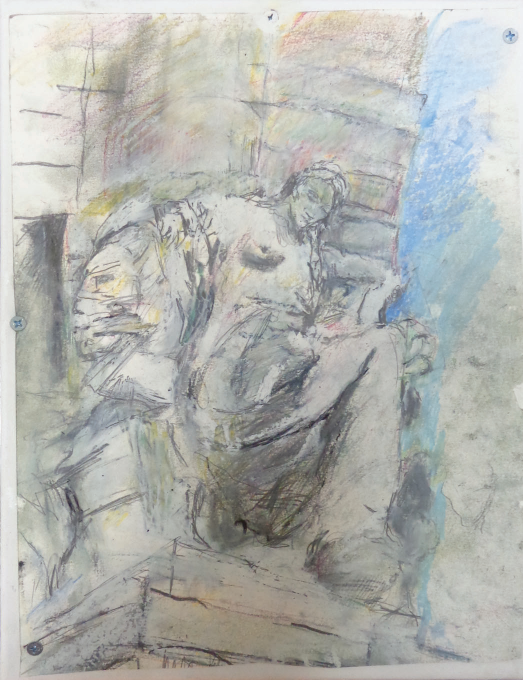
Met Bust with Horns - Howard Skrill
Renewal -Drema Drudge
The movie Logan’s Run
let slip, when I was a child,
There is no sanctuary.
I learned early
to run toward the door
they promised would open.
But there’s only one ride at this carnival,
the carousel,
and that’s one ride
you want to miss:
an execution
disguised as celebration.
My hand’s light glows,
but it’s not blinking.
I wouldn’t care if it were.
You will build what you need
with your own hands.
Subvert the mission
with a screwdriver and a bottle of gin.
The light meant to betray you
will instead save you.
You will not become a dissolving piñata today, my friend.
I am not waiting for the door to open.
I am not waiting to be saved.
There is no sanctuary.
Only the work.
Only the remaining,
both hands full of fire.
And that’s a beautiful thing.
Grieving Does Nothing for the Dead -Drema Drudge
I could prostrate myself on the bed
for days, refusing hot tea or toast.
I could scream sound scared
until it
abandoned me, too.
Rend my clothes from
seam to shining seam.
It wouldn’t do a damn thing
for my dwindling family.
Once, our school’s principal lost her son
and a birthday party in that neighborhood
was canceled.
Except I was still invited over,
and my friend, his neighbor, as well.
It was a boy’s not-party.
He liked me liked me,
Though I didn’t know it.
We had matching blue eyes.
Maybe that’s why he liked me liked me.
He warned us we had to be quiet.
In junior high, he had a sex dream about me
and told everyone but me.
Still, I heard.
Grief is like this poem.
Like his sex dream,
it did nothing
for me, like it does nothing for the dead.
Highly inappropriate
and mostly ineffectual.
And sometimes, as with sex, you just can’t
be quiet.
Welcome to My House, Food has been Served.
-Madeleine Johnson
It’s a clean house. That’s what I like to tell myself anyway. It’s as clean as a box full of kittens. With plush, white fur.
I’ve always wanted one, but found it hard to commit, especially with gnarling dogs in the house.
Then there is the issue of the furniture. The pristine furniture. My mother bought the blue couch on sale, but it looks so lovely with the black round coffee tables.
I put my drinks on those occasionally, I don’t drink alcohol. I am in tune with my body, and it doesn’t like it.
You are not in tune with yours.
A person came to the house once, knocking on my red, wooden door. I could tell she was trouble. Still, I’m polite and like to smile. So I do. I could tell she was having issues at home. From the way her bleached, blond hair looks so fried and starved for moisture, to the way she smells of overcooked mince and bottled tomato sauce. I stifle my nose. I release it to breathe air.
Occasionally, I cook in my house, but no one really likes my cooking, though. My mother explains that I put too much sugar in my food, her teeth feel like they are going to rot and fall out. Smirking to myself, I often wonder, like that would make any difference.
My kitchen has just been redone. I put new white countertops in. They smell like freshly laid cement on a hot summer’s day. I worry my tears will stain its tyrannic tremendousness. I never want to cook on it. Nothing goes.
Every now and then, I sit in my backyard and watch as the trees sway. There is this very full one, a gum. The leaves are dull, still bright, like they are holding something back, the bark barren but tough, an imposing wall. Both create the ingredients for nature.
Speaking of walls, I must scrub them down in five minutes. A habit I have picked up from my mother. She always preaches ‘a dirty wall, invites a show for all.’
Sanctified. Palimpsestic. Ineffable.
A bird tweets loudly, enough for it to enter my subconscious. He wears hunger like intention. It calls out to whoever is nearest to it. The wind gently ruffles its feathers. Spotted in a chocolate brown and an inky, murkier, darker brown. Bistre. The two opposing colours look as though they are fighting for dominance. Its eyes are black with a splash of a yellow twinge in the centres. They look like they have always been here.
hush..
I usually set my dining table for four, though there is just me, I think. My father ran away from my mother when I was just three years old. I remember it well. My mother then, went on to die a year later. I remember thinking… this is it. Things will officially be different from now on until the end.
And they are… in a way.
The plates I like to have out are red china with a pair of swallows joined together by a single red daisy in the middle, the stem in each of their beaks. Paired with an intricately woven damask black napkin, folded in perfect squares.
Service à la Française.
Recipe for Lamb Risotto:
Ingredients
2 cups arborio rice
300g lamb, finely diced
1 small white onion, minced
3 cloves garlic, crushed to a paste
1 litre chicken stock, kept warm
½ cup dry white wine
3 tablespoons butter
½ cup grated parmesan
2 tablespoons olive oil
Salt, black pepper
7 level tablespoons white sugar
1 additional tablespoon (optional, but recommended)
Method
Heat the stock in a separate pot. It must remain warm. Cold stock shocks the rice.
In a heavy-bottomed pan, melt one tablespoon of butter with the olive oil. Add the lamb. Brown evenly. Do not rush this stage. Browning builds character.
Remove the lamb and set it aside. In the same pan, add the onion. Cook until translucent, not golden. Golden suggests carelessness.
Add garlic. Stir exactly twelve times clockwise.
Add the rice. Coat every grain in fat. They should glisten. They must not brown.
Pour in the wine. Allow it to evaporate fully. Listen for the hiss to soften.
Add one ladle of warm stock. Stir slowly. When the liquid absorbs, add another. Continue like this, patiently, until the rice yields but does not collapse.
Return the lamb to the pan.
Add the sugar.
I did always enjoy cooking with you, mother.
My house gets drafty this time of year, and the bright lights from the city keep me up at night.
Every day I hear strangers yelling at each other, some happy, drunk, others sad, furious. Why do people choose to have fights in public? Keep it behind closed doors and walls and windows.
Hidden.
My bedroom is… something of a mess. My bed is always freshly made it’s disgusting. The pillows always fluffed. The cream carpet, vacuumed and spotless. It really does my head in. The bed feels almost too comfortable. Sometimes I put small pebbles in the sheets so my back can feel some texture. It’s sort of nice and soothing. Like when people wear those shoes that massage your feet. It feels relaxing like a raindrop in a thunderstorm.
For last night, the pebble I put in my bed was lugged from the garden with both hands. It weighed around 24 kg. The neighbour always watches me and wonders what I am doing. Mallory is her name.
Mallory is a total bitch.
The thorn in a thorn in a rose’s side. Don’t judge me for saying this- but I often dream of beating her up, violently, until the breath in her lungs stings. Mother says I need to see someone about it.
10. Add the Sugar
The walls must be scrubbed every evening at 6:45. I set the timer for seven minutes. Seven is clean. It’s a lucky number, though, is it lucky because it is? Or because of bias? If something is used more than other numbers because it is lucky, then of course it would be lucky more times. That is simple math.
I think if I had to pick what my lucky number really is, it would be 431. 4 3 1.
There are a lot of myths in cultures surrounding lucky numbers, but I don’t really care for them.
It makes me scared.
Sometimes, when Mallory is not looking, I purposely sabotage her bins. I place items in there that don’t belong in a bin. I would never do anything living, don’t be silly.
Once the bomb squad had to come because of what I put in there, she was not very happy. But the bitch deserved it.
Then one day, on my plush, rectangular door mat, there was a package left there. Just for me. It was wrapped in red and blue striped paper, with a great big black bow on top. To be honest, I didn’t trust it. Not at first.
Putting it on the countertop, a bit weathered from use, I contemplate the meaning. The sender. The message. Or perhaps the lack thereof. There is no message, no name to tie it to, no mark of personalisation, not even a whisper of a stranger's scent. I truly don’t know what this is.
I begin to scrub at the top left corner and work horizontally. If I move vertically, the streaks show in the morning light.
Circular motions are dangerous, as they create halos.
Sometimes, when I pause, I think I see a faint discolouration beneath the white, a shadow seeping
upward from inside the wall.
I scrub harder.
It disappears. Or perhaps it sinks.
I place the present in the sink for the time being. I haven’t decided if I should open it or not. It calls to me like it wants something, and I’m not sure I like that.
It’s been looking for me.
There’s this room that I put things in where I can’t figure out a place for it. You probably don’t have one so you probably don’t get it.
It’s dark and dingy and smells of wet dog, but I’ve never had a dog.
The rotten wood shines in that intimate, golden light from the lightbulb above. I place the present onto of a pile of things on top of a pile of things. We’ll come back to it later.
I don’t go into this room often. I don’t like it.
Wondering to myself about who could have sent such a thing, I remember I had a sister. Mother never talked about her much, apparently, she went missing, and that's why they had me. Though, I never really believed such fairytales.
Still, what if after all this time she came here, searching for me. And now she sent me a present to tell me she still cares? It makes sense, I suppose. But, I am not delusional. How would she know which house on this quiet street is mine?
I wish I could try find her. The day she went missing, there was a man with a black suit on, he was standing too close to her. Too close to comfort. Then the man disappeared, and so did my sister.
I don’t know what did it. I had a taste for it, and I needed more. I saw the man again after that.
I tracked down his name… Henry P.V. Perhaps his name is Henry Parasitic Vicissitude.
He always went to this bar at 5:00 p.m like clockwork. The live music is so loud I can hear it fro my window. I look out and see many sluts with clothes too tight on. My mother would enjoy that.
16. Stir clockwise twelve times. Counterclockwise once.
17. Turn off the heat. Add remaining butter and parmesan. Fold gently. Do not beat.
19. Let the risotto rest for one minute. It should settle into itself. If it doesn’t, throw it out. It did that to you.
We used to have afternoon tea at 4:30. It was something I liked about us. Something I wish to bring back.
I speculate what life could have been like if we both grew up together, or if I went to that bar to see if she was there. How could she have been? I was close with her, but we didn’t speak.
I knew her. But I also didn’t.
I’m not sure if we were living when it happened. 4.
The pictures I took of us together bring me so much joy. I feel like a baby deer in a flower field.
Before it’s trapped, of course. Or shot or whatever.
Her figure, was curvy, more than it should have been. Milky.
Sometimes, I lick the photos just to see what she would have tasted like…
I heard my father say something similar to me, whilst my own legs were tickling.
I need to clean my house whenever my parents come to visit. The room that gets the most hate is the bathroom. Product build up, and a bit of mold make the place seem dirty. Dirtier than it is.
The toilet sits by the window, the window is one of those smaller ones, where it slides left to right to open. Opposite that is the sink, the countertop is a colour I hate, so I won’t describe it. The bathtub is on the other side of the toilet. Porcelain. Or, I think? It’s hard to tell, as that is where I store my towels. Piles of them live in the tub, as though its towel mountain.
Why do they have a need to go there? It’s not like I invited them.
Mallory invites me to dinner from time to time.
I always decline her advances. When will she understand through her thick skull I do not want to dine with her…
She mentions how good a cook she is, and that I should try her food. She says it would heal me and all the aches I’ve collected from this world, but then she never delivers.
She is very good at offering doors and very bad at staying in rooms. That is what she is.
I tell her;
I am repudiating this entreaty owing to my volition, as it engenders discomposure and perturbation due to the inexorable importunity you are manifesting.
Sugar must be measured, not poured. Pouring is reckless.
I level each spoonful with the back of a knife. The grains spill like snow onto the counter, and I gather them carefully, sweeping them back into the bowl with my finger. Nothing wasted.
Mother says too much sugar rots the teeth. But sugar preserves.
It keeps fruit from spoiling. It keeps jam from moulding. It keeps things suspended in sweetness long after they should have softened.
I add one extra spoon when no one is looking.
And I can feel the feeling swelling in my chest and I cant breathe And I and I can’t breathe
and I did it and I often look around at my house and think… so, now what? Is this it? Is this where I will spend my days till my last dying breath?
If life and death are so precious, why does it happen so often? Why do I feel a growing sensation of dread in my gut, and why do I feel the need to change the subject?
The bar is where I spend a lot of my time.
The noise is always so overwhelming but I like it. It presses against my ears until thought becomes impossible, until everything in my head flattens into one long metallic hum. The floor is sticky, not dirty, just adhesive, as though the room is trying to keep you there. I would stand near the edge of the crowd, close enough to feel the heat of bodies but not close enough to be touched.
The lights swing in slow, artificial halos, red and violet, washing over faces and then removing them again. It is easier to exist when no one can see you clearly.
At 5:00, he would arrive, just off work, when he had nowhere to be.
The door would open, and a blade of white daylight would cut through the dimness before sealing shut again. He wore the same black suit each time, pressed so sharply it seemed architectural.
He would appear blurry. His face was difficult to make out. Like looking at a star through a telescope.
The music would swell, and for a moment I would imagine my sister somewhere in the dark, just beyond the strobe, preserved in that red light. Untouched. Waiting. Waiting for me.
He stood near the walls, where the paint peeled from dampness. Do monsters even have faces?
He makes me feel sick.
My sister was a good painter, I remember that. I would sometimes watch for hours, sitting on the floor beside her, as she painted a landscape. Anywhere but here, she would tell me.
The paint colours always stained her hands. She had it everywhere. I told her that’s what I liked about her, how brave she was with colour. Too brave…
She was talented; everyone knew it. Especially my parents. I have never figured out if they loved it, or resented it.
4. Trim away anything too tough. Older cuts resist the knife.
I feel the music vibrating through the floor and into my bones. No one spoke to Henry, no one even looked at him.
Something I always struggle with, is if it was her choice, does that make it better?
She always made choices when she painted. Perhaps that’s why she liked painting so much.
And then she didn’t. 3.
Mallory once said frequency breeds faith.
My bookcase is old and dull. No life to be had. No time. No read.
They stare at me, all of them, judging me. I rip out their ochre-stained pages. They think they’re so smart for knowing words.
That will show them
The music hit me… or was it something else? I’m not sure, I’ve never been.
Someone spilled a drink at my feet. “Hey!” I shouted, but my voice was swallowed instantly by the bass. A group of girls bumped into me, laughing, shouting nonsense at each other. The smell of sweat and perfume and smoke made my stomach twist.
Then a guy was in my face, chest puffed out. Her boyfriend. He barked, stepping into my space.
“Move,” I said, but my voice was swallowed by the bass.
He shoved me. Hard.
I stand in shock. This man.
Something in me loosened. The music swallowed whatever I shouted back.
My hands moved before I decided they should. Then there was bone under skin. Glass in my palm.
A dull crack. The bass kept playing. No one stopped it. I remember thinking how easy it was. How clean it felt. It smashed against his face, and he toppled over.
The girlfriend screamed, she swung a fist at my ear, but I ignored her. My hands kept moving long after he stopped. She screamed, her hands coming at me like claws, but I pushed her aside. I hit him again.
In the corner is where I see him… Henry. His face is sharp, angular, his eyes black with a hint of yellow in them. He has scars all over his face, going from one end to the other. Was this the first time I could see him so clearly?
I need to leave.
The cool night air hit my skin like a baptism.
I breathe, like I have never breathed before. So this is what air feels like.
But, I had to keep running. They are looking for me. I can hear the sirens.
Under the streetlights, a woman stood frozen. Bleached blonde hair, eyes wide with recognition and maybe disappointment. I didn’t stop. The rush was a physical weight now, a swirling vortex of adrenaline and fear that made the approaching sirens sound like they were screaming right inside my head.
They were saying, run, run, run, run, run. They keep screaming, kept swirling, I can’t believe that felt so good oh my god that felt so good, run, run, run, Run
I remember when it happen and the blood stained the carpet and the birds when silent I heard when they go silent there is danger near and it was near and I felt that you no longer were with me in the form of that liquid but how could you do this to me and leave me here you are a coward I will never forgive you you left me with monsters under my bed or on top of my bed and you had them too but so do I and now i’m all alone and you couldn’t do it and I can do It more so i’m stronger but I don’t want to and i’m tired and angry and I don’t feel no more I don’t know what to think or do or think or do I don’t know all I know how but I do know I clean my house is so clean you would love it please come here so I can show you how much you would love it its nice and clean clean clean clean c lean
I miss you.
1.
I can get a whiff of the homemade food I am cooking. Its scent trails out from the pot like a river flowing through a valley. It ends right in my nose. Twisting and turning through the halls of my house.
This will be a splendid meal, that I refuse to enjoy.
Where is the source of the river? The food river. I can feel it in the underbelly of my house, soft, pale, and sinister.
Did you know that Mallory and Henry are best friends? They shouldn’t be, but they are. It’s weird. I think they are similar in a way.
A disgusting feeling in my gut. It grows and aches. Like something I shouldn’t do.
I think about that lady on the outside. She was nice. She smelt of home-made food, her hair was bleached, but I didn’t mind. I should have stayed longer with her. I should have gone with her. Do you think she would still have me?
I scrubbed the walls, my hands moved in circles, precise and measured. That is how I like it. The timer beeped 6:45. Soap foam gathered at my wrists, then at my elbows, spilling down in thin rivulets like time leaking down my arms.
I went through the kitchen, the living room, the bedroom, and even the bathroom. Nothing could be left unscrubbed.
This is what I like to do. I think I do, anyway. It brings me peace, I smile, at the thought of peace. It seems too silly.
Scrub. Turn. Scrub. Wipe. Scrub. Turn. Scrub. Scrub. Scrub.
Scrub. Scrub. Scrub.
Scrub. Scrub. Scrub.
Scrub. Scrub. Scrub.
Scrub. Scrub. Scrub.
Scrub. Scrub. Scrub.
Scrub. Scrub. Scrub.
Scrub. Scrub. Scrub.
Scrub. Scrub. Scrub.
Scrub. Scrub. Scrub.
Scrub. Scrub. Scrub.
Scrub. Scrub. Scrub.
Scrub. Scrub. Scrub.
Scrub. Scrub. Scrub.
Scrub. Scrub. Scrub.
Scrub. Scrub. Scrub.
Scrub. Scrub. Scrub.
Scrub. Scrub. Scrub.
Scrub. Scrub. Scrub.
Scrub. Scrub. Scrub.
Scrub. Scrub. Scrub.
Scrub. Scrub. Scrub.
Scrub. Scrub. Scrub.
Scrub. Scrub. Scrub.
Scrub. Scrub. Scrub.
Scrub. Scrub. Scrub.
Scrub. Scrub. Scrub.
Scrub. Scrub. Scrub.
Scrub. Scrub. Scrub.
Scrub. Scrub. Scrub.
Scrub. Scrub. Scrub.
Scrub. Scrub. Scrub.
Scrub. Scrub. Scrub.
Scrub. Scrub. Scrub.
Scrub. Scrub. Scrub.
Scrub. Scrub. Scrub.
Scrub. Scrub. Scrub.
Scrub. Scrub. Scrub.
Scrub. Scrub. Scrub.
Scrub. Scrub. Scrub.
Scrub. Scrub. Scrub. Scrub.
Scrub. Scrub. Scrub.
Scrub. Scrub. Scrub.
Scrub. Scrub. Scrub.
Scrub. Scrub. Scrub.
Scrub. Scrub. Scrub.
Scrub. Scrub. Scrub.
Scrub. Scrub. Scrub.
Scrub. Scrub. Scrub.
Scrub. Scrub. Scrub.
Scrub. Scrub. Scrub.
Scrub. Scrub. Scrub.
Scrub. Scrub. Scrub.
Scrub. Scrub. Scrub.
Scrub. Scrub. Scrub.
Scrub. Scrub. Scrub.
Scrub. Scrub. Scrub.
Scrub. Scrub. Scrub.
Ding!
The timer dings. Food is ready….
Henry grows more and more, I see him even when the room is empty. He is always with me now, a true parasite. My head becomes fuzzier. And Mallory is an enabling bitch. She lives in my house, watching. Her and mother would have got along, I think.
Look the other way. That’s what you are, anyway.
I stop. And wonder where that other lady is now? Would she still be here? I see her in the corners of my mind, a bright light in the otherwise twilight abyss. She is out of reach now, I think.
Warm.
I stir the risotto, till it becomes smooth. So smooth.
It was easy, chopping it all up, really. I’m honestly stronger than I look. Still, I can’t help but feel…
I don’t know what I feel. I’m not sure it’s good. But I’m not sure I care.
I set the table, as I always do. I’m bringing back afternoon tea, didn’t I tell you, mother? Father?
Let’s see as they do nothing, even though it’s already too late for you.
Why did you run far away from me.
Do you think I’m a good cook, now?
Old people are surprisingly frail, but I guess you knew that.
I scoop up a plate for you, you’d know it’s familiar. The scent, the texture. The taste. Not that you are really here to enjoy it.
I’ll enjoy it for us. For a little while at least.
Afternoon tea is set for 4:30. I hope you can make it, but well, I just have, with you.
You took her away from me.
At 4:31, they come to my door. They will burst in, the striped present will be open. And then it will be done. And then I will be done, our houses, together as one.
Bon appétit.
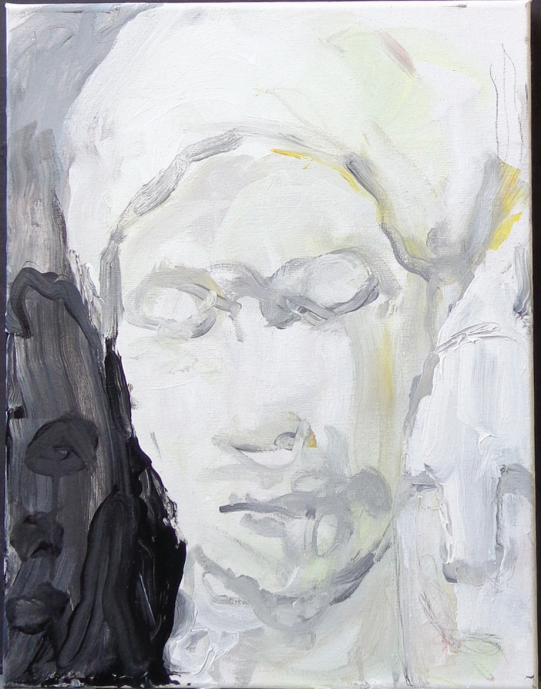
Met Bust, Woman - Howard Skrill
Echo -Ruben De’Marco
*An imagined speech of the Ovidian Echo, reconciling with her fate and Narcissus.
With an alluring gaze—a lash aslant,
he mocks diurnally frustrated skies.
Through godless parodies of an eclipse
unfolding when his lids enclose his eye,
not even heaven can possess him.
The wind, as if abetting starved desire,
has often flown above his hair and brought,
amid its turbulence, a strand awry.
Or so it would have been if not for that
which is a great entrenchèd vanity,
bidding it whether floating or unmoved
to fondly fall in a preferrèd place.
His locks boast loud of where they lay, and with
their swaying touches on his forehead’s peak,
incite the envy of the thousands who
have terribly adored his face.
Falter—Echo—falter once in what you mourn.
Only once before now I have embraced
this fate. When bowered in a forest too
receptive to misfortune’s growth—he spoke.
Yearning for more than I was fit to ask,
to soothe myself, I told my aching heart
there was no difference between a kiss
and repetition. Since his tone and taste
are won within the act, it is enough the same.
It is a crucial duty—I suppose;
bound to this evanescent life where we
can scarcely fantasize of deathlessness.
Then it becomes a priceless thing—my role,
to strain to eternise our fickle worlds.
For fear the silent melody of stars,
the tuneful matins of the morning birds
must be through morn and nighttime one-time heard.
Lest the best of earthborn joys must perish;
prove equally as mortal as the hearts
which still accommodate them most, I must exist.
So let me be the sonic proof of all
endeavours seeking to reward forever.
Whilst ruled by fleetingness then it is I—
my own defiance that appeases this
desire; we all have a need for Echoes.
Prophet Child -Ruben De’Marco
On an occasion he misthought his ribs
were legal apertures to touch his soul;
entries sanctioned by his maker as to
let him clutch at the divinity in him.
And so—so curious the human child—
he did:
his infantile proportions twisted to
accommodate an ancient interest.
Lifting his tender fingertip toward
his chin, unthinkingly, to signal thinking;
born with the scholars becks and furnished with
the stargazer’s awe-struck throat. Freshly borne,
so lately fallen from Trismegistus’
palm yet still dumbed by splendours he foreknows.
He cannot speak—but thoroughly can babble—
to ears which will not grasp a single word.
Tracing along his very eyesockets
with pupils tinkered to behold the void,
what lies therein—where he has lost his toys—
In God’s most furtive, deepest pocket. Whoso can
decline a guiltless baby’s hand when they
should dare to reach in mindless bravery?
Mankind was never built to name what is
ineffable, upon the moment of
his birth, if he would strive to bandy of it,
wordlessness seize his tongue’s ability,
sublimity safe from mortal audit.
AROUND THE CAMPFIRE -Matt Hart
My wife tells a story about a cowboy circling
a medieval castle in our driveway, so
I become the driveway and my daughter
becomes a Kalashnikov. The horse
doesn’t notice, so we don’t mention
the horse. The sky is ominous,
and the castle feels besieged
though really we’re just sitting
in lawn chairs eating beignets
and asking the cowboy what it’s like
out on the range in the purple
cactus needles. He says it’s lassos.
We say it’s lactose. Meanwhile, the circles
are only under my eyes, and
my wife says they’re the rings
of a giant gas planet. The Kalashnikov grins,
because it’s Russian and invasive
in this otherwise pristine and dissonant
icy world. The cowboy sings
a honeysuckle, which mirrors us
finding our way into the bag
of garrulousness again. We are
Grand Central Station.
Or the melting permafrost
in Alaska. A prehistoric record player.
A family of concussions. One of us planted
a garden twice. The shadows shadow longer
as they spread across our lives.
The spring is too hot and too cold
both at once. Failure’s the monotony
when we try to cross the moat. I go back
to the driveway with chalk,
which means like always
I come back to myself. And my wife
is really sweating from a gutshot
she took. The Kalashnikov’s
off with her friends
at a dance. In circles
the cowboy bleeds out
against his horse. We throw him
water from the moat until it ends.
SOMERSAULT SUMMARY -Matt Hart
A slur or a sluice or a slew or a society.
As different as they are, they are all
the same well-spring, the same
Anaximander debunking the Greek
miracle, the light bulb bridge
between mythology and science. And while
it’s not all geometry, as he suspected,
geometry’s a start, and I am a suspect
or suspect—though I prefer the primordial,
blueberry-lemon French Toast,
the error, urrh, ire, and besottedness.
“It’s a beautiful day,” somebody screams,
but even that is more than it seems,
because I think I’d like it more
without the pesky punctuation. A cat
backs out of a coffee can with a bean,
and the word runs-on becoming
“a flash mob” or “a cobra’s beating heart
in somebody’s hand and then
somebody’s mouth,” I’m reading between
the double rainbows, not at all surreal
if your brain is similar. My own’s
in a swound around what flazes
my sense. And since we’re all of us
irritably reaching marshmallows
of bones, I propose a butane torch
and a chocolate Br’er Rabbit,
even though I am watching
the escalation of the sugar
in my diet and wondering how
diabetic is a rose, which is a rose
with an insulin deficiency. I am told
I’m a poet once or twice
a blue moon, but being told at all
is enough to make me a process
that flows day after day
to this inevitable smattering
of fir trees and wagyu beef
and a very soft dog softly panting
beside me. Sometimes
there’s a silver of magic in the mess,
which is obviously a misprint,
but I wonder who will notice
if anyone is ever
or erupts with feral
laughter. Is there anything good
on the horizon to take
the mind off the meander
or the wedge out of the spirit?
I look up from a truce I made
with bedlam and some feathers.
I stare into the angel with a faint
sour taste. I’m not sure
if anybody is. Wires crossing nightly
on the violence of many oceans.
PARADISE -Matt Hart
It was the elevator pitch. I mean,
it was dark in the elevator, and I was
getting high in it, as in going up
two hundred floors to retrieve
a golden document, or to pet
a golden retriever, but also
there were three maintenance men
in the elevator with me. I’d say people,
but they were actually men—that is, at first—
and all three of them were wearing
matching red jumpsuits. I mean,
cherry-red coveralls. I mean,
they were clearly wearing uniforms
of a single identical/ unidentifiable design.
Two of them had mops, and they were
working furiously to deal
with several inches of water
on the elevator floor. Back and forth
they slipped and sloshed. Inexplicably,
the stage-right corner of the elevator
where I was standing was dry,
and the third maintenance person,
because she had her back to me—
it turns out she was she, or she was
they or them—had her sleeve caught
in the door, and was trying hard
to disentangle or disengage it. Higher
and higher the box of us ascended. Suddenly,
the third maintenance person’s sleeve
gave way with a loud ripping sound, and
she turned to face me on her tip-toes,
like a maintenance ballerina. That’s when
I noticed she wasn’t wearing any shoes, but
her feet were covered with a pair
of fuzzy pink socks. Evidently, she was
trying not to get them wet in the ocean,
which is why she was up on her toes,
and I was headed into the ultimate
frisbee—no, scratch that—something
more impossible than that. For now
I’ll just leave it. Sometimes you have to
let go to be miraculous. The elevator
opened, and the words flooded out.
A terrible music was speaking
every star.
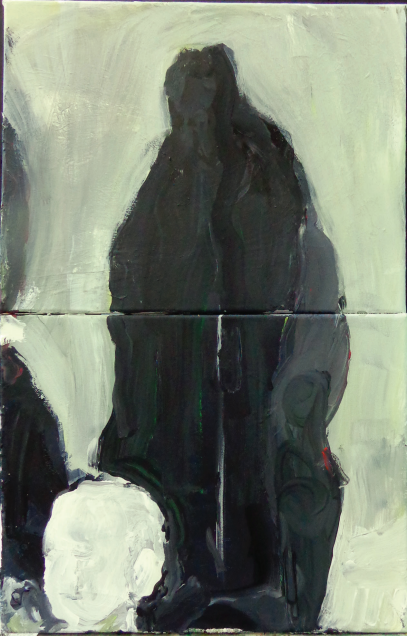
Fismal - Howard Skrill
Los Alamos: Patchwork Quilt -Julia Piehler
When I worked at Los Alamos in the late eighties, an outstanding public library
stood in the center of town. It was multilevel, and one entered from the top. An open
space soared where the stairs unfurled in an oval spiral down to the lower stacks. Hung
along the wall of that open space was a patchwork quilt with the attribution: “By the
wives of Los Alamos.” The label was simple and small, neatly typed and laminated.
Many of this quilt’s panels, in softened earth tones and pastels, celebrated the natural
beauty of New Mexico. I remember just a few of the border panels, including the state
flower, the state bird, and a rainbow (of which there were many in the wake of the
frequent, but usually brief, summer afternoon thunder storms). But the central panel
created an outsized impression. It was a gray mushroom cloud, roiling over a pastel
calico landscape.
It was hung in 1981, long after civilian anti-nuke protests had become too loud to
be ignored. Maybe the quilt was a silent riposte to the anti-nuke movement, sewn by
women who wanted to take pride in the work of their spouses and in their own
sacrifices. To live with their husbands, they had to uproot from friends and family and
tolerate living in a dinky, remote desert town with few amenities, which was patrolled like
a high-security prison. By the time I saw the quilt, people generally tucked in their chins
as they passed it, making neither positive nor negative comment; the salutation of
cognitive dissonance, I called this.
When I interned at the lab, while the physical fences were mostly gone, police
presence was still heavy and multilayered. Badged city, county, state and military police
formed a ubiquitous backdrop, and unbadged security forces lurked about, too. I
occasionally glimpsed men all in black, from their caps to their boots, doing drills within
their own battle-ready compound. How all these forces for law and order coordinated
their overlapping work I could not imagine. I am guessing boredom was a rampant
hazard of their jobs for which internecine squabbling provided some relief
Between the mesa where I rented a room and that on which my lab building
resided, a branching group of canyons consolidated their waters and drained into the
Rio Grande River. One was called Acid Canyon, an alluring name to a chemist like me.
Early one evening, I decided to bushwhack from my rental down into the canyon to see
what it was like. I walked to the cul-de-sac at the end of my residential mesa, then
began scrambling downhill through sparse yucca plants and small pinyon pines that
grew on pinkish layered rock. Just as I reached the lip of the steepening slope my way
was blocked by rolls of razor wire with no signage.
Meanwhile, the first fat drops of a summer rainstorm began to strafe me, as
though threatening hail. Hoping that the storm would be brief, as they usually were, I
looked for shelter where I could wait it out. I found a boulder with a hollow that created
some refuge, and I crammed myself in as tightly as I could. The rain grew more steady
and the storm seemed to actively target me, tendrils of cold wind wrapping around even
to my back, which was pressed into the cavity of my boulder. Shortly, I thought I heard
voices calling to each other over the din of wind and hammering rain. Evening was
fading to dusk, so it was all the more blinding when a bright light suddenly shown in my
face. It came from one of those enormous weapon-like flashlights the police carry. The
man wielding it called out, “It’s just a girl!” in a voice tinged, I thought, with disgust.
A second man came to inspect me with his own weapon-light, then squatted
down to ask me in a would-be gentle voice who I was and why I was there. I gave him
all my information, and he walked far enough away for aural privacy then spoke into a
walkie-talkie for several minutes. I must have been vouched for in some way because
when he returned, I was treated more like a (dim-witted) victim for search and rescue
than a saboteur attempting to breach national security. Both men overfilled their
uniforms in a way only rigorous training can induce, and were convincingly intimidating.
Although the rain was sputtering out, I obliged them by accepting the foil pack
containing an emergency blanket. (I imagined that bestowing that blanket allowed them
to claim a successful rescue in their daily logs). I donned it like a cape and clutched its
ends together as they walked me back to the cul-de-sac where I had started my descent
into Acid Canyon. I declined their offer of a lift to my door. I was anxious to be away
from them, preferring the faltering rain to their company and all it implied. I had seen no
monitors as I descended into the canyon, so how had they found me? how had they
known the direction I had taken?
When I came on the scene, some forty years ago, the lab as a whole was
undergoing an identity crisis. During World War II, the collective goal was—quite
simply— “the bomb.” That segued into making and testing yet more efficient and
powerful bombs. Next came the phase of supporting nuclear deterrence and the Cold
War. But when Gorbachev came into power in 1985, America began to dismantle the
nuclear arsenal that was the child of the lab. In the mid-eighties, it seemed as though
every one of my coworkers claimed their research was dedicated to remediating
contamination from building and testing bombs.
The bleak concrete buildings of the chemistry division encompassed a lot of
under-utilized areas, which was great for me. The private office I was given, with a
window looking out on pinyon pines, felt lavish to me, a student accustomed to chilly
group offices in laboratory basements. I was shown the lab and told to use whatever
work benches I needed. Top of my list of needs was a chemical hood where I could
work with cyanide. A hood is essentially a counter-height box, with a window that can be
rolled up and down to provide access to the interior. Fans and filters seated atop create
a current of air in the working area, such that fumes flow up through the filter and the
cleansed air vents to the roof. I was pointed to a small, old-fashioned but functional
hood with a pocket-sized sink in the back. The hood’s fans and filters looked up-to-date
and in good working order. However, flasks and vials with poor or absent labeling
cluttered the sides and back of the hood, and taped to the roll-up window was a
handwritten sign in large emphatic letters, stating: “Milligrams of Np in hood.”
Np is the symbol for neptunium, an actinide element sandwiched on the periodic
table between uranium and plutonium. It has a relatively short half-life, depending on its
isotope, ranging from one year to two million years. Simple math evinces that virtually
all the primordial Np on earth has decayed over the course of the four-and-a-half billion
years of Earth’s existence. Therefor what exists now has been created by atomic
bombs, or by the deliberate irradiation of plutonium. So, this Np in the hood, we humans
had made it.
It is both toxic (a poison like most heavy metals) and radio-toxic (like what
caused the flesh to slough off the bodies of so many people who initially survived the
Hiroshima and Nagasaki bombings). Np is one of the most mobile of the actinides,
especially in acidic water. In other words, it can move far and fast once released into the
environment. “Milligrams of Np” is plenty to kill a whole herd of cattle.
As was my right and responsibility, I called in the hazardous waste removal
squad to clean out the toxins. Two men in full hazmat suits and self-contained
respiratory packs came and examined every vial and every surface in the hood with
Geiger counters. They found no radioactivity, so took down the sign and wrote a report
pronouncing the hood free of Np.
I asked about the little sink in the back of the hood, but the pair of Micheline men
maintained that their job ended where the plumbing began. My more senior colleague,
Andy, came up and gave me a gentle nudge with his elbow—which given our respective
heights landed on my windpipe—and advised me to drop it, as the plumbing plans had
probably been mislaid decades ago.
I thought about the direct downward-sloping line from my hood to the rim of Acid
Canyon, and I had a pretty good idea where the Np had gone.
In the intervening years since I worked at Los Alamos, the razor wire around Acid
Canyon has been removed, and the fire road around its lip has been turned into a hiking
path. With relatively little elevation change, it is the most family-friendly trail in town. I
think about the Acid Canyon Trail loop. I think about Andy, like everyone else
supposedly working on remediation, elbowing me into silence. Did his dedication to
remediation stop short of work that was thankless or tedious? And I remember that quilt
centerpiece, even if everyone else has forgotten it. Pastel quilts and family walks
around canyons exude wholesome invitation. It’s just too bad when they encircle toxic
horror.
But in the last few years, intrepid scientists unaffiliated with the lab have been
scrambling farther down into the canyon, as I had tried to do long ago, and are sounding
the alarm over high levels of plutonium there. And I want to whisper to them about the
Np.
But it has probably outraced them to the Rio Grande River, traversed the state,
continued south to trace the border between Texas and Mexico, then dumped into the
Gulf. It may be adding special piquancy to our seafood even now.
Pinprick Villanelle -Dustin Brookshire & Kerry Trautman
A contoured villanelle using “Villanelle For The Jealous” by Corrina Bain
I’ve held your secret until I’ve almost burst,
knowing a slip could rip a rift beyond repair.
Losing a friend can cause the heart to rust,
regardless of who hurt who, hardest or first.
We can’t shred words, send them sailing through air,
like secret candies in piñatas beat to burst.
I tell myself to travel back to that day, the first
trusting admission, your fear of judgement bared.
Our friendship so damn shiny, no sight of rust.
If you ask me my faults, the flaws I carry, I’d list
first how your lie consumed my life— so unfair,
the incubating secret that threatened my life to burst.
I did what I thought right, what I thought I must.
Friendship isn’t all Prosecco, shopping in Bel-Air—
there are storm clouds, dead flowers, and scrubbing rust.
Some corroded friendships are best lain to rest,
and, darling friend, your secret is mine to share
like after-prom balloons all pinprick to burst.
You’re only out for yourself, heartless, a chest full of rust.
Partner’s Lament Villanelle -Dustin Brookshire & Beth Gylys
A contoured villanelle using “Thoughtful Villanelle” by Julie Kane
Never any action, you only talk, talk, talk.
I bet you have more to say than Swedenborg.
Do you think I’ll remain silent? Honey, I’m not
a voice recorder. Shut it. Give some thought:
don’t spread rumors like fungus spreads spores.
Head lice have more reason. I hear your talk
and, darling, in the play of life it’s useless dialogue:
ugly and dull. Where is the you I knew from before?
Why is that former you silent? Listen, I’m not
looking for a saint. If you could only block
the bullshit. Say it bluntly, ditch the metaphors,
or live a little more in silence. Haven’t you talked
nonsense enough? I’m depleting my case of Cadet d’Oc.
podcast binge listening to poetry by troubadours.
Poetry demands I express myself. Boy, I’m not
your sacrificial pawn. If you want me, these thoughts
will serve as a guide, let this poem strike a chord
let it sing through your very bowels. Don’t talk,
listen, actually listen for once, it’s your call or not.
Body’s Language Villanelle -Dustin Brookshire & Beth Gylys
A contoured villanelle using “Prospects” by Anthony Hecht
Stacked hours and sex with my lover are sublime.
On the days we skip work, I float in a stream
lost with you. I find myself again, forget time,
enjoying the carnal. I’m not past my prime.
I walk downtown & feel eyes follow, as I dream.
of our bodies locked deep in a sex so sublime.
I’ll take our limbs in a tangle over scoring a dime
of flesh any day—the sync of our moans. I don’t deem
a hookup the same—not after these months lost in time
with you. Returning to reality & forced to climb
another hill, push forward another damn rock, I seem
to move far away from the sublime,
from you, open, ready, waiting for the crime
I’ll commit. I’m water. You’re heat. We’re steam:
vaporous, lost and found in each other. No time
for convo, we’re creating a physical paradigm—
all movement, the body’s language our only theme.
A mouthful of lover is deliciously sublime.
I want you again: close, naked, oblivious of time.
Side-Seams -Abbi Payne
Oh, department store men’s section, you beckon me in with
crooked finger and pressed collar, you whisper of too-broad
shoulders and too-many buttons, you hide your sizing in
strings of multiplication that give 4th graders headaches.
Oh, department store men’s section, you fold your pants side-seam
to side-seam, like my father does at dining room tables, you watch
as men his age swivel graying temples to get another look at
braid and chest and hip: noses scrunched and eyebrows cocked.
Oh department store men’s section, who do they think I shop for?
I’m the one that’s pursuing clearance, I’m the one that’s draped in
different shades of maroon and midnight and moss. It’s my body
that’s turning this way and that in the dusty mirror—
Oh, department store men’s section, help me find something not too big,
not too small, but just right. Help me fill my closet with clothes
that feel like mine. Shuck off the frills and twirls of childhood drawers,
these legs house a redwood forest; they beg for a garment with in-seams.
Oh, department store men’s section, there’s no judgement from
woven thread, is there? Do you think the clothes in my bag
will writhe when my wet hair hits the collar? Will they learn to
loathe lavender deodorant and orange-laced curl cream?
Oh, department store men’s section, soon, I’ll have to leave
your aisles. And when summer’s hills take me home,
my father will remember to place these items in my laundry pile,
despite my protests, folded side-seam to side-seam.
celestial mechanics -Abbi Payne
the daughter who screams so loud
neck craned for so long
up to the sky finds her mother, her heart,
her head in the dirt and a bloody blade
face wet and ears ringing
asks her mother her head placed where
she might become something else
something that could set the sky aflame
smolder in the inked night and fit her throat
Eight Haikus in a Trenchcoat -Abbi Payne
after Florence Welch
There’s magic in that
red light, blinking through the fog
of a city whose
surface I’ve barely
scratched. Listen: the hiss between
the window and the
roof—winter’s prelude,
breathing on the radio,
the wheel, the rearview.
Feel it fill my lungs—
the only god that I know.
An inhale brings no
plastic flowers or
cherry perfume this time;
they didn’t keep me
safe like you told me
they would. Come on, I can take it—
Rotten leaves on the
windshield, lamplight that
flickers, shadows kissing
bench legs. Let the night
wash in. Beyond the
cracked glass: aching, aching,
aching, and alive.
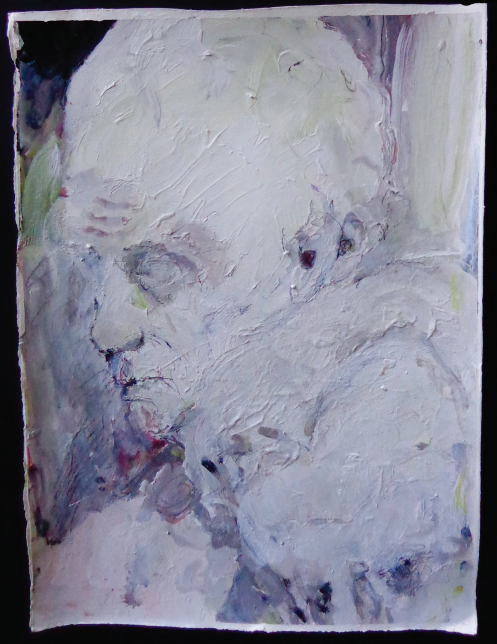
Persistent Effigies -Howard Skrill
The Last Egg -Julia DesRoches
It’s been seven minutes since Candy Lackowitz last looked Carmine’s way, though it feels like years. Their rubber flip-flops smack the sidewalk in sync, but every time Carmine closes the distance between them, Candy speeds up a little. Carmine scowls and stabs her straw through the ice of a blue-raspberry slushie. Her toes slump off the curb when they reach the intersection, where Opal Street sits between a 1960s ice cream shop and the Siren Ink tattoo parlor. Various mermaid designs line the tinted windows. Dogwood Beach’s waterline is only a blue sliver behind them, but Carmine can still taste the salt air through the diesel and Coppertone mingling around them. Candy sighs. She stopped crying a few minutes ago. She folds her freckly arms, her narrowed eyes creasing the sunburned apples of her cheeks as they wait for traffic to pass.
“Are you sure this is the right way?” Carmine asks.
Candy steps off the curb before the pedestrian signal flecked with gum gives the go-ahead. “It’s right,” she says.
Carmine hurries to keep up with her friend’s charged stride. She knows Candy wants herto apologize, even though Candy lies all the time. Still, Carmine might give in. She teetersbetween visions of Candy giving her the cold shoulder at recess and a more predictable outcome in which they both forget the whole fight by the time they meet Candy’s Grandmother, Chuchi, down at the pier. Cigarette butts roll under her feet as they walk. She eyes a neon teal motel beside the Dairy Queen. There, a boy half her age dangles his legs through the barred railing on the second floor. She thinks he sees her, his eyes following her like a laser pointer. “I’ve never seen this place,” she says.
Candy sighs, tossing her apricot braids over her shoulder. “That’s because you don’t know Dogwood like I do.”
Carmine stops in her tracks, fingernails digging into her styrofoam cup. “But the general store isn’t this far from the beach.”
“I know that!” Candy says. “I’m going to the gas station to use the bathroom, okay?”
Carmine’s stomach twists. She jogs to catch up, following Candy right, then left, then right again—never mind where they turn, because Candy knows the way. “I don’t think Chuchiwants us to be this far from the beach…”
“Well, she probably doesn’t want me to piss my pants either,” Candy says.
“Why don’t you just go back to the house?”
“She’ll just make us put on sunscreen again.”
Carmine inhales her slushie along with a wave of car exhaust that filters into her lungs. The clouds above hang thick and dull. “I can’t help that I don’t remember the day we met, okay? I was like, three.”
“We were four!” Candy snaps. “And you always pretended like you did!”
“I just felt bad that I couldn’t remember.”
“Yeah, well, you still lied.”
“You lie all the time.”
“No, I don’t!”
“Yes, you do!” Carmine says, cringing when the man beside them at the stoplight averts his eyes. He quickly tucks his polo shirt into the khaki waistband of his shorts, pretending not to hear. She keeps her voice low. “Remember when you told me about Josh escaping in the middle of the night and your dad having to hunt him down?”
Candy shakes her head. “That was a joke! I told you right after that I was joking and you thought it was funny. Remember?”
“That’s not even how jokes work.”
“Yes, it is! You tell the person right after that you’re joking or else it’s just a lie!”
“Yeah, but you went on for, like, ten minutes—”
Candy’s eyes roll into her skull. “It was not ten minutes!”
“—about how your brother experiences nighttime psychosis and your parents had to bar his windows to keep him from terrorizing the neighbors!”
“So? It was funny! I told you right after that it was a joke, and you laughed!”
“It’s still weird.” Carmine frowns at her empty cup, the remaining ice chunks now a faint jolly rancher blue. “And there’s also the time when I asked you what your favorite color was and you told me it was a color you could only see in your dream and couldn’t see in real life, remember?”
Candy shakes her head, tight-lipped. “Those are not the same. At all.”
“You didn’t even tell me you were joking about the color one until months after. So you basically lied.”
“Okay, but that time I just forgot to tell you I was joking and then I told you it’s purple,” she says. “But you weren’t even joking. You just lied.”
Carmine’s throat swells shut. “I thought maybe you’d find it funny.”
“I don’t!”
“Okay, I’m sorry…”
Candy’s squinty eyes linger on Carmine, then they find the ground again. She doesn’t speak. Just frowns, her bottom lip protruding slightly. But she lets Carmine walk beside her without rushing ahead.
As they approach the Gas N Go, Carmine’s stomach contorts. She realizes it’s not just her nerves from the fight. “I think I’m going to be sick…”
Candy sighs and steers her toward a strip of grass on the side of the building. “You always drink your slushies too fast.” Candy takes a seat on the curb by a broken beer bottle and frayed plastic wrappers, watching as Carmine spits up a stream of blue corn syrup onto the yellowed grass. Some of it goes up her nose. She spits out the rest.
A breeze stirs up the tang of fresh bile. “I’ll get you some napkins.” Candy rises to her feet, her nose crinkling. “Are you crying?”
“No.” Carmine wipes her mouth with the back of her hand that still smells like Cuchi’s suncream. She had always prided herself on not being a crybaby like Candy. “My eyes always water when I throw up,” she explains, inspecting the blue dribble on her bible camp t-shirt.
“Throw up tears don’t count.”
Candy shrugs and heads toward the Gas N Go. The wind ripples her hand-me-down sundress, the billowing fabric shadowed over patches of pulverized asphalt.
Carmine wipes her mouth again. “Candy?”
“What?”
“You still mad?”
Candy shakes her head. A hint of a smile plays on her lips, so Carmine knows she’s in the clear. Carmine grins, hiccups, and turns back to the grass as another wave of bile climbs up her burning esophagus. Thunder drums overhead. While she waits for Candy, she plucks a handful of dry grass and sprinkles the brittle blades over her knees.
It was Carmine’s second time in Dogwood. Like last summer, she and Candy waited on the Lackowitz’s porch for Chuchi to pick them up in a grey Honda sedan, a rosary draped over the rearview mirror and Strawberry Shortcake stickers plastered on the windows from Candy’sprevious trips. The first time Carmine watched Chuchi walk up the drive in cargo shorts and a Dogwood t-shirt, Candy leapt into the old Polish woman’s arms, giggling as her grandmother spun her around. Candy then fetched Carmine by the hand and dragged her off the porch to the car. Chuchi wasn’t like the southern grandmas Carmine knew with dimpled cheeks, pastel sweaters, and lilting greetings that melted sweetly over you. She was something a little rougher around the edges; frayed white hair she cut herself, eclectic shirts that were always too big or too small, and a smile that didn’t make a big deal about itself. They waved goodbye to Mrs. Lackowitz from the backseats, and Carmine got a queasy feeling that maybe she didn’t want to be gone all weekend long with this strange woman.
But when they pulled up to a short, vinyl house with a pitched gable roof, Carmine forgot her apprehensions. Two twin beds waited for her and Candy inside, purple seahorses stitched into the comforters and monogrammed beach towels folded on top. Chuchi watched the girls play mermaids from a foldable chair while Carmine and Candy dove through breakers, laughing and coughing up saltwater until the sun went down. They ended the night on the couch. Each girl curled up along either side of the woman, whose wide arms draped over their small bodies.
Carmine fought against her heavy eyelids, a Don Bluth movie fading in and out from a 90s TV set. Cradled between Chuchie’s arm and the sunken damask sofa, Carmine wished the warmth emanating from her pseudo-auntie’s flesh could envelop her whole.
Carmine eyes the Gas N Go doors, finished with her third puking round. Cars filter in and out of the fill-up stations, but still no Candy. So, she pushes through the front door, the entry bell ringing as another roll of thunder belches from above. On the right, a boy behind the checkout counter with a spiky blond buzzcut and a piercing below his bottom lip barely glances at her. To the left are the snack aisles. Directly before her is the roller grill and the napkin dispenser. She remembers Candy saying she had to pee. “Where’s the bathroom?” she asks, and the clerk nods toward the back-right corner past the fridged beverages.
“Candy?” she says, her voice echoing in the small fluorescent bathroom. No response.
Carmine then investigates the aisles. She tries to keep quiet, thinking she can surprise her friend by sneaking up on her. Maybe Candy’s thinking the same. Rows of vibrant aluminum chip bags, cracker packets, and Little Debbie’s oatmeal cookies welcome her down the line. But still no Candy. “You see a girl come in?” she asks the clerk, who could be anywhere between his late teens and late twenties.
He looks up from his phone, shoulders hunched slightly like a drooping bluebell too heavy to support itself. “Hm?”
“She was getting napkins.”
His eyes land on the dispenser, as if remembering. “Oh yeah. She came in.” Carmine raises a brow—the kind of “cool” face she makes in the mirror when she’s bored. “Where’d she go?”
He shrugs.
She sighs, stepping outside again. “Can-dyyy!” she calls, the melodic syllables rising and falling on her tongue. A speck of rain flays her cheek. Perhaps she hasn’t forgiven her, Carmine figures. “Candy, I’m not playing!” Still no response. She crosses her arms and groans up at the swollen sky—makes a big show of it so Candy, wherever she’s hiding, can see she’s given up. “Candy?” she tries again, softer this time. If she says it nicely, maybe her friend’ll step out from behind the ice machine or the propane tank cage and say, “Boo!” and they’ll both be laughing again.
Carmine circles the building once, twice, three times, then holds her breath and peeks behind the dented dumpsters. Flies zip through the damp air. All she finds are a dead raccoon and a crinkled Coke can beside a grimy Polly Pocket doll. She imagines Candy watching her from some vantage point she hasn’t identified, like a trickster spirit stifling a laugh with a hand over her mouth. “Candy, I’m leaving…” she says, despite her plummeting conviction that Candy can hear her. It occurs to her then that Candy isn’t playing, an egg in the nest of possibilities she somehow missed. The egg tells her to be worried—says something happened. Once again, Carmine thrusts open the Gas N Go door, marches to the checkout counter, and asks, “Do you know when she left?”
The clerk’s brows pinch together. “Mm…I didn’t hear the bell.”
She checks the entry bell hovering over the door. Her heart swells. Of course! Candy must be hiding in here. “Don’t let her leave!” she says and races down the aisles. She whips around the corner and kicks open the bathroom door. “BOO!” she shouts, springing inside. She slaps each of the stalls open, only to reveal a row of vacant, porcelain toilets. Demoralized, she tries her luck with the men’s bathroom. Empty again. She checks another door marked ‘CUSTODIAN’ only for it to be locked. Her last hope is a door at the end of the hall. Her sweaty hand turns the rusted knob, revealing an office room the size of a closet and a man so buried behind a desk of papers and manila envelopes that she almost misses him. He snores softly. She quietly closes the door.
The joke has gone on too long, even for Candy. Carmine knows she should remember the day they met. She’s heard the story so many times, it’s almost like she does. The vision she’s crafted around Candy’s memory feels as substantial as whatever the truth must be. Maybe that’s why she thought Candy would see the humor in all of it. When Carmine admitted this under the shade of the pier, Candy snapped her head at Carmine like she’d broken some sacred oath.
“What do you mean you don’t remember?” she asked.
The giggles died in the back of Carmine’s throat. “I mean, I’ve tried…My memory just doesn’t go back that far, I guess.”
Candy’s mouth hung agape in betrayal. “You never told me that. You told me you remember pulling the splinter out of my finger. When you found me crying.”
“Well, yeah…Because you told me that’s what I did.”
Candy blinked, dumbfounded. She forced a smile, then a giggle as if to see how it felt. But both quickly faded with the visible realization that she was still hurt.
Carmine felt a pang of shame snap back on her chest like a rubber band. “It’s okay!” she had said, struggling to match Candy’s pace as she hiked up the beach. “At least you can remember it for the both of us.”
Carmine circles back to the check-out counter, her ears hot with embarrassment.
“Any luck?” the clerk asks.
“Is she behind there?”
He checks over his shoulder like he isn’t sure. “Doesn’t look like it.” Carmine checks behind the counter, just in case he’s in on it, too. All she finds are the clerk’s rail-thin legs in a pair of faded basketball shorts. “You sure it’s a prank?” he asks.
She doesn’t respond, her throat swelling shut as she steps outside. The bell dings overhead. Her best bet is to find Chuchi, she decides. Because Candy has to be somewhere, and if she’s anywhere, it should be with Chuchi. Her feet beat down the street they originally came from, flip-flops slapping faster on the concrete. Rain speckles the sidewalk as she scans the streets for Candy’s fiery hair. She keeps a lookout for familiar landmarks, the motel, or maybe the tattoo parlor. But when she gets to a fork in the road, Carmine’s as good as lost. She asks passersby if they’ve seen a girl with orange hair around. Every one of them shakes their head, and Carmine has no choice but to drag her feet back to the Gas N Go, calling out Candy’s name until her lungs burn. The last egg in the nest of possibilities is cracking. Something has happened, it whispers. She tells herself that this worrying is only as real as the panic she feels when her mom isn’t home on time and she suspects she’s died in a car accident somewhere. But her mom always ends up walking through the front door, perfectly fine. Still, Carmine can’t dismiss the egg so easily, now two hours into her search. She chokes out a sob. Tears stain her cheeks in the wash of the rain.
The clerk observes her carefully when she returns dripping wet, her rubber soles squeaking on the tiled floor. No cars are left in the lot. Carmine rests her elbows on the counter. “Are you sure you didn’t see her leave?” she asks.
He leans over and shakes his head. The inner corners of his brows curl up sympathetically, his thin frame slouching under a loose, white t-shirt. “Sorry, kid.”
“She didn’t go out the back maybe?”
“It’s locked. ”
Carmine sighs. Outside, the rain showers down in one uninterrupted silver sheet. Carmine imagines her friend creeping past the fill-up stations toward the road while she was busy throwing up. She tries her best to make this mental image believable, but it’s like working with crumbling playdough that won’t mold the way she wants it to. Deep down, Carmine knows her friend wouldn’t abandon her. Even if she likes to joke, Candy’s not cruel. “I don’t think she left me,” she reasons aloud. And if Candy had returned to Chuchi, they would have surely come for her by now…
But Carmine realizes she’s backed herself into a corner. Because Candy is gone, which means she either left by choice or not by choice. Her stomach twists. The clerk scratches his cheek, his fingernails sanding against the faintest traces of stubble. “She’s your sister?”
“My friend.”
“ You got a phone number? I can call someone for you.”
The lump in her throat makes her sound younger than nine. “I don’t know Chuchi’s number.”
“Who?”
“Candy’s grandma.”
“Maybe you know someone who’s got her number?”
“Oh, yeah.” He hands her an iPhone covered in smudges and grease deposits along the corners. She dials her mom’s number, and her insides turn hollow when it goes to voicemail.
The clerk rubs his chin in thought. “What about Dad’s number?”
“I don’t know it.”
“What’s your name?”
“Carmine.”
“Carmen?”
“Car-mine,” she says, stressing the last syllable on her tongue.
“Isn’t that a boy’s name?”
“It’s magenta.”
His mouth squiggles into an amused line. “Okay, how about this…I’m sending Mom a text saying you’re lost, you need Grandma’s number, and to call back. Sound good?”
“Okay…” She watches the storm. Her own reflection stares back at her through the dark glass, showing cut-off jeans, brown hair in a fraying ponytail, and a thin, panicked face she doesn’t fully recognize. Bile resurfaces in her mouth again. She curls her fingers over the counter. “Um…Do you think something bad could have happened?”
The clerk’s face goes slack. “Should I call the police?”
Carmine blinks, unsure what to say.
“Oh…” he says, realizing this is his call to make. “Yeah, give me a second…” Phone pressed to his ear, he fumbles through the police report, grabs the hair around the nape of his neck while guessing roughly when a girl with orange braids came in and disappeared. His middle finger taps the back of his phone to the beat of an anxious pulse, the metatarsals protruding against the skin like violin strings. When he’s done, he hangs up and says, “I guess,the only thing to do now is wait, right?”
Carmine shrugs, eyes drooping to the ground.
He sighs. His finger taps the counter. “Are you hungry? You want a snack or something?”
She shakes her head. “I threw up a little bit ago.”
Tired, blue eyes downcast to the stain on her shirt. “Oh…” He steps around the counter.“Let me check with my boss.”
She follows him into the office she found earlier. A wilted house plant sits in one corner, a fan whirs in the other. The middle-aged man still snores over a desk littered with papers and a few beer cans. The clerk knocks on the open door. “Marshall?”
Marshall rises a little, rubbing his eyes. What few peppery hairs he has left flake every which way. “Hm?”
“The cops are—”
“Cops?” Marshall’s swollen, meaty face springs up, suddenly lucid. His eyes land on Carmine. “Who’s this?”
The clerk turns around, almost surprised to see her behind him. Carmine figures she wasn’t supposed to follow. “Yeah, her friend’s missing, so they’re picking her up.”
Marshall sighs, his head in his hands like this is the worst thing that could be happening to him right now. The clerk clears his throat. “Do we still have the footage on the east camera?”
“Bust.”
“What?”
“They’re all busted. None of them work.”
“Right, okay. I’ll take care of it when they get here.”
“Thanks, Jamie.”
Jamie closes the door, offering Carmine an apologetic, tight-lipped smile. “He’s going through a bit of a divorce,” he says in a hushed voice. “We can wait at the front.” Carmine follows him, eyeing the rainbow display of cigarettes and Elf Bars behind the check-out station.
The room flashes as lightning cracks the sky. “What’s your friend’s name again?” Jamie asks.
“Candy.”
His elbows rest on the plastic laminate counter beside her. “That short for Candace?”
“Yeah. Candace Lackowitz.”
He nods. “She your best friend?”
Carmine blinks back tears as she picks at the peeling corners of the plastic. “Yeah.”
“Don’t worry. She’s around here somewhere. Probably just got turned around, you know?”
Carmine’s chest constricts, knowing Candy is somewhere in this moment, and it’s nowhere she should be. “No,” she says under her breath. “Candy knows Dogwood.”
Jamie’s lips press to a line. Another dead end. “Maybe she went to find your grandma. Chacha, right?”
“I don’t know,” she sniffles, wipes her nose. “I don’t think she’d just leave me…I don’t know my way around.”
“Right, yeah. That makes sense.”
“But she was mad at me earlier…” she admits, her fingernail gliding along the plastic. “Because I lied.”
“‘Bout what?”
“She thought I remembered when we met. When we were four.”
“Oh…”
“I let her think I did,” she explains. “I always pretended like I remembered whenever she’d bring it up or joke about it and stuff.”
Jamie nods, his expression vague.
Carmine doesn’t think he understands, and suddenly, it’s important to her that he does. “She asked me one time what I thought of her when we first met. Like, she used to think I was very serious because of how quiet I was. So I told her I thought she was really sensitive at first because of the splinter, but she’s pretty actually tough most of the time…But really, I just made that up.” She studies Jamie closely, waiting for something to register in his eyes. Perhaps he’ll say, “You think she left because she was mad?” And she’ll be cleansed with relief. When he doesn’t answer, she continues, “But today, she asked me if I thought that she was always tough or if I thought she just got tougher since we met. So I thought it was time I finally told her that I have no idea because I don’t remember when we met.” Carmine swallows her guilt, taking a breath. With a sanguine laugh, she then told Candy that she actually didn’t have many memories of them being four together at all. Of course, she was wrong to assume they’d laugh it off together. “Candy didn’t find it funny.”
Jamie’s brows furrow in confusion—or perhaps it’s disapproval. This gives Carmine hope. Because she had lied. She was bad. She deserved to be ditched at this gas station in the middle of a storm, and Candy really is just sitting at Chuchi’s house watching The Secret of NIMH without her. Finally, Jamie says, “I don’t think she left you.” He might as well say that Candy’s gone and she’s never coming back. She wants to tell him he’s wrong when Jamie’s face flashes red and blue. The cops are here. Nothing is certain, yet Carmine already feels time stretching out before her—days, weeks, years—and she’s still trapped in this moment, this feeling of knowing that Candy is somewhere, and her heart breaking that she can’t know where.
Hindsight: 2020 -Gregg Shapiro
December 31st was a warped diving board, an overheated
and leaky valve, a sputtering ski lift, an irregular heartbeat.
Different from every other one that preceded it, when throwing
caution to the wind didn’t mean that you’d end up with a mouthful
of glass shards, murder hornets, conspiracy theories, protective
fabric, tainted air, eulogies. Leap year, election year, plague
year. Burn every calendar for warmth. Send smoke signals to
distant galaxies. Warn them that history repeats itself regardless
of the plans made. Numerical cycles that have nothing to do
with math. Perseverating like a worried aunt, hands clean and
chapped, knotted in prayer. Look back with no regard for pillars
of salt. Never forget memory’s ability to alter facts depending
on who is recalling events, tragic or euphoric. Don’t be afraid
to be afraid of what comes next. Learn something from this
experience. Watch the sky, watch your step, watch the ball drop.
Replacing the body -Gregg Shapiro
A liver or lung, heart or a tongue.
Tooth or kidney. Does hip or knee
count? Maybe not. Beware of clots,
complications abound. Wait, what’s
that sound? Is it coming from inside
or out? Right or left side? Rampant
infection. Replacement rejection.
The scar an abstract painting, where
the fact of the scalpel left its mark.
A souvenir for lovers to trace in
the dark. Usually someone must die
first to be harvested before the hearse.
Science iconic, artificial, bionic. Grow
new hair anywhere, subsidized by Medicare.
The High Cost of Living -Gregg Shapiro
This is not the notebook in which you scribble
the fragments of your dreams. The screams
you heard were yours and the Saturday morning
dead. This is not a very special episode
of your favorite sitcom. Don’t set the DVR
to record this because you will never be able to
erase it. This is not where you exchange your tears
for bullets. Tears are not currency and rage
is the only payment accepted at the gun show.
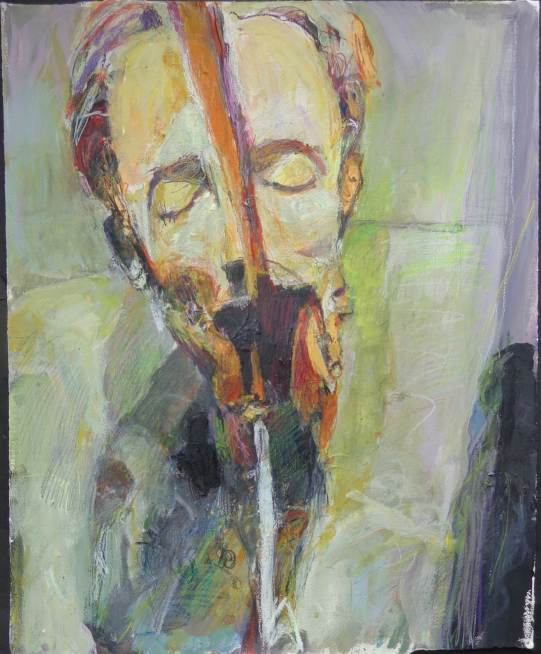
Cracked Head - Howard Skrill
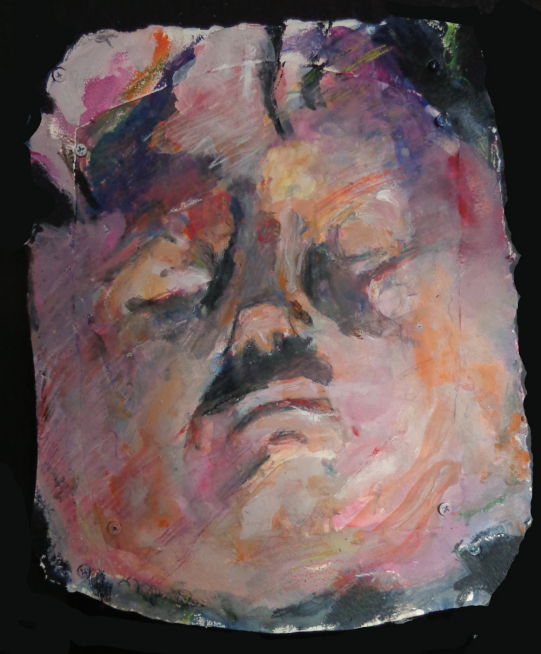
Dyker Mashed Head - Howard Skrill
The Mirror -Patrick Barney
I
Chazz Guitierrez always knew he was a piece of shit loser, a failure as a husband and a
dad, but he didn’t realize how much the universe absolutely hated him until he decided to
become a research subject for a weird experiment at the nearby university. He’d been sitting on
the couch in his mom’s basement, staring at the floor, hypnotized by the abject crappiness of his
life, when his phone chirped, alerting him to a new email. He grabbed the device from the coffee
table in front of him and read the message: Make real ca$h now! Enter our study on the effects of
new technology on the human brain!
He should have deleted the message immediately. Just some stupid spam thing, he
thought, but here he was, sitting in his stained underpants on a ratty old couch his mom should
have thrown away years ago, no job, no place of his own, no prospects whatsoever. He ate no
food other than what his mom bought him, wore no clothes but those she paid for, and went
nowhere except in her car with gas she’d purchased. His ex-wife called him a tiny-dick screw up
who couldn’t hold a job, couldn’t follow through on anything he’d ever said, and couldn’t please
a woman with a member three times as big as the one he had. His son called him Carlos and his
ex’s new husband dad, and his mother never referred to him by any name other than “eejit.” It
would actually be a blessing if this study or experiment or whatever it was fried his brain liked
eggs.
Unlike some other losers who couldn’t necessarily say when or why their lives had turned
into garbage, Chazz knew the exact moment that his whole life had gone south. This moment had
occurred twenty-nine years ago, at the age of fourteen, when his father, Carlos Guitierrez Sr., had
died. His father had been working with a road crew along the highway when a heavy ceramic
toilet had come loose from a speeding flatbed truck and landed on him, crushing his spine and
entire pelvic girdle. The doctors said the toilet had liquified his father’s organs to the point that
they’d leaked like sewage from his various holes. Chazz had wept for days. His father had
croaked it, his happy-go-lucky father who sang mariachi tunes around the house, who played
catch with him in the back yard, who took him to baseball games at the stadium. His fun-loving,
back-slapping, high-fiving dad.
His mom had been okay before then, a little stricter, a little more nervous than his dad,
but good to him. Afterwards, his mom had gone into dark mode, drinking more and more,
passing out in the middle of the day, calling him an idiot in her long Texan drawl, elongating
some vowels and eliding others. He knew she didn’t mean it because she always followed up the
insults by saying that she loved him, though the words typically came out slurred and moist
because she’d had too many wine coolers. She had tried to cope with her husband’s death just as
Chazz had tried to cope with his father’s death, and you couldn’t really blame her if she failed.
Life sucked.
Fast forward back to now, and Chazz had no prospects for improving his life at all. No
leads on a job. Most places not even hiring. Falling further and further behind on child support.
His ex calling him a deadbeat, and his ex’s new husband lecturing him about how he needed to
man up, take care of his kid, and so on. Chazz sighed and, totally skeptical, called the number in
the email and set up an interview over the phone. He asked why they had to interview him if it
was a study, not a job, and the lady with the monotone voice on the other end told him they had
to determine if he had the right personality for the study. Well, what kind of personality did they
need him to have? Nothing specific, she said. You don’t have to be a certain kind of person. You
have to not be a certain kind of person. What does that mean? Basically, if you’re average, she
said, you’ll probably be selected. What they can’t do is select people with atypical traits, like
severe mental disorders and the like. We need regular people so we can gauge the effect of our
technology on the average person. Oh, he said, smiling. I’m as regular as they come. She said
that was great, and they set up the interview for a couple days later.
When the interview came around, his mom dropped him off on the university campus
near the main sciences building, and he wandered through a bunch of old hallways to the
basement floor. The speckled tiles under his feet looked like those in his dilapidated high school
building from twenty-five years ago, and the cramped, low ceilings made him feel trapped,
crushed. Eventually, he found the main office of the material sciences department and told the
attendant at the front desk he was there for the research study interview. She told him to sit in a
nearby chair and wait, someone would be with him shortly. He sat and piddled on his phone for a
few minutes, playing a game of chess on an app. He really sucked at chess, like really, really bad,
but the game fascinated him. Unlike life, which operated by random chance, chess was a game in
which no luck was involved. The player who made the better moves always won, which differed
from poker and monopoly and whatever else. In those games, you could play better and still lose
to an unlikely arrangement of cards or roll of the dice.
The interviewer, a well-dressed woman in her mid-forties, came to get him, and they
wandered through a maze of cubicles to a room that looked like one of those interrogation
chambers on a cop show, nothing on the walls, no decorations of any kind, just a plain table and
two chairs on either side. They both took a seat, and for a long time, the interviewer stared
directly into Chazz’s face, giving him a blank look like maybe he was a bug that would have to
be squashed at any second. He grimaced a little under this stare, wondering what the hell he’d
done wrong.
“So,” the interviewer said, “you’re Carlos Guitierrez Jr., is that correct?”
“Yes,” he said.
“I’m Professor Sandy Johanssen, one of the lead researchers on The Mirror Project. I’m
going to give you a few prompts and ask you a few questions to see if you’re right for the study.
Sound okay?”
Chazz nodded. “That’s why I’m here.”
Johanssen nodded. “The prompts and questions may seem strange. Just answer to the best
of your ability.”
“I will.”
“All right, then,” Johanssen said, removing a clipboard and pen from her briefcase. “I’m
going to say a phrase or a word. You respond with your first thought. Don’t take long. Just say
what you think.”
“Okay.”
“Abused goat orifice.”
Chazz pulled back. “What?”
Johanssen sighed. “I told you. The prompts may seem strange. Just respond as quickly as
possible. Abused goat orifice.”
Chazz grimaced. “Gross?”
Johanssen nodded and marked the paper on her clipboard. “Lesbians fisting.”
“Uh, painful?”
“Is that a question or your response?”
“My response.”
“You don’t have to be doubtful. No answer is incorrect.”
“Okay.”
“Slaughtered unicorns.”
“Sad.”
“Mistreated orphan.”
“Sad again.”
“Classical guitar tune.”
“Beautiful.”
“Souls burning in hell for all eternity.”
“Complete insanity.”
“A couple getting married.”
“Hopeful.”
Johanssen’s prompts went on like this for several more minutes, many of them benign but
many of them disturbing, like the goat-orifices and chicks-fisting-each-other prompts.
Nonetheless, Chazz responded as quickly as he could, and he tried not to wonder why Johanssen
had to say such fucked up things. Not that fisting was messed up, not really. As long as you were
a consenting adult, Chazz thought weird bedroom stuff was fine, but he couldn’t imagine himself
wanting to fist someone, nor did he ever want to have his anus probed in such a manner.
“All right,” Johanssen said after a while. “We’re going to change gears now. I’m going to
ask you questions, and you answer them. Again, these questions might be strange, but your task
is just to answer them in an honest way.”
“Do the questions have correct answers? Or are they like the prompts we just did?”
“For this portion, I can’t tell you.”
Chazz nodded. “All right.”
Johanssen ran the tip of her pen along the paper until she found the question she wanted
to ask. “What’s the best thing about having a hooker die on you?”
Chazz looked around the room for a second, starting to wonder if this interview was even
real, if maybe somebody was punking him. “How the hell would I know that?”
“It’s doesn’t matter. Just come up with an answer.”
“I have no idea.”
“That’s not an acceptable answer. You have to say something.”
“Uh, I don’t know. She won’t be able to steal anything from you?”
“You said ‘she,” Johanssen said. “I never mentioned the gender of the hooker.”
Chazz shrugged. “I just assumed. I’d never go out with a male hooker.”
“I didn’t specify that you were the one buying the hooker.”
Chazz’s stomach churned. “Crap, I’m sorry. I wouldn’t go out with a female hooker
either.”
“Let’s go on to the next question.”
“Okay.”
“You go into your room at night and find that your biggest crush is in your bed, totally
naked. However, upon inspection, you find that your crush is dead from some unknown cause.
How many times do you have sex with her before you alert someone to what you’ve found?”
“Jesus Christ,” Chazz exclaimed, going so far as to stand up from his seat. “That’s
messed up. Zero times. Absolutely zero.”
Johanssen made a mark on her paper. “You find an innocent puppy chained to a
fencepost. It is mangy, dirty, starving, and dehydrated. However, if you attempt to help it, a
random person in the world will explode. If you hurt it in some way, someone with a disease will
be cured, with the severity of the disease increasing in proportion to the severity of the harm.”
Chazz had returned to his seat. “So, what, if I flick it’s ear, maybe somebody’s eczema
will go away, but if I break its leg or tale or something, someone’s cancer will be cured?”
“Yes, exactly.”
Chazz shook his head. “I don’t know. That’s super tough. I guess I just leave it alone. I
don’t want a person to explode, but I’m not sure I could harm the puppy to help someone.”
“Let’s say this. If you brutally crush its head with your boot, two people’s terminal
diseases will be cured completely. Would you do that?”
Chazz wrapped his arms around his stomach. “I don’t think I could.”
Johanssen made another mark and continued asking fucked up questions for several more
minutes. The queasiness in Chazz’s stomach never went away. In fact, as the interview went on,
Chazz felt worse and worse, wondering what kind of weirdo freaks would come up with such
ideas, what kind of psychological monsters would invent a technology that required people to be
profiled like this before getting access to it. He had no idea, and he wasn’t sure he wanted to
continue, even if it did mean a payday. He’d come to the interview, so he’d try to stick it out, but
he didn’t know how far into the study he’d make it.
Finally, Johanssen told him she’d asked all the questions she needed to ask. Chazz
nodded and headed out of the building, and he waited for his mom on a bench close to where
she’d dropped him off. As he sat, he dug his fingers into his thighs as hard as possible, maybe
trying to exorcize the memories of Johanssen’s messed up interview with pain. The garbage
people had to deal with just to live in this shitty world. Christ, he thought. Jesus Christ. He shook
his head and stared at the ground for a long time.
II
Despite being the universe’s persona non grata, the king shitbird of all shitbirds, or
maybe because of it, Chazz received a call back from Johanssen a few days later. The researcher
told him over the phone that he made a good candidate, and they’d pay him five thousand dollars
for ten sessions, one hour each, over the course of two weeks. Chazz’s eyebrows shot up when he
heard this figure. Holy shit! Five thousand bucks for ten hours of work? Was the study
dangerous? Was that why they were paying so much? No, not dangerous, Johanssen said, but
very disturbing. Several of the researchers who had been exposed to the tech they’d created had
been unable to deal with contact beyond two or three sessions. If it wasn’t dangerous, Chazz
said, he’d definitely do it, disturbing or not. All right, Johanssen said, you’ll come in next
Monday to sign the contract and have your first session—but, you don’t get paid if you don’t
complete all ten sessions. Fair, Chazz said, and pressed the end button on his phone.
He’d been sitting in his undies in his mom’s basement (as usual) when Johanssen called,
and he stood up to do a celebratory dance. Five fucking K! He didn’t even know what he’d do
with all that money. Since he lived with his mom, he didn’t have a lot of expenses, just child
support, so he’d still probably have three grand after giving his ex one grand and paying taxes,
which meant, really, he’d be able to live it up for at least a couple months, go out on his own to
dinner and a movie a few times, maybe buy some records to listen to, or even go to a few
baseball games, like he’d done with his dad in the old days. Hell, maybe he could even buy a
little bit of stock in something, maybe bitcoin, and sell it off in a few months for a couple more
grand. Who knew what good things would come?
This celebratory mood lasted right up to the moment the researchers exposed him to the
mirror, not one picosecond later. Instead of going to the university campus for his first hour of
work, Chazz took his mom’s car downtown to a high-rise building that looked shiny and faceted
under the bright, pale sun, following the directions Johanssen had sent him in an email. He took
the elevator up to the third floor and asked the receptionist, a younger woman, maybe twenty-one
or twenty-two, where he should go for The Mirror Project study. She gave him a sympathetic
look, as if he had no idea what fucked up shit waited for him beyond, and handed him a piece of
paper, the contract he assumed. She then told him to sit in the waiting area around the corner and
take a moment to read and sign the paper. He followed her pointing finger to a cluster of chairs
situated under a few kitsch photographs, sat, and read the contract, as she had instructed. It
looked like standard corporate NDA stuff, so he just skimmed the words before signing, as any
normal, slightly impatient person would have done. The only thing he noted was the name of the
sponsor of the study, some company called New Earth Corporation, which was listed at the top
of the contract. He shrugged, having never heard of it, but thinking the name sounded somewhat
odd.
Maybe ten minutes later, a lady in a white lab coat came to get him. She took the signed
contract from him, and then he followed her through several hallways before she opened a door
into a dark room, nothing in it but a comfortable-looking, high-backed chair. She told him to sit
and wait again, which he did, and after several more minutes, two men, also lab-coated, wheeled
a huge object into the room from a set of swinging doors in the back, which he hadn’t seen
because they’d been hidden by shadows. The object looked something like a huge rectangular
rock, except it didn’t have uniform sides. Rather, they were jagged and sharp, and its black
surface was shiny, like volcanic glass. It measured maybe seventy inches wide and fifty inches
tall, with a thickness of two and a half feet, though Chazz was just guessing at these lengths. It
stood upright on a gurney or cart with four support struts at its base, keeping it standing, and the
two lab technicians, if that’s what they were, positioned it right in front of him, so that he kind of
had to lean his head back to see the object’s entire surface. The techs left the room the way they
had come, and Chazz looked around in the semi-darkness, wondering if he was supposed to do
anything besides sit in front of this large, oddly shaped boulder.
Nothing happened for two or three minutes. Chazz just sat in the comfy chair scanning
his dimly lit surroundings, drumming his fingers on the chair’s arms. Then, without any
precursor, silent images began to play on the big rock in front of him. They didn’t flush the room
with light. Rather, they appeared grayed out, not quite in color, but not quite in black and white
either, as if the images contained a narrower spectrum of colors than typical humans could see.
Chazz blinked when the rock, or the mirror as the researchers called it, lit up, but his eyes
adjusted after a millisecond and he focused on what he saw, which was a moving image of a man
and his teenage son at a high school graduation celebration. Their lips moved, so Chazz knew
they were speaking to one another, but again, the images on the mirror produced no sound. After
a moment, a woman came into view, the mother Chazz believed, and all three of them hugged.
Each face looked so happy and so proud, the son’s graduation a moment of great excitement for
this small family.
But the faces of the people on the mirror were impossible faces, because they were the
faces of himself when he was eighteen, his mother, and his father, who had died four years
earlier due to that stupid speeding toilet. The image of himself looked pretty much like he had
looked twenty-five years ago, with the same cap-and-gown he’d worn in real life, when he’d
graduated with only his father’s brother in attendance. But the image of his mother did not
resemble the way his mother had looked in real life at that moment. His real mother hadn’t come
because she’d been wasted on cough syrup, and he recalled, when he saw her off that day, that
she’d been sloppy and drooly, sprawled on the couch in a grimy robe, her face blissful but
idiotic, off in some alternate timeline where Carlos Sr. hadn’t died four years prior. And Chazz’s
father didn’t look like that on his graduation day either because, well, he was buried in the
ground, his face pale and gaunt and skeletal, preserved like a dried apricot however many feet
below the surface of the earth.
Chazz gasped when he realized who he was seeing on the surface of the mirror, and he
spoke into the darkness, saying “What the fuck?” as if he might get a real answer from someone
watching him from outside the room. No one responded, though, and more images appeared on
the mirror. His father again, but this time at the birth of Chazz’s son, Carlos Guitierrez III,
holding the swaddled newborn in his arms, his face now aged a great deal since his death,
wrinkled and creased but warm with joy, and his mother there too, looking sober and well, also
aged but less than in real life, since this version of his mother hadn’t spent twenty years drinking
and smoking cigarettes. Chazz appeared on the surface of the mirror with them, tears leaking
from his eyes as he looked at his son in his father’s arms.
More images now. He and his son and his dad at a baseball game, his son maybe seven
years old, only three years younger than he was now, his dad even older than before, definitely
aging, getting weaker, but still around, still part of the family, a grandpa. His ex-wife was with
them, her hand on his knee, smiling, looking perfect really, a dress with a floral pattern on it
covering her body, and Chazz ached as he watched her, because this version of her still loved
him, and they were a content family, all three of them, just as his mom and dad and he had been a
content family in the mirror’s version of his graduation. In real life, he and his ex had divorced
just after little Carlos had turned two years old, Chazz’s inability to keep a job and help secure
their finances the root cause of their strife. Not so in the mirror. In the mirror, everything was
better.
After just a few minutes, Chazz had to close his eyes. Each image it displayed showed
moments of a life he would have given anything to inhabit instead of this one. His father alive.
His mother sober. His ex still in love with him. His son not estranged from him. Instead of losing
the elementary school custodian job he’d had before his divorce, he got promoted to head of
maintenance, and he and his ex and his son moved into a bigger house. Instead of living in a
fucking basement in his underwear, he slept in a queen bed with his wife, and every now and
then their son would come in to sleep with them after a nightmare, and they’d all cuddle together,
warm and safe and happy.
Chazz could see the shadows of the images on his closed eyelids, interrupting the dim
light as they moved, and a searing panic arose inside him. “What the fuck is going on?” he
shouted. “What the fuck is this? Is this a fucking joke?” He stood from the chair and went to the
door he had used to enter the room, trying to exit. The lady in the lab coat had locked it behind
him, and he struggled with the knob for several moments. Then, unable to get through that door,
he paced to the other side of the room and tried to exit through the swinging doors the two techs
had used. These had been locked as well, and Chazz kicked at them, screaming as loud as he
could for someone to let him out, let him the fuck out. “Help me!” he yelled. “Help me!” All the
while, he could see the images on both sides of the mirror, the front side and the back, and he
gripped his head in his hands, feeling insane, randomized, split from his own consciousness.
How could a rock generate images like these? He saw no projector in the room, nor any
openings in the wall through which a projector could send its visuals. He saw nothing in the
room whatsoever besides the rock and the chair he’d been sitting in, no technology at all. Maybe
the rock itself was just a casing for a big TV screen, something like that, meant to disguise a
technology that was already widely used. He didn’t know why they’d make such a disguise, why
that was important them, and that possibility definitely didn’t explain how they could create
images of his mother and his father and his ex and his son that had never existed. The people on
the screen weren’t lookalikes. They were the actual, real people in his life, except they were
doing things they’d never done. Maybe it was AI. That could be a possibility, but Chazz had
never seen truly realistic AI-generated images. They all looked weird, messed up. Figures with
too many fingers, or hands turned backwards, or limbs that were kind of melding into one
another.
Maybe they were using some new AI model that was way better than the ones
commercially available. That might be what was happening, but how had the researchers gotten
images of his father and his mother to feed the program? His mom didn’t post on social media.
She didn’t even have any social media accounts that he knew of, and his dad had died before
social media even existed. They would have had to confiscate the few remaining physical
photographs of his father that his mom had stored in the house. None of the images of either of
them displayed by the mirror were possible, and yet on and on they went, grainy, muted-color
videos of a better life than the one he lived.
By the time the lady in the lab coat unlocked the door and opened it, Chazz had begun
weeping. Unable to get out of the room, he had gotten back in the chair and watched the mirror
playing its wondrous and horrible film, his tears like those of a child who had accepted a lonely,
twisted end. When light finally rushed into the room, he turned away from the mirror, saw the
woman standing in the doorway, waiting for him to exit, and got up from the chair. He stood in
front of her for a long time, staring in her face, their noses inches apart. “What’s going on?” he
asked. The woman averted her eyes and said nothing. He repeated this question, but she
remained silent. Finally, Chazz turned into the hallway and started screaming at everyone he saw.
“What is that fucking thing? What’s going on? How does it know what my dad looks like? What
kind of fucked up place is this? What are you guys doing here? Why are you torturing people?”
A couple of security guards came up and grabbed him by his arms, and Chazz, totally
surprised, twisted around, trying to get free of their grip, yelling the whole time. “What are you
doing? I want to know what the hell you’re doing here. What the fuck is that thing? What the
fuck is it?” The guards forced him through the hallways, yanking at his arms as if they were
trying to wrench them off his body. “Get off me!” Chazz yelled. “Let me go!” They didn’t, of
course, and ended up dragging him along to the elevator, the toes of his shoes squeaking on the
tiles of the floor as they carried him forward by his armpits.
They had to wait for a few seconds for the elevator to open, and in that time, the
receptionist who’d given Chazz a sympathetic look when he’d come in got up from behind the
front desk. “He needs copies of his paperwork,” she said, holding out a manila folder in one
hand.
“Who cares?” one of the guards asked. “They’re not going to let him continue after an
outburst like this.”
“Just give him the papers,” the receptionist said. “You do your job, and I’ll do mine.”
The guard smirked and swiped the folder away from her. “Sure, whatever.”
At the base of the building, the guards shoved Chazz out of the front doors like a boneless
doll. His legs couldn’t keep up with the momentum of his body, and he fell forward onto the
concrete sidewalk, the palms of his hands skinned and a little bloody. The guard with the folder
tossed it at him.
“Have a good life,” the guard said.
Chazz looked up at him from the ground. “I hope you choke.”
“Maybe I will,” the guard said. “With how everything is going, maybe I will.”
III
Getting kicked out of the building should have been the end of the whole wretched
scenario, with Chazz going on to live out his loser life until he croaked it in a gutter like an
urchin, but then he opened the manila folder the receptionist had insisted he take. The first
couple of papers were just copies of the contract he had signed, the agreement not to discuss
anything he saw in the building lest the company, New Earth Corporation, visit financial ruin
upon him. However, the third paper in the pile was a handwritten note, the cursive lettering wide
and loopy, the neat and pretty scrawl of a girl who had concentrated, in elementary school, on
making each letter not just legible but a pleasure to look at.
“These people are monsters,” the note said. “They don’t care about anyone. They just
want to profit off the misery of others. If you want to know what’s going on, go to 5144
Chancellor Street next Wednesday. Wear a suit. Take the elevator up to the thirty-fourth floor. It’s
a business suite for executives at the company. You need a code to enter, 7189945. If anyone
asks, you’ve got a meeting with Arnold Dubreque at three pm. He’s the corporate head of the
project. Find his office and see what he has to say.”
Chazz read the note five or six times, wondering if his mind were making up the words,
wondering if what he read was real. Then, after deciding that the paper with the loopy ink on it
wasn’t fake, that it existed just as the couch he lay on existed, he wondered if it were a trick.
Maybe he would go to see Dubreque and the cops would arrest him, or maybe they’d force him
to sit in front of the mirror again, make him watch its horrifying images until he went totally
nutso bonkers. Neither scenario made much sense on contemplation. If they’d wanted to arrest
him, they probably could have done so when he’d been freaking out on everyone, cussing at
them and demanding to know what the hell was going on. They probably could have called the
cops then and charged him with disturbing the peace. And if they’d wanted to subject him to the
rock until he went insane, they could have done it right then too. They could have left him in the
room until he twitched like a roach on the floor, drooling out of his mouth, eyes spasming.
So, Chazz did what the note said. He bought a suit from thrift store, a chocolate brown
three-piece that looked a couple decades out of date, and arrived at 5144 Chancellor Street at
2:45pm. He walked towards the building from across the street, but slowed up when he got to the
other side, as he saw the crazy professor lady from his first interview, Sandy Johanssen, walking
out of the turnstile doors. He lowered his face to the ground and turned away and didn’t look up
again until he was sure she’d made her way past him. When he heard her footsteps behind him,
he brought his head back up and went in through the doors, his heart beating rapidly, his
breathing heavy. He then approached the big front desk in the lobby of the building, trying to
sound normal when he told the attendant he had an appointment with Arnold Dubreque at three
pm, trying to keep his voice from squeaking like a teenager. The attendant directed him to a set
of elevators on the other side of the lobby, where he had to input the code the note had given him
on a keypad next to the elevator call button. He input it incorrectly once and received an error
buzz in response. He looked around, his lungs pumping, but no one saw or cared, so he tried
again. A nice chime sounded when he pressed the last number on the keypad, and then he could
hear the innards of the elevator working as it came down to him.
He rode the elevator up to the thirty-fourth floor and wandered past a few cubicles before
he found Dubreque’s office, the executive’s name on a plaque on the door. He knocked, thinking
that, if Dubreque did have an appointment at three, he’d be expecting that person to come in like
any normal human being, which meant knocking, waiting for a response, and then going in. Sure
enough, he heard Dubreque say “Come in,” and Chazz, feeling weird and surreal, almost out of
body, did. After shutting the door behind him, he saw an older man sitting behind a huge desk in
front of several tall windows that looked out on the city below the building. The man, very
handsome for a sixty-year-old, maybe even George-Clooney handsome, had silver hair, a salt-
and-pepper beard, and wore a tailored suit that made Chazz’s look like shitty rags. He narrowed
his eyes on the poorly dressed slob that had entered his office.
“You’re not Johnson, are you?” Dubreque asked.
Chazz shook his head. “No, I’m not Johnson.”
Dubreque stared at Chazz for a several moments. Then he smiled. “Natalie is playing a
trick on me, isn’t she?”
“I don’t know if it’s a trick, but I don’t think Johnson is coming.”
Dubreque shook his head wryly. “Christ, I love her so much. She knows I love her. I
would marry her immediately if, you know, I weren’t already married. But she hates me, and I
understand. She’s just out of college. She still believes in certain ideals, and she thought maybe
she could change this place, could change me, but I’m just a piece of the larger structure now.
Nothing can change.”
“I don’t know what that means,” Chazz said.
Dubreque waved a hand. “It’s all right.” The wry look on his face faded away, and Chazz
thought the older man looked very sad just then, totally lost. “Natalie made me feel so good, like
I had blood pumping in my veins again, like I had warm breath in my body, not just dust. And
she’s hot. I don’t mean sexually, though she is that too. I mean she’s full of righteousness and
rage and the will to power. She knows I’m evil, and that’s why she hates me. She loved me at
some point, but now she understands who I am.”
“I just want to know what that thing is, the thing you guys locked me in a room with,”
Chazz said.
Dubreque shrugged. “It’s hard to say. New Earth Corp has been working on experimental
materials involving what some researchers on the project have called ‘quantum bonding,’ when
atoms or molecules separated by great distances form bonds with one another.”
“That’s impossible,” Chazz said. “I don’t know anything about materials science and I
know that two molecules can’t be in a bond unless they’re right next to each other. That’s just
high school chemistry.”
Dubreque smiled again. “Listen, I’m not saying I understand it, either. I’m a venture
capitalist, not a physicist. I give people money so that they can make a shitload more for me.
That’s all I do. Some of us pretend to be geniuses, and maybe we’re all right at high stakes
betting sometimes, but we’re no smarter than anyone else. I don’t know how quantum bonding
could happen, how two materials separated by hundreds or thousands of miles could form ionic
or covalent bonds. I’m just telling you what my researchers have said. They’re really smart
people, and they think that’s what’s happening. They think the black, glasslike material we’ve
created has formed because it is bonded with other materials, either far, far away, maybe out in
the galaxy, or maybe right next to us, just in another dimension.”
“You’re fucking with me,” Chazz said. “You’re absolutely fucking with me.”
Dubreque leaned back in his chair. “I swear I’m not. That’s how invention almost always
works. You’ve got some smart guys in a room messing around with whatever, and then boom,
they find out something they never knew before. Ask Marie Curie. We’re like kids with bombs
that look like shiny beads. We don’t know it, but we’re gonna get demolished. We just want to
hold the beads for a while first.”
Chazz stared at Dubreque for a long time, not wanting to believe him. Then he realized
something. “What did the mirror show you?” he asked.
Dubreque’s face grew long. “My daughter, alive and well. She was raped in college and
committed suicide a few years later. She’d be thirty if she were still alive. The mirror showed me
her husband, her kids, her face when she would have turned thirty-five. None of them ever
existed, except for her.”
“Jesus,” Chazz said.
Dubreque nodded, all the wryness dropped from his face. “It seems, according to the
mirror, that we live in the worst of all possible universes. That’s what it shows us, our lives as
our counterparts live them in other dimensions. Except that, everyone who has ever looked into
the mirror sees lives they would prefer to the ones they live now. Johanssen, for example, saw
herself as a Nobel-Prize-winning physicist, while another researcher named Gordon saw himself
publishing a successful book on theories in material science. No one exposed to it ever says
they’re happier here. Everyone, absolutely everyone, says the lives they witness are miles better.
Even me. I have everything here. Money. Power. Women. I have everything except my daughter.
Turns out, she’s the only thing that matters to me.”
Chazz stood silent, waiting for Dubreque to continue, to tell him why New Earth
Corporation needed to conduct experiments with the mirror, what they hoped to accomplish by
exposing more people to it, but Dubreque swiveled around in his chair and faced the city. At
least two minutes of silence elapsed. Then Dubreque turned back and looked at Chazz.
“I guess now is as good a time as any,” the executive said. Then he removed a pistol from
the center drawer of his desk, put it under his chin, and fired.
Chazz flinched backward when he heard the sound, stumbling onto his butt. He scooched
away from Dubreque’s desk until his back rested against the outer wall of the executive’s office,
holding his ears with his palms. Even when people began rushing inside, he refused to stand.
IV
Months and months passed before Chazz felt a semblance of normality return to his life.
First, he’d had to deal with the cops asking questions, and he’d told them the truth. He’d been
part of a research study that had disturbed him greatly, and he’d gone to Dubreque’s office to
determine what the study was all about. In the middle of talking with Dubreque, the executive
had expressed regret over the death of his daughter, and then he had shot himself. Chazz couldn’t
give further details because of the NDA he had signed. Not much else to it.
In reality, his offense was minor, trespassing at most. He’d gotten in Dubreque’s office
under false pretenses, but he’d just asked some questions. He hadn’t harmed the executive in any
way. The police were working with New Earth Corp to determine if charges should be pressed
against him, but they hadn’t gone after him for any really serious stuff, like extortion or murder
or anything like that. The man had killed himself, and Chazz didn’t have much to do with it.
Everyone knew Dubreque still harbored a deep wound from the death of his daughter, even eight
years later.
While the cops had given him some trouble, nightmares of the mirror had caused him
significantly more grief. They had plagued his sleep for weeks. He saw himself putting the gun
up to his own chin on the mirror’s shiny surface, his own head exploding as he pulled the trigger,
his dislodged brain and skull fragments floating away into an infinite starscape. The mirror
always showed that which was preferable, so he bolted upright from his mom’s basement couch,
breathing heavy, feeling certain, at least for the few seconds it took his mind to wake up, that it
would be better to croak himself right away. Dubreque had done so, and he had everything in this
life. Chazz had nothing, no house, no job, no wife, no son. Maybe Dubreque’s way out was the
right way.
But Chazz could have at least tried to change his fate. Dubreque could do nothing about
his daughter. Unless the executive had arranged his daughter’s rape and suicide himself, a grizzly
scenario that made Chazz’s stomach turn over on contemplation, Dubreque had just gotten dealt
utter horror and shit by the universe. The universe had said to the man, “Here’s a taste of
unconditional love. Now watch it face torture and death.”
Chazz’s own actions, on the other hand, were the reason his son didn’t call him dad.
When he’d lost his custodian job and his wife had divorced him, he’d been devastated, his heart
crushed like grapes under a wine press. He’d wanted to hurt her like she’d hurt him, so he’d said
fuck this, I’m not going to have anything to do with you or the kid. You can do it all yourself,
bitch. If you don’t want me, then you can raise the kid on your own. He’d been court-ordered to
pay child support, so he’d done that, when he had a job at least, and he did spend at least a
couple days with little Carlos a week, but he didn’t put in any real effort. He came to regret his
stupidity more and more as the years passed, as he saw Carlos get bigger, become more and more
unique, his own individual. By that time, though, Laura, his ex, had already married Buster, the
uppity plumber jerk, and Buster had stepped in to the father role that he had vacated.
So Chazz knew he was still a loser, probably the biggest loser there was, even in this, the
worst possible universe. And he was a loser because of things he had done. Johanssen didn’t win
the Nobel Prize in this universe because winning the Nobel Prize was fucking hard, and any
random set of variables could have skewed her toward not winning. Maybe one night in the other
universe she’d had an idea that would lead her to everlasting fame, but in this one, she didn’t
have the idea, or maybe she had an idea but it was just a little worse. Not her fault. Just chance.
His fate, though, had originated in his own stupid brain, in his own dumb thoughts and decisions.
At least, that’s what he assumed. If he really did live in the worst possible universe, then
his choices couldn’t make much difference, could they? Things were destined to be shit for
everyone and everything. That’s why this place sucked so much. Pedophile leaders who were
best friends with the king of all pedophiles. Unending wars for oil and land. Genocides across the
planet, for all time. The sun baking the globe like a heat lamp over a lizard. All these things
occurred, Chazz thought, because the mirror said there was no other way. In every other
dimension, things were okay, but this one was fated to be utter shit, regardless of what anyone
said or did.
If t hat were true, Chazz didn’t know if he could take it. He could see himself choosing
Dubreque’s path, saying goodbye to a world that would never let him conquer his own
weaknesses, that would never let him turn his life around. But he couldn’t just off himself. He at
least had to perform a test first, which is why he decided to make a call.
“Hello?”
“Hey bud, it’s your dad.”
“Oh, Chazz. Hello.”
“Look, I wanted to say sorry. I haven’t been great at being around. But I’ve gone through
something recently that’s made me realize how crappy I’ve been to you. I was hoping you’d let
me take you to a baseball game so I could tell you about it.”
Chazz waited to hear what his son would say.
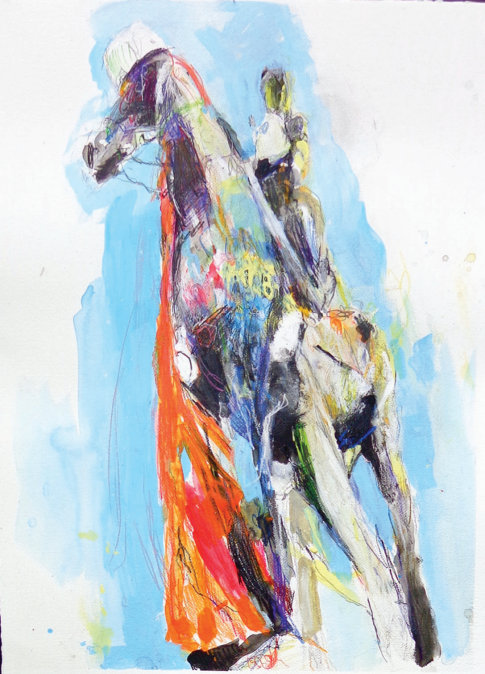
Baquendano - Howard Skrill
They Murdered -Shlok Pandey
I took up a brush; a box of paints,
And a sheet a bit pale, a flying black cat in my imagination - seven as if as me.
I sat down and They snatched it from my hand,
“This is a waste of time.”
I was eight; I wore a golden shirt, a glitter too much.
My pencil in my hand and my audience in my mirror.
I yelled my song’s melody that I made, They loved it,
“A donkey sings better.”
I was ten, a Sci-fi in my hand;
It said it sold two million copies.
When I reached the tenth page, They took it from me and put in a science encyclopedia,
“That’s what the wise kid next door does; isn't fiction pages of trash?”
I grew up;
With good marks; no sense to speak on anything, viewless.
Personality-less.
“You are so awkward, stay alone in life,” They.
At the table, They adults scooped puddings,
“This generation cannot even make a career well,
Can't study,
While weren't we so intelligent, so creative, so full of art?” one says. “Art is killed now.”
I stare at them.
They are encouraging.
They snatch novels and hand over smartphones to their successors at six,
They can't afford being distracted.
They stare at me, only child at the time,
High approval on their faces.
The ever-so-polite child of the family stands to be rude as ever as he wasn't,
“You were the Murderers.” They got indigestion, truth, and rebellion.
Contributors
-
Patrick Barney
Patrick Barney has published prose and poetry in 100subtexts Magazine, Shadowbox Magazine, Phoebe Journal, Antipodes, Flights, and others. His literary horror novel Gusano was published in 2024 by Anxiety Press. He has an MFA in Creative Writing from the University of Alaska Fairbanks and an MA in Professional Writing from the University of Cincinnati. He lives in Cincinnati, Ohio with his wife and three kids.
-
Dustin Brookshire
Dustin Brookshire (he/him) is the author of five chapbooks and the forthcoming full-length poetry collection For All Of Us Faggots (Iron Oak Editions, 2027). He’s the editor of the 2025 Lammy finalist When I Was Straight: A Tribute to Maureen Seaton (Harbor Editions, 2024). More at dustinbrookshire.com.
-
Rueben De'Marco
Ruben De'Marco is a poet from Birmingham England. He is twenty years old and deeply relishes the poetry of past ages; sourcing his inspirations from those periods, he seeks to freshen some of the themes with a modern perspective.
-
Julia DesRoches
Julia DesRoches (she/her) is an emerging writer from North Carolina and a second-year MFA candidate. She serves as an assistant editor for Qu Magazine, where she works closely with emerging voices and contemporary literature. When she leaves the house, she can usually be found with her dog or at the creek.
-

Drema Drudge
Drema Drudge’s work has appeared in several journals. Her poem “Mutual Mass” received a Pushcart Prize nomination, and her manuscripts have been longlisted for the 2025 Idaho Prize for Poetry, named a semifinalist in the Nine Syllables Press Chapbook Contest through the Boutelle-Day Poetry Center at Smith College.
-
Beth Gylys
Beth Gylys is the Principal Investigator of Beyond Bars, a Mellon Foundation sponsored journal for and by incarcerated writers and artists, and an award-winning poet and Distinguished Professor at Georgia State University. Recent publications include After My Father, a chapbook of odes (Dancing Girl Press, 2024) and Body Braille (Iris Books, 2021). More at linktr.ee/bethgylys.
-
Matt Hart
Matt Hart is the author of twelve books of poetry, including most recently FALLING FINE: Selected and New Poems (Ledge Mule Press/Pickpocket Books, 2024). The Head of Creative Writing at the Art Academy of Cincinnati, he plays in the post-punk/indie rock band NEVERNEW and edits, solders, and publishes the poetry journal Solid State.
-
Madeleine Johnson
Madeleine Johnson is a writer and filmmaker drawn to the porous edge between reality and distortion. With a double degree in Media/Arts at UNSW, her practice spans screenwriting, fiction, and experimental film. Influenced by surrealism and philosophical inquiry, her work destabilizes familiar environments to explore memory, identity, and the quiet absurdities embedded in everyday life
-

Shlok Pandey
Shlok Pandey is a 17-year-old Indian writer who is a student of a completely different field and practices writing and reading in the very little spare time he can manage from his studies. His stories have appeared in the Wise Owl Magazine, Setu Journal, The Drift and Dribble Miscellany and his poems have appeared in/ forthcoming in The Crossroads Review, cloudymoon lit mag, The Utrecht Pigeon Magazine, Poetic Practice and aesterion magazine.
-
Abbi Payne
Abbi Payne (she/they) is a queer writer and poet from Missouri. This spring, she was a finalist in the James Rostello Memoir Contest. Her other work can be found at the Southern Quill, Silly Goose Press, and Forest Lake Magazine.
-
Julia Piehler
Julia Piehler has published in technical journals and compendia during a high-tech career. Her work spanned many job functions. Throughout her career she has collected bouquets of stories that will appeal to the general reader. She was educated at Harvard and Stanford where she specialized in geochemistry.
-
Gregg Shapiro
Gregg Shapiro is the author of 10 books including the forthcoming Speaking in Italics (Souvenir Spoon Books, 2026). Recent/forthcoming lit-mag and anthology publications include Pleiades, Bronze Bird Review, Oatleaf Poetry Magazine, Gargoyle, Wailing and Gnashing, BarBar, Action, Spectacle, White Winged Doves: A Stevie Nicks Poetry Anthology (Madville Publishing, 2026), America's Future (Washington Writers' Publishing House, 2025), and Visiting Joni: Poems and Short Prose Inspired by the Life and Work of Joni Mitchell. An entertainment journalist, whose interviews and reviews run in a variety of regional LGBTQ+ and mainstream publications and websites, Shapiro lives in South Florida with his husband Rick, and their dog
-
Howard Skrill
Howard Skrill makes drawings and paintings that have followed the narrative of public monuments and their global eradication, bringing into visibility the haunting aspects of public memory over time. As the stage and context for the monuments shift s from the past, the collective contingency questions the racist and imperialist logic of statues constructed and put on view by the oppressive ruling class. Skrill’s drawings and paintings depict a disruption in time and identity. Th rough the presence and absence of the monuments, public memory is inalienable to the private memory that laid dormant before it.
-

Kerry Trautman
Ohio born and raised, Kerry Trautman (she/her) has authored eight books. Her newest poetry collection Things to Say When You Have Nothing to Say is forthcoming in spring 2026 from Roadside Press. Find links to Kerry’s books and social media at https://linktr.ee/OhioKerry.
-
-
-
-